BTCC Fees Explained: Trading, Futures and Withdrawal Costs in Canada


BTCC fees depend on the type of trade, your VIP level and whether you are depositing, trading or withdrawing funds. For Canadian users, the main costs to check are spot and futures trading fees, withdrawal charges, funding rates and any active zero-fee promotions.
BTCC Fees at a Glance
| Fee Type | Standard Rate / Cost |
|---|---|
| Spot Maker | 0.20% |
| Spot Taker | 0.30% |
| Futures Maker — VIP 0 | 0.03% |
| Futures Taker — VIP 0 | 0.048% |
| Futures Maker — VIP 7 | 0.01% |
| Futures Taker — VIP 7 | 0.015% |
| Crypto Deposit | Check applicable asset/network |
| Crypto Withdrawal | Varies by asset/network |
| Futures Funding | Variable, applied separately |
BTCC fee rates and promotional terms can change. Check the current fee schedule before placing a trade.
What Are BTCC Fees?
When people search for BTCC exchange fees, they are usually looking for more than one number. The cost depends on what you are doing with the account.
The main BTCC trading fees are charged when you buy or sell spot crypto or open and close futures positions. Other costs can apply when you hold a perpetual futures position, withdraw crypto, or use a particular payment method.
| Cost | When It Applies |
|---|---|
| Spot trading fee | Buying or selling crypto on the spot market |
| Futures trading fee | Opening and closing a futures position |
| Funding fee | Holding a perpetual futures position through a funding period |
| Withdrawal fee | Moving crypto from BTCC to an external wallet or exchange |
| Network fee | Blockchain transaction costs associated with a withdrawal |
| Deposit/payment cost | Depends on the funding method and applicable provider terms |
| Promotional rebate | Only when specific campaign conditions are met |
For Canadian traders, this distinction matters. A low trading fee does not necessarily mean the total cost of a trade is low. A futures position, for example, can involve both the trading fee and a separate funding payment.

Sign up free for BTCC Download the BTCC app
 Claim Up to 30,000 USDT in Welcome Rewards
BTCC Spot Trading Fees
BTCC spot trading fees are currently 0.20% for makers and 0.30% for takers under the standard fee schedule.
The maker/taker distinction is easier to understand with an actual order. A market order normally acts as a taker because it fills against orders already sitting in the book. A limit order can qualify as a maker when it adds liquidity instead of being filled immediately.
Example: BTCC Spot Fees on a $1,000 Trade
| Order Type | Fee Rate | Fee on $1,000 |
|---|---|---|
| Maker | 0.20% | $2 |
| Taker | 0.30% | $3 |
If you buy $1,000 of crypto and later sell it for $1,000, the trading fee applies to both transactions.
So, ignoring price changes:
- Maker on the buy: $2
- Maker on the sell: $2
- Total round-trip trading fees: $4
With taker orders, the same two transactions would cost $6 in trading fees.
That is why checking the order type matters when comparing BTCC spot fees with other exchanges.
BTCC Futures Trading Fees
For users mainly interested in futures, this is the part of the BTCC fee structure worth watching most closely.
Under the current BTCC fee schedule, VIP 0 futures fees are 0.03% for makers and 0.048% for takers. The rate decreases as you move through the VIP levels, with VIP 7 listed at 0.01% maker and 0.015% taker.
BTCC Futures Fee Schedule
| VIP Level | Futures Maker | Futures Taker |
|---|---|---|
| VIP 0 | 0.030% | 0.048% |
| VIP 1 | 0.025% | 0.045% |
| VIP 2 | 0.022% | 0.040% |
| VIP 3 | 0.020% | 0.035% |
| VIP 4 | 0.018% | 0.030% |
| VIP 5 | 0.015% | 0.025% |
| VIP 6 | 0.012% | 0.020% |
| VIP 7 | 0.010% | 0.015% |
The important point is that the futures fee is based on the position’s trading value, not simply the amount deposited as margin. That becomes especially relevant when leverage is involved.
For the full VIP qualification requirements and the latest rates, readers should be directed to the official BTCC fee schedule.
How Much Are BTCC Futures Fees on a $10,000 Trade?
Suppose a VIP 0 trader opens a $10,000 futures position as a taker.
$10,000 × 0.048% = $4.80
If the position is later closed at the same $10,000 notional value and the closing order is also a taker:
$4.80 + $4.80 = $9.60
So the round-trip BTCC futures trading fee is $9.60 in this example.
That is the trading fee only. It does not include funding payments, spread, slippage or any applicable withdrawal and network costs.
💡 A Simple Way to Read BTCC Futures Fees
A quoted fee such as 0.048% applies to the position’s notional trading value. With leverage, your margin may be much smaller than the position itself, so looking only at the amount deposited can make the actual fee look lower than it is.
BTCC Futures Funding Fees
Trading fees are not the only cost to consider when using perpetual futures.
A funding fee is separate from the futures maker/taker fee. It applies according to the funding mechanism for the specific perpetual contract and can result in a payment between traders on opposite sides of the market.
This means a futures pair can have a 0% trading-fee promotion and still have funding payments.
For traders holding positions for several hours or longer, checking the current funding rate can therefore be just as important as checking the advertised trading fee.
BTCC Withdrawal Fees
BTCC withdrawal fees vary by asset and network, so there is no single withdrawal fee that applies to every cryptocurrency.
For example, withdrawing an asset through one blockchain network may cost a different amount from using another supported network. Network conditions can also affect the cost structure.
For that reason, a fixed withdrawal-fee table can become outdated quickly. The more useful approach for a Canadian user is to check the withdrawal screen for the specific coin and network before confirming the transaction.
Before You Withdraw
BTCC withdrawal fees can change by asset and network. Always check the fee displayed on the withdrawal page before confirming a transaction. Also make sure the withdrawal network matches the receiving wallet or exchange.
BTCC Zero-Fee Trading: What Does 0% Actually Mean?
BTCC has introduced several zero-fee or fee-rebate promotions covering different products. These offers should be treated separately from the standard fee schedule because eligibility, supported assets and campaign periods can change.
For example, selected futures pairs may appear under BTCC’s “0 Fee” filter.
As of August 7, 2026, the supplied market data shows HYPEUSDT, BEATUSDT and LABUSDT among the listed zero-fee futures pairs. That list is dynamic, so it should not be presented as a permanent fee table.

The same distinction applies to spot rebates and TradFi promotions. A campaign can remove the trading fee while other trading costs, such as spread, slippage or futures funding, still exist.
A zero trading fee does not automatically remove funding, spread, slippage or blockchain withdrawal costs. Always check the terms of the specific zero-fee promotion and the product you are trading.
BTCC VIP Fees: How Can You Pay Less?
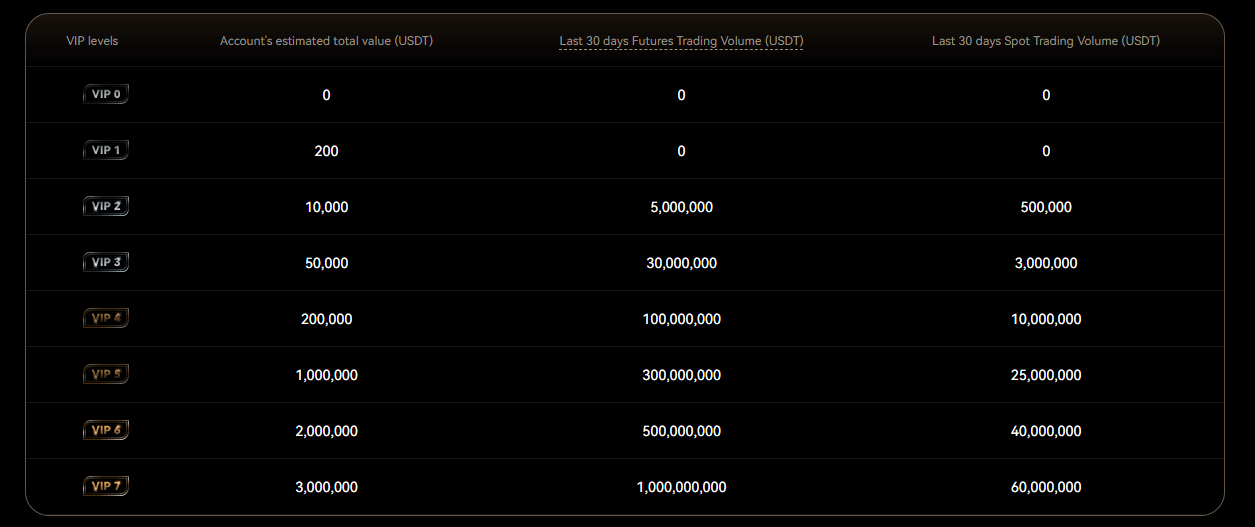
BTCC does not use one futures fee for every trader. Your trading rate depends on your current VIP level, while the level itself can be determined by your estimated total account value, 30-day futures trading volume, or 30-day spot trading volume.
For new users, the first VIP upgrade is relatively straightforward: VIP 0 users move to VIP 1 after reaching a cumulative deposit of 200 USDT or the equivalent amount in another supported cryptocurrency.
From VIP 1 onward, BTCC checks the relevant VIP criteria on a daily basis. The VIP level and fee rates are updated at 17:00 UTC each day.
The important detail is that you do not necessarily need to rely on deposits alone to qualify for a higher tier. An active trader may qualify through recent spot or futures volume, while users with a larger account balance can qualify based on estimated total value.

When Are BTCC Fees Updated?
BTCC VIP levels and fee rates are updated daily at 17:00 UTC.
If you are comparing a fee shown in an older review, screenshot or forum post, check the current BTCC fee schedule before placing a trade. The rate attached to your account is based on your current VIP level.
For the exact VIP thresholds and the latest maker/taker rates, the official BTCC fee page is the better reference. The Academy article can then be used to understand how those fees work in an actual trade.
BTCC Deposit & Withdrawal Fees in Canada
For Canadian users, BTCC fees are not limited to trading commissions. The cost of moving money onto and off the exchange depends on the payment method, asset and blockchain network involved.
It helps to separate the main cases:
| Transaction | What to Check |
|---|---|
| Crypto deposit | Supported asset and blockchain network |
| CAD / fiat deposit | Payment method and any applicable provider terms |
| Interac e-Transfer | Current BTCC promotion and payment terms |
| Crypto withdrawal | Current BTCC withdrawal fee and selected network |
| Blockchain transaction | Network conditions and applicable network cost |
Crypto deposits and withdrawals should not be treated as having one permanent fee across all assets. In particular, BTCC withdrawal fees can vary by asset and network conditions.
Before confirming a withdrawal, BTCC displays the applicable charge on the withdrawal page. That is the figure worth checking rather than relying on an old fee table from a third-party website.
BTCC Fees for Canadian Users
Interac e-Transfer is particularly relevant when looking at BTCC fees in Canada. BTCC supports Interac e-Transfer for Canadian users, and its current payment terms or promotions can change over time.
Cards and other payment methods can work differently because the final cost may depend on the payment provider as well as BTCC.
Before You Withdraw
BTCC withdrawal fees can change with network conditions. Always check the fee shown on the withdrawal page before confirming a transaction.
The same rule applies when choosing a blockchain network: make sure the network selected for the withdrawal matches the network supported by the receiving wallet or exchange.
This approach is more useful for Canadian readers than publishing a fixed BTC or USDT withdrawal fee that may become outdated a few weeks later.
Sign up free for BTCC Download the BTCC app
Claim Up to 30,000 USDT in Welcome Rewards
Are BTCC Zero-Fee Trades Really Free?
“Zero fee” sounds simple, but it only describes one part of the transaction.
A 0% trading fee means the applicable trading commission has been waived under the terms of a specific promotion or eligible market. It does not automatically remove every other cost associated with trading.
For futures, the distinction matters even more. A trader can pay 0% trading commission on an eligible contract and still encounter funding payments, spread or slippage.
What Does “0% Fee” Actually Mean?
| Cost | Can still apply? |
|---|---|
| Trading commission | No, if the trade qualifies for the 0% promotion |
| Futures funding | Yes |
| Bid-ask spread | Yes |
| Slippage | Yes |
| Withdrawal fee | Yes |
| Blockchain/network cost | Yes, where applicable |
BTCC’s perpetual futures funding mechanism is separate from its trading fee. Funding is exchanged between traders on opposite sides of a perpetual contract rather than being collected by BTCC as a trading commission. Funding is applied on an 8-hour cycle, so it becomes relevant when a position remains open across a funding time.
That distinction is easy to miss when comparing exchanges purely by their advertised trading fee.
A zero-fee promotion removes the applicable trading commission. Futures funding, spreads, slippage and blockchain withdrawal costs are separate.
Eligible zero-fee pairs may change. Before opening a position, check the “0 Fee” filter on BTCC’s USDT-M Perpetual Futures market for the current list.
BTCC Fees vs Other Crypto Exchanges in Canada
Comparing crypto exchange fees in Canada is not as simple as putting four maker/taker rates next to each other. Exchanges can charge in very different ways. Some use a maker/taker model, while others build more of their cost into the spread or charge separately for instant purchases and withdrawals.
For Canadian users, the useful comparison is how the fee is applied and what you are actually trading.
| Exchange | Main Pricing Model | What Canadian Users Should Compare |
|---|---|---|
| BTCC | Maker/taker + VIP tiers | Spot and futures fees, funding, withdrawals and zero-fee markets |
| NDAX | Maker/taker | Trading fees, CAD funding and withdrawal costs |
| Bitbuy | Trading / instant purchase fees | CAD deposits, withdrawals and purchase method |
| Newton | Spread-based | Spread and withdrawal costs |
| Wealthsimple Crypto | Spread-based | Spread, available products and transaction costs |
How to Reduce BTCC Trading Fees
There are a few practical ways to keep an eye on BTCC trading fees without changing your trading strategy just for a smaller percentage.
1. Know When You Are Paying Maker or Taker Fees
A market order normally executes against orders already sitting in the order book, so it is generally treated as a taker trade. A limit order can receive the maker rate when it adds liquidity rather than filling immediately.
The maker rate is lower than the taker rate on BTCC’s standard spot and futures schedules. But that does not mean a limit order is always the better choice. If getting into a position quickly matters more than saving a small fee, the taker cost may be reasonable.
The useful part is knowing which rate you are actually paying before placing the order.
2. Keep Track of Your VIP Level
If you trade futures or spot regularly, check your current VIP level rather than assuming you are still on the base rate.
BTCC can determine VIP status using estimated total account value, 30-day futures trading volume or 30-day spot trading volume. VIP levels and applicable fee rates are updated daily at 17:00 UTC.
For an occasional trader, this may not make much difference. For a high-volume futures trader, the gap between VIP tiers can become noticeable over a larger number of trades.
3. Check the 0 Fee Filter Before Trading
BTCC periodically offers zero-fee trading on selected markets. The eligible pairs can change, so memorising a list of coins is not particularly useful.
Instead, check the “0 Fee” filter on the relevant USDT-M Perpetual Futures market before opening a position.
As of August 7, 2026, HYPEUSDT, BEATUSDT and LABUSDT were shown among the zero-fee futures pairs. That list is dynamic and should not be treated as a permanent fee schedule.
4. Check Funding Before Holding Futures Overnight
This is an easy cost to overlook.
A futures position can have a 0% trading fee and still incur a funding payment. Funding is separate from the trading commission and applies to perpetual futures according to the applicable funding schedule.
So if you plan to hold a leveraged position for several hours or longer, check the current funding rate before opening it. Looking only at the headline BTCC futures fee can give you an incomplete picture of the trade’s actual cost.
Sign up free for BTCC Download the BTCC app
Claim Up to 30,000 USDT in Welcome Rewards


