What Is Rektember? Why September Is a Weak Month for Bitcoin in 2026
 Written by F, Fairy.fLast updated:
Bitcoin has a nickname for September. It isn’t exactly flattering.
Crypto traders call the month “Rektember,” a mash-up of September and “rekt,” the slang term for getting badly burned in a trade.
The joke has some data behind it. September has historically been Bitcoin’s weakest month by average return, although the pattern is far from reliable. In fact, Bitcoin closed the previous three Septembers higher.
That makes Rektember more interesting than a simple market meme. The real question is whether September itself matters—or whether the macro conditions that often appear during the month are doing the damage.
Key Takeaways
- Rektember is crypto slang for September, combining “September” with “rekt,” and refers to Bitcoin’s historically weak performance during the month.
- Bitcoin’s September record is weak, but not consistently bearish: BTC’s average September return was -4.02% from 2013–2025, with 5 of 13 Septembers ending higher.
- The Rektember pattern has recently weakened:Bitcoin gained 4.00% in 2023, 7.25% in 2024 and 5.36% in 2025.
- 2026 has a mixed setup:a strong August rally and higher Treasury yields, oil prices and Fed rate expectations support the bearish case, while ETF demand and changing market structure argue against assuming another September sell-off.
- Rektember is better treated as context than a trading signal. ETF flows, Fed expectations, Treasury yields, DXY, funding rates, open interest and Bitcoin’s price structure can provide a clearer picture of current risk.
What Is Rektember in Crypto?
Rektember is a crypto slang term for September, combining “September” with “rekt,” a common crypto expression for suffering heavy losses.The nickname refers to Bitcoin’s historically weak performance during the month, although September has not been negative every year.
In crypto,“rekt” is informal trading slang. It usually describes a trader or position that has taken a severe loss, often after a sharp price move or liquidation. Put the word next to “September,” and you get Rektember.
The term is not an official financial term or a recognized market indicator. It is part of crypto community slang, much like “Uptober,” the nickname often used for a historically stronger October. When traders talk about Rektember crypto trends, they are usually referring to Bitcoin’s September seasonality rather than a specific trading strategy.
The historical data helps explain why the name stuck. Bitcoin has recorded several sharp September declines, including an 18.59% drop in 2014 and a 16.36% decline in 2019 in one 2013–2025 dataset. But the pattern is not consistent enough to treat Rektember as a rule that Bitcoin must fall every September.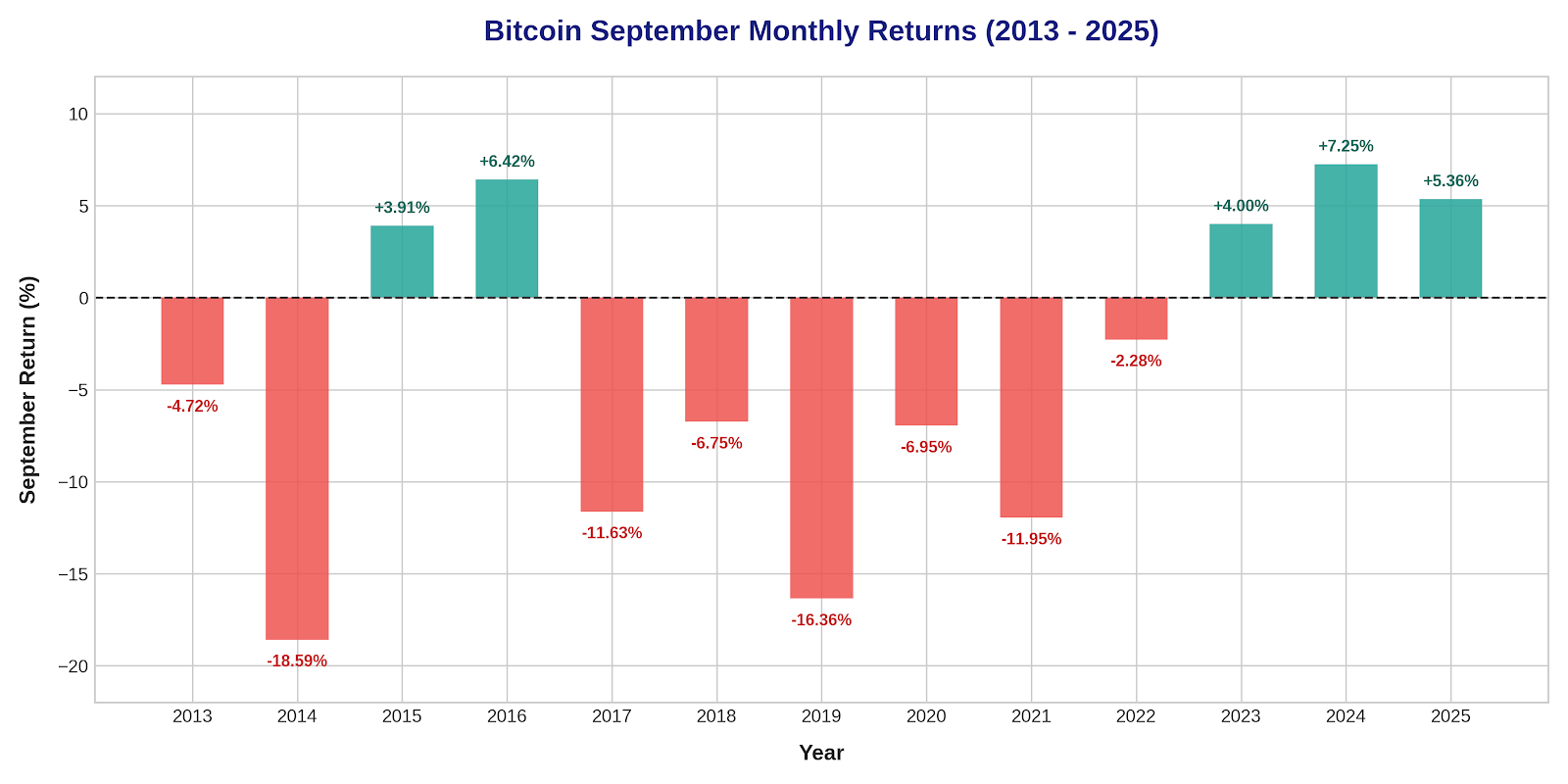
Quick Definition
Rektember is a crypto slang term for September, based on “rekt” and the month’s historically weak Bitcoin returns. It describes a seasonal market pattern,not a prediction that Bitcoin will crash every September.
So, if you’re wondering what does Rektember mean, the short answer is simple: it is the crypto market’s tongue-in-cheek name for a historically difficult month for Bitcoin.
Why Is September Called “Rektember” for Bitcoin?
The name comes from a fairly simple observation: September has often been a difficult month for Bitcoin when measured by monthly returns.
From 2013 through 2025, Bitcoin finished September lower in seven of the 13 completed years in one commonly cited dataset. The weakest result came in 2014, when BTC fell 18.59%. September 2019 was another particularly poor month, with a 16.36% decline.
Here is the full September record:
| Year | Bitcoin September Return |
|---|---|
| 2013 | -4.72% |
| 2014 | -18.59% |
| 2015 | +3.91% |
| 2016 | +6.42% |
| 2017 | -11.63% |
| 2018 | -6.75% |
| 2019 | -16.36% |
| 2020 | -6.95% |
| 2021 | -11.95% |
| 2022 | -2.28% |
| 2023 | +4.00% |
| 2024 | +7.25% |
| 2025 | +5.36% |
Source: DefiLlama data compiled by CoinJuice; monthly return is measured from the September opening price to the September closing priceAcross these 13 completed Septembers, the simple average return was-4.02%, while the median was-4.72%.
That said, historical averages can differ depending on the data source and calculation method. For example, recent market coverage has cited an average September decline of around 3%, while other datasets produce a somewhat larger negative figure.
The important point is not whether the average is exactly -3% or -4%.The broader historical pattern is that September has been one of Bitcoin’s weaker months, but the pattern has never been absolute.That distinction matters when considering why is September called Rektember. The nickname grew out of repeated periods of weakness; it was not created because Bitcoin follows a fixed September rule.
How Has Bitcoin Performed in September Historically?
Looking at the full record gives a more useful picture than simply saying that September is “bad for Bitcoin.”
Bitcoin September Performance at a Glance
| Metric | Historical Takeaway |
|---|---|
| Average September return | Negative |
| Positive Septembers | 6 of 13 in the 2013–2025 dataset |
| Worst September | 2014: -18.59% |
| Best September | 2024: +7.25% |
| Most recent trend | 2023, 2024 and 2025 all finished higher |
| Overall takeaway | Weak seasonality, but no guaranteed September decline |
The recent record is particularly important. Bitcoin gained in each of the last three completed Septembers: 4.00% in 2023, 7.25% in 2024 and 5.36% in 2025. That creates an obvious problem with the simplest version of the Rektember narrative.
If September were inherently bearish for Bitcoin, three consecutive positive months would be difficult to explain.
They do not invalidate the historical pattern, but they do put it into perspective. Seasonality describes what has tended to happen over a particular sample of years. It does not determine what happens next.
⚠️ Rektember Does Not Mean Bitcoin Must Fall Historical September weakness is a tendency, not a price target.
Bitcoin has posted positive September returns several times, including three consecutive gains from 2023 through 2025.
Traders who treat the calendar alone as a sell signal are ignoring the market conditions behind each individual year.
There is also a statistical limitation worth keeping in mind. Bitcoin only has a relatively short history, so the September sample is small. A handful of unusually weak months can have a noticeable effect on the average.
That is why Bitcoin September seasonality is more useful as context than as a standalone trading signal.
Track Bitcoin Markets on BTCC: New users can also access an exclusive welcome offer, including up to 60 USDT in registration rewards and the chance to participate in a 30,000 USDT futures trading event. A 100,000 USDT demo account is also available for practice.
\ 🚀 Ready for the Next Market Rally?/
Why Does Bitcoin Tend to Struggle in September?
There is no single explanation for the Bitcoin September effect. The historical weakness may reflect several factors that can overlap, and some are broader financial-market patterns rather than crypto-specific ones.
1. Liquidity can become less supportive
Late summer and the transition into the third quarter can bring changes in trading activity and risk appetite. When liquidity becomes thinner, relatively large orders can have a greater impact on price. In a leveraged market such as crypto, a move that starts as ordinary selling can also trigger liquidations and create additional downside pressure.
That does not mean lower September liquidity automatically causes Bitcoin to fall. It can, however,amplify an existing move.
2. Investors reassess risk after the summer
September is also a busy month for traditional financial markets. Investors return from the summer period with new economic data, revised growth expectations and upcoming central-bank decisions to consider.
Recent market coverage has noted that September weakness is not unique to crypto. The S&P 500 has historically recorded its weakest average monthly performance in September, suggesting that some of the pressure may come from broader risk sentiment rather than Bitcoin itself.
3. Quarter-end positioning may add volatility
September marks the end of the third quarter. Funds and institutional investors may rebalance portfolios, lock in gains or adjust exposure before the final quarter of the year.
These flows do not necessarily push Bitcoin lower. But when they coincide with weak sentiment, they may contribute to short-term volatility.
4. Macro expectations matter more than the calendar
Interest rates, inflation and the U.S. dollar can have a much more direct impact on Bitcoin than the name of the month.
When markets expect tighter monetary policy, yields can rise and financial conditions can become less favorable for risk assets. Bitcoin, which does not generate cash flow or a conventional yield, can become particularly sensitive to changes in the rate investors use to price risk.
This is especially relevant in 2026. The current September market is dealing with renewed expectations of a Federal Reserve rate hike, elevated Treasury yields and geopolitical pressure on energy prices.
5. Leverage can turn a normal pullback into a larger move
Crypto derivatives add another layer that did not exist in the same form during Bitcoin’s earliest September cycles.
If traders enter September with crowded leveraged positions, even a modest spot-market decline can trigger forced liquidations. Those liquidations can push prices lower and create another round of selling.
So, rather than asking “Why is September bad for Bitcoin?”, a more useful question is:
What market conditions are present when September weakness occurs?
That distinction becomes increasingly important as Bitcoin’s market structure changes. Historical seasonality can tell us that September has often been difficult. It cannot, by itself, tell us whether the same setup exists this year.
Bitcoin September 2026 Outlook: Is Rektember Likely to Continue?
Bitcoin entered September with a mixed setup.
On one side, the historical case for Rektember is still there. September has been Bitcoin’s weakest month on average since 2013, and BTC opened the month after a roughly 24% gain in August.
On the other side, the market structure is very different from the one behind much of that historical data. Spot Bitcoin ETFs have become a major source of demand, while leverage has not reached the same crowded levels seen during some previous rallies.
btc
The more useful question is therefore not “Will Bitcoin crash in September?” It is whether the current market conditions are strong enough to offset the seasonal headwind.
What Supports the Rektember Case?
| Factor | Current Signal | Why It Could Support Rektember |
|---|---|---|
| Historical September returns | Historically weak | September has produced the lowest average monthly return for Bitcoin |
| August rally | BTC gained about 24% | A sharp rally can leave room for profit-taking or consolidation |
| Fed expectations | Rate-hike odds around 67%–70% | Tighter policy expectations can pressure risk assets |
| Treasury yields | 10-year yield around 4.81% | Higher yields can tighten financial conditions |
| Oil prices | Brent around $95 | Higher energy prices can reinforce inflation concerns |
| U.S. dollar | DXY recently strengthened | A stronger dollar can weigh on risk appetite |
| Geopolitical risk | Elevated | Risk-off flows can increase short-term volatility |
The macro backdrop has become noticeably less friendly. On September 2, Reuters reported that the U.S. 10-year Treasury yield reached 4.8122%, while Brent crude climbed to about $95.45 as renewed U.S.-Iran tensions pushed energy prices higher. Market pricing for a September Fed hike also moved higher, reaching roughly 67%.
That combination gives the Rektember narrative more than just a historical argument. Rising yields, a firmer dollar and higher oil prices can all tighten financial conditions or reduce appetite for risk assets.
What Argues Against a Classic Rektember?
The bullish counterargument starts with capital flows.
U.S. spot Bitcoin ETFs recorded eight consecutive sessions of net inflows through late August, bringing about $2.8 billion into the funds during that run. August ETF inflows exceeded $3 billion, making it the strongest month of 2026 for the products at that point.
The streak did not continue indefinitely. CoinDesk reported that the funds recorded a roughly $202 million net outflow on August 29 after nine positive sessions, showing that ETF demand can change quickly.
There is another important difference from previous Rektember cycles: the last three Septembers were all positive for Bitcoin. That does not invalidate the long-term seasonal pattern, but it is a useful reminder that the historical average does not dictate every individual year.
Rektember 2026: Bullish or Bearish?
At this point, the evidence is mixed rather than one-sided.
The bearish case has a stronger macro foundation than the seasonal label alone. Bitcoin is entering September after a large August rally, while Treasury yields, oil prices and expectations for tighter Fed policy have all moved higher.The bullish caserests more on market structure and demand. Spot ETF flows have recently provided meaningful buying pressure, and Bitcoin has remained relatively resilient despite rising yields and geopolitical stress. CoinMarketCap also noted that BTC was holding above the $75,000–$78,000 area despite the broader risk-off environment.
That leaves three broad possibilities for September:
| Scenario | What Would Support It? | What to Watch |
|---|---|---|
| Deeper correction | Higher yields, stronger dollar, weak ETF flows | BTC loses major support while macro pressure persists |
| Range-bound September | Mixed ETF flows and macro uncertainty | BTC remains volatile but holds a broad trading range |
| Rektember fails | Strong spot demand and easing rate expectations | ETF inflows return while yields and dollar strength cool |
There is no reliable way to assign a fixed probability to these outcomes from seasonality alone.
For now, Rektember 2026 has a stronger macro backdrop than the previous few Septembers, but that does not make a Bitcoin crash inevitable. The direction of ETF flows and the market’s response to the September FOMC decision may ultimately matter more than the calendar.
This section reflects market conditions as of September 2, 2026 and should be updated as new macro and Bitcoin market data become available.
Track Bitcoin Markets on BTCC: New users can also access an exclusive welcome offer, including up to 60 USDT in registration rewards and the chance to participate in a 30,000 USDT futures trading event. A 100,000 USDT demo account is also available for practice.
\ 🚀 Ready for the Next Market Rally?/
Is Rektember Still Relevant in 2026?
The historical pattern behind Rektember is real. The harder question is whether it still carries the same weight in today’s Bitcoin market.
Bitcoin is no longer traded in a market dominated almost entirely by crypto-native retail investors. Spot Bitcoin ETFs have opened another route for capital to enter the market, while institutional investors, derivatives markets and macro-driven funds now play a much larger role.
1. Spot Bitcoin ETFs Have Changed the Market
The arrival of U.S. spot Bitcoin ETFs is one of the clearest differences between today’s market and the one that produced much of the historical September data.
In late August 2026, U.S. spot Bitcoin ETFs recorded eight consecutive sessions of net inflows, bringing roughly $2.8 billion into the funds during that run, according to CoinDesk data citing SoSoValue. August ETF inflows had also passed $3 billion by the end of the month.
That does not make Bitcoin immune to a September sell-off. It does, however, give the market a source of demand that was not present during most of the earlier Rektember history.
Historical September returns tell you what Bitcoin did under previous market conditions. ETF flows can help show whether those conditions are being repeated today.
2. Institutional Participation Matters
The older Bitcoin September seasonality data largely reflects a market that was more crypto-native, more fragmented and more heavily influenced by retail trading.
The current market is different. Bitcoin can now be accessed through ETFs and traditional investment accounts, while institutions can gain exposure through spot products, futures and other derivatives.
That makes the historical average useful as context, but less useful as a standalone trading signal. A four-week seasonal pattern cannot fully capture changes in market structure, ownership or capital flows.
3. Bitcoin Is More Sensitive to Macro Conditions
Bitcoin’s price is also increasingly tied to the same macro variables watched across other risk assets.
Federal Reserve policy, Treasury yields, the U.S. dollar, inflation expectations and broader liquidity conditions can all influence how much risk investors are willing to take. The relationship is not fixed, but it has become difficult to analyse Bitcoin without considering the wider financial market.
That is particularly important during September, when major economic data and central-bank decisions can arrive alongside the seasonal narrative.
So, does the old Rektember pattern still work? Not as a rule. September seasonality remains worth watching, but its signal should be weighed against ETF flows, institutional positioning and macro conditions rather than treated as a forecast on its own.
Rektember 2026: What Is Driving Bitcoin Right Now?
1. 2026 Market Context
Rektember 2026 started with an unusual setup: Bitcoin had just come through a powerful August rally, while macro conditions were becoming less supportive.
Bitcoin gained roughly 24% to 25% in August, making it the strongest monthly performance since November 2024. CoinDesk and CoinMarketCap both highlighted the August rally as an important backdrop to Bitcoin’s move into September.
That matters because a strong monthly rally can leave the market more vulnerable to profit-taking or consolidation. It does not, by itself, mean a September reversal is coming.
2. Fed Expectations Are Back in Focus
Interest-rate expectations have become one of the main short-term drivers of Bitcoin.
Markets entered September 2026 reassessing the Federal Reserve’s next move. CoinMarketCap reported that traders were pricing in roughly a 66% probability of a 25-basis-point rate hike at the September 16 FOMC meeting. The probability had risen sharply after Federal Reserve Chair Kevin Warsh’s comments at Jackson Hole.
For Bitcoin, the important variable is not simply whether the Fed raises rates. It is how expectations for monetary policy change relative to what the market has already priced in.
3. Treasury Yields and the Dollar Add Pressure
The U.S. 10-year Treasury yield briefly reached around 4.784% as bond markets reacted to the changing rate outlook. Higher yields can make interest-bearing assets more attractive relative to assets such as Bitcoin, which does not generate a native yield.
A stronger U.S. dollar can create another headwind for risk assets. Neither relationship is automatic, but both are useful variables to watch when Bitcoin loses momentum.
4. Oil and Geopolitical Risk Complicate the Picture
Oil prices and renewed tensions in the Middle East have added another layer of uncertainty. Brent crude moved above $90 per barrel at the start of September, while WTI also climbed sharply.
The significance for Bitcoin is indirect. A sustained rise in energy prices can feed into inflation expectations and complicate the interest-rate outlook. That can matter more for risk assets than the calendar itself. This is why Rektember 2026 should not be viewed as a simple “Bitcoin falls in September” story. The seasonal pattern is one variable. ETF demand, interest-rate expectations, bond yields, the dollar and geopolitical risk are moving at the same time.
Rektember vs. Bitcoin Fundamentals: What Should Traders Watch?
Rektember gives traders a historical reference point. It does not tell them what Bitcoin will do next.
A better approach is to compare the seasonal signal with the market data that can explain what is happening underneath the price.
| Rektember Signal | What It Tells You | Why It Matters |
|---|---|---|
| September historical returns | Seasonal tendency | Shows how Bitcoin has performed during previous Septembers |
| Spot Bitcoin ETF flows | Institutional demand | Strong inflows can provide a source of buying pressure |
| Fed expectations | Liquidity conditions | Changing rate expectations can affect risk appetite |
| Treasury yields | Cost of capital | Rising yields can make risk assets less attractive |
| DXY | U.S. dollar strength | A stronger dollar can weigh on broader risk appetite |
| Funding rates | Leverage positioning | High funding can indicate crowded long positions |
| Open interest | Derivatives exposure | Rapid increases can raise liquidation risk |
| Bitcoin price structure | Current market trend | Helps distinguish a normal pullback from a broader trend change |
Seasonality vs. Positioning
Historical Bitcoin September returns answer one question: What happened before? ETF flows and derivatives data address a different question:How is the market positioned now?The latest data shows why the distinction matters. U.S. spot Bitcoin ETFs recorded eight consecutive sessions of net inflows through late August, pulling about $2.8 billion into the funds during the streak. August inflows later topped $3 billion. But the buying streak was broken by a roughly $202 million net outflow on August 29.
That is a more useful signal than simply saying that “institutions are bullish.” Capital is flowing into the market, but the pace can change quickly.
The derivatives side tells a similar story. CoinDesk reported that perpetual open interest was at its lowest level since May as September began, suggesting that the August rally was not simply driven by a build-up of crowded leveraged longs.
For anyone researching Rektember crypto trends, this creates an important distinction. A seasonal bearish pattern combined with heavy long leverage could produce a sharp liquidation-driven move. A seasonal bearish pattern combined with strong spot demand and relatively restrained leverage is a different setup.
Watch the Macro Data, Not Just the Calendar
The September 2026 setup shows why macro data can matter more than the calendar itself.
The U.S. 10-year Treasury yield reached 4.8122% on September 2, while the dollar strengthened as investors reacted to higher oil prices and renewed geopolitical tensions. Market pricing for a September Fed rate hike also moved higher, with estimates around 67% to 70% depending on the point in the session.
Oil has become another variable to watch. Brent crude rose to roughly $95.45 as concerns over the Middle East conflict increased the risk of further energy-price pressure. Higher oil prices can feed into inflation expectations, which in turn can influence expectations for monetary policy.
For Bitcoin, the important question is how these variables interact. If yields and the dollar continue rising while ETF inflows weaken, the historical September headwind has a stronger macro backdrop behind it. If yields retreat and spot Bitcoin demand returns, the Rektember signal becomes less convincing.
That is why the calendar should be treated as one input rather than the entire thesis. Rektember is a signal of historical seasonality. ETF flows, leverage, liquidity, Treasury yields and Fed expectations help determine whether that historical pattern has support in the current market.
How Should Investors Approach Rektember?
The biggest mistake is treating Rektember as a forecast.
Bitcoin has fallen sharply in some Septembers, but it has also posted positive monthly returns. The previous three Septembers were all positive. That makes “September = sell” too simplistic to be useful.
A more disciplined approach is to manage the risks that can become more visible during periods of seasonal volatility.
1. Don’t Trade Solely on Seasonality
Historical Bitcoin September performance can provide context, but it should not be the only reason to open or close a position.
A seasonal pattern does not tell you the entry price, invalidation level or position size. It also cannot account for an unexpected Fed decision, ETF flow reversal or geopolitical event.
2. Keep Leverage Under Control
Leverage can turn an ordinary Bitcoin pullback into a much larger loss.
This is especially relevant when open interest is high and traders are positioned heavily in one direction. A sudden move against crowded positions can trigger liquidations, adding forced buying or selling to the original price move.
For that reason, Rektember risk management is often more useful than trying to predict the exact direction of Bitcoin for the month.
3. Watch the Events That Can Move the Market
Instead of watching the calendar alone, keep an eye on the events that can change market expectations.
Key areas include:
- Federal Reserve meetings and rate guidance
- U.S. inflation and employment data
- Treasury yields and the U.S. dollar
- Spot Bitcoin ETF inflows and outflows
- Bitcoin funding rates and open interest
- Major geopolitical developments
A seasonal pattern can persist quietly in the background. A major macro surprise can overwhelm it within hours.
4. Don’t Assume Every Dip Is a Buying Opportunity
A September pullback is not automatically a bargain.
Before treating a decline as a buying opportunity, it is worth asking whether the move is simply profit-taking after a strong rally or part of a broader change in liquidity, positioning or market structure.
The same applies in reverse. A strong September does not invalidate historical seasonality forever.
5. Think About Volatility, Not Just Direction
Rektember does not have to produce a major Bitcoin crash to matter.
A month with large intraday swings, sharp liquidation events and repeated reversals can be difficult to trade even if BTC finishes September close to where it started.
For investors and traders, position size and leverage can therefore matter as much as the final monthly return. Key principle: Use Bitcoin September seasonality as context, not as a buy-or-sell signal. The more useful question is whether current flows, leverage and macro conditions support the seasonal pattern.
6. Trade Bitcoin With Risk Controls in Mind
For traders who want to monitor Bitcoin during periods of higher volatility, BTCC provides access to spot and perpetual futures markets, including BTC/USDT perpetual trading. Futures allow traders to take both long and short positions, but leverage also magnifies potential losses.
The platform’s trading tools can be used to monitor price action and manage positions, but the decision to trade should still be based on an individual’s risk tolerance, position size and market view.
Rektember vs. Uptober
Rektember and Uptober are two pieces of crypto slang built around Bitcoin’s seasonal reputation. Rektember refers to September and its historically weak Bitcoin performance. Uptober refers to October and the idea that Bitcoin tends to perform better during the month.
| Term | Meaning | Typical Narrative |
|---|---|---|
| Rektember | September crypto slang | Bitcoin has historically struggled during September |
| Uptober | October crypto slang | Bitcoin has historically shown stronger performance during October |
| Bitcoin seasonality | Recurring historical price patterns | Certain months have tended to perform better or worse than others |
The two terms are often mentioned together because they describe consecutive months in Bitcoin’s seasonal calendar. But neither is a reliable forecast.
A weak September does not guarantee an October rally, just as a strong September does not rule out a strong October. For traders researching Rektember crypto trends, the useful takeaway is to treat both terms as historical context rather than trading signals.
This also makes Rektember a natural starting point for broader topics such as Bitcoin seasonality.
BTCC Exchange
BTCC offers an exclusive welcome campaign for new users. Sign up and start trading today to earn up to30,000 USDT in rewards. You can also enjoy a higher VIP level based on your deposit amount (Higher Deposit = Higher VIP Level). As a VIP, you’ll benefit from lower trading fees and additional exclusive privileges.
- Sign-Up Bonus: Receive 10 USDT upon registration.
- KYC Bonus: Complete identity verification to earn an additional 20 USDT.
- First Trade Rewards: Earn 5 USDT for your first spot trade and 5 USDT for your first copy trade.
- First Futures Trade Bonus: Complete your first futures trade to receive 20 USDT.
- Deposit Bonus: Deposit 200 USDT or more to receive 10 USDT, or deposit 500 USDT or more to receive 20 USDT. Users who accumulate 2,000 USDT in deposits within 30 days will receive an additional 30 USDT Flexible Trading Fund.
- Futures Trading Challenge: Trade futures over a 90-day period to earn up to 30,000 USDT in rewards, with leverage of up to 250× available.