The Ministry of Finance directly intervened to suppress long-term interest rates.
 BlockbeatsAuthor: Odysseus
The U.S. Treasury's use of repurchase operations to suppress long-term Treasury yields has drawn market attention to the coordination between fiscal and monetary policies. This article analyzes whether the Federal Reserve will follow suit, the U.S. deficit and the dilemma of technology investment, and the impact of these operations on gold, the dollar, and the long-term economic outlook.
Original title: "Ministry of Finance Directly Intervenes to Suppress Long-Term Interest Rates"
Original author: Odysseus
Original source: Peifengke
We've spent a lot of time discussing the logic behind rising long-term bond yields in Europe and the US, and the various measures central banks and the Ministry of Finance have devised. Finally, last night, we saw the US Treasury directly use repurchase agreements to suppress long-term Treasury yields. Their exact words were, "The current maximum size of 2 billion per operation will be at least 4 billion per operation." I think there are a few points I want to share: 1. Although this isn't the traditional YCC (Yield Controlled Repurchase Agreement), and you can find many differences in definition and operating entity, such minor details are meaningless. This is the government directly intervening in its own financing costs. And I don't think we need to discuss whether this approach will be effective in the long run; the core issue is how far the government is willing to go and what price it will pay. 2. A few days later, the Fed's or Warsh's statements at Jacksonhole became very subtle. It's known that he and Bessant communicate frequently, and the market has been saying that the Fed needs to raise interest rates and increase communication to reduce policy uncertainty. But you see that Warsh isn't so hawkish, and in the latest minutes, he tried to continue reducing the frequency of communication. This divergence is very obvious. I think ultimately, this is a short-term versus long-term issue.
The long-term concern regarding US national debt is the deficit ratio, which has two components: economic growth and spending levels. Spending levels are unlikely to decrease, and may even increase significantly in the fall and January. Therefore, resolving the deficit ratio ultimately depends on the economy. The economy currently consists of two parts: traditional industries and technology. At present, it seems like a pipe dream for the US to reduce its deficit ratio through traditional industries; everyone knows that for the US to return to a low deficit ratio, it needs higher economic growth, and the hopes of the entire nation rest on technology. Of course, in the past six months, technology has been dominated by GAI (Growth Atmosphere Infrastructure), but GAI has shown some signs of decline. I believe there will be a new narrative later, because apart from this, I really don't believe that traditional industries can bring the US back to its golden age.
This is the narrative that the White House, Bessant, and even Warsh believe in: more financing, credit, and economic growth are needed for the restructuring of the industrial chain and the development of technology, not to mention the populist issues. Suppressing demand at this time might be monetary discipline in the short term, but in the long term, it could be a policy error. Powell has consistently said that without price stability we cannot achieve anything, but the reality in the US is that they need some economic bright spots to reduce the deficit ratio. While it's true that without price stability we cannot achieve anything, price stability alone is also useless. Therefore, I strongly believe what the market says: interest rate hikes can curb long-term interest rates, and increased communication can reduce term spreads. I have no doubt that these issues can reduce short-term risks, but they don't actually help solve the real problems.
In a few days, we'll see the Fed's stance. If Warsh is willing to share, his choice could be a watershed moment, influencing how the Fed views this issue in the short term. However, I think in the medium to long term, they all face a strategic problem: how to make a massive investment, try to develop technology, and reshape the supply chain when the US deficit rate is high, while minimizing the suffering of the American people. This is a very difficult problem. Currency has three prices: interest rate, exchange rate, and inflation. You can see that as time goes on, when the inflation problem becomes difficult to solve and the market stops supporting interest rates, Bessant, who previously supported a strong dollar, is now trying to buy some time regardless of the dollar's exchange rate. Therefore, the key in the short term is whether the Fed will cooperate with the Treasury's actions.
This kind of intervention in long-term interest rates has several comparable periods in US history, increasing in degree: 1. The Treasury's repurchase of Treasury bonds from 2000-2002 is the most similar in behavior, but the underlying logic is completely different. At that time, the US deficit ratio was very low, and the Treasury issued bonds not to lower financing rates. According to their own words, it was more about liquidity management than interest rate management, to "enhance liquidity of benchmark securities; prevent what would otherwise be a potentially costly and unjustified increase in the maturity of our debt; and more effective use of excess cash." 2. Operation Twist, 2011-2012 and in the 1960s. These operations were not carried out by the Treasury but by the Federal Reserve, on a larger scale, but the effectiveness depended on whether the Treasury cooperated. 3. The real wartime YCC, during World War II, directly capped the interest rates of short-term and long-term debt. Currently, we are at most at 1% or 1.5%. If the Federal Reserve were to intervene, it might be at level 2. In the short term, I don't think the Fed needs to get involved in this process. I suspect Bessant's approach is still to achieve more with less, avoiding too much disruption in the months when liquidity in the long-term bond market is tightest, thus preventing the market from continuing to steepen the yield curve. But you don't know what Warsh is really trying to do, or how much influence Trump will have on him. This approach is very much in line with his personality and experience, but whether it will be effective in the end depends on subsequent fiscal and economic developments.
The longer-term problem lies with the US economy itself. These liquidity operations, or the practices of technocrats, are essentially treating the symptoms but not the root cause. The lower end of the K-shaped curve of the US economy remains mired in difficulties.
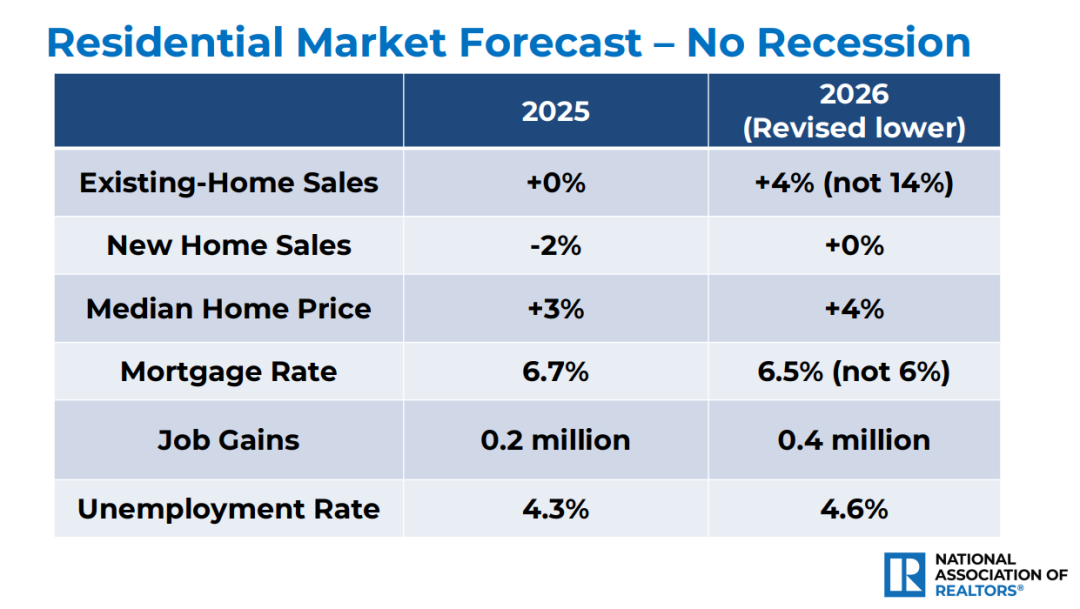

The reason the absolute data for the real estate market looks good is simply because prices are higher. Recently, the narrative of the upward K-line has loosened, indicating that overall economic expectations were already poor. I completely understand Bessant's thinking. Previously, when people saw weakening economic data, they thought it would lead to lower interest rates; now, seeing weakening economic data, they might think it will lead to a higher deficit ratio. Coupled with the Fed's communication, this led to a rapid widening of the one-month term spread, prompting him to intervene administratively. Eliminating this part of the market's bets has its own logic.
Finally, regarding gold, in the short term, it may need to observe the Fed's stance. If the Fed's thinking is that only raising interest rates can curb long-term interest rates, which is also the current view of many market participants, then gold will experience fluctuations but not a major problem. If there is no actual increase in productivity and interest rates are only raised for various reasons, then they will eventually fall back down. If the Fed's thinking is that only easing can stimulate more supply to improve US competitiveness and reduce inflation, then gold may have already broken out.
In the final section, I'd like to briefly discuss some undeniable issues. Many of America's problems today, whether it's the Middle East quagmire or the massive investments in AI without a reasonable return in the short term, cannot be solved by fiscal and monetary policies alone. The actions of technocrats don't address the core issues. (Moreover, I don't think Bessant and Walsh, given the current situation, can be considered excellent technocrats. I don't understand why so many people praise Bessant, saying things like, "China is like a dilapidated house that collapses with a single kick; the dollar must remain strong to benefit the US economy; tariffs can bring sufficient revenue, 3% economic growth, 3% deficit, 3 million barrels of oil." From 2024 to today, you can make money by doing the opposite of what he said.) As a country reaches its mid-to-late stages, the necessity and demand for reform increase daily, but the feasibility and motivation for reform decrease daily. Successful reforms exist, but failures are far more common. This process is inherently extremely difficult. Successful reforms are often subtle yet impactful, while reforms based on ideology often fail due to too much opposition.
For example, in Chinese history, many have heard of Zhang Juzheng and Wang Anshi, but few understand the Two-Tax System reform, yet the Tang Dynasty's Two-Tax System reform was a success with far-reaching influence. To some extent, I think many seasoned Wall Street financiers have a more sophisticated perspective than Bessant. For example, Jamie Dimon and Ray Dalio both stated on the Iran issue that if a war is started, it should be fought to the end and won, not half-heartedly. They also believed that raising interest rates might alleviate the pressure of long-term debt. These are all correct and difficult things. Sometimes, people have to do the right and difficult things; the brilliance of politicians lies in their ability to get society to do the right and difficult things.
If you're always trying to find the so-called optimal solution through shortcuts, it reminds me of many Indians I've met. They always think they can see things others don't and then easily win. The biggest lesson I've learned from history is that many things can't be done by shortcuts. If you don't go through life-or-death situations with your brothers, no one will come to your rescue when you're facing danger yourself. Without decades of experience and trust, you can't build a core team to do things that take decades to see results. Our era is filled with fast-paced narratives; technology has diminished the importance of humanity, but I think the underlying logic remains unchanged. Many things, whether you're doing them with robots or with people, require time.
Today's actions by the US Treasury remind me of the Indians I've encountered at work; they always think they can achieve great things with minimal investment and see things others can't. I've never believed that. I think everyone you meet isn't a fool, unless you are. So, if this is just the Treasury's short-term, opportunistic response to seasonal and geopolitical disturbances, I think it's fine. But if the Federal Reserve joins in, then I think it represents a radical shift in the underlying logic.
I rarely discuss the twilight of the dollar, not because I think the US is without problems, but because I always feel these grand narratives require a lot of time and sufficient catalysts before they can be worth discussing. I think if the Federal Reserve also adopts this kind of regulation of long-term yields, and if the Strait of Hormuz project ultimately ends in a mess, that would be sufficient catalysts. We can discuss that tomorrow.
This content is for informational and educational purposes only and does not constitute investment advice related to BTCC. BTCC makes every effort but cannot guarantee the truthfulness, accuracy, or originality of the content above.