Bitcoin briefly broke through $75,000: Short covering ignited the price action, with ETFs and Strategies determining the market's potential high.
 cryptonewsAuthor: SoSoValue
Original author: SoSoValue
Trump's urging of Congress to advance the Clarity Act at a White House crypto conference quickly improved market expectations for the future of US crypto regulation. Meanwhile, the US Treasury expanded its long-term bond repurchase program, pushing long-term yields down and easing pressure on risk assets from the dollar and real interest rates. The narrowing policy discount, improved liquidity expectations, and short covering combined to push Bitcoin briefly above $75,000.
This surge was initially triggered by policy signals, followed by a breakout above key price levels that sparked massive short covering. Short sellers were forced to cover, further amplifying the gains and causing Bitcoin to quickly break out of its previous trading range. However, the buying pressure from forced liquidation is temporary; as highly leveraged short positions are gradually cleared, further upward movement will require active capital inflows.
The key to determining whether Bitcoin can shift from a rapid rebound to a sustained upward trend has fallen to two institutional funding channels: the US Bitcoin spot ETF and Strategy's leveraged Bitcoin buying cycle.
ETF funds begin to take over short covering
Short covering can quickly push up prices and improve market sentiment, but it's difficult to sustain a sustained upward trend on its own. The forces capable of absorbing short-term profit-taking and raising the price center still come from the spot market, especially US Bitcoin spot ETFs.
According to SoSoValue data, on August 19th, US Bitcoin spot ETFs saw a net inflow of approximately $517 million, marking the third consecutive day of net inflows and the largest single-day net inflow in three and a half months. This indicates that institutional funds have begun to take over from short covering, and the market's buying structure is shifting from derivatives-driven to a combination of spot and derivatives trading.
This change improves the quality of this rebound. Previously, Bitcoin rose rapidly on the back of policy news, which the market may still interpret as event-driven trading; however, three consecutive days of net inflows into ETFs indicate that some institutional funds are taking advantage of improved policy expectations to rebuild their spot exposure.
The key going forward is whether ETF net inflows can continue to maintain levels of several hundred million dollars and spread from a few top products to more funds. Sustained large net inflows can absorb short-term profit-taking and provide support for Bitcoin's price center after the breakout; if the fund flow falls back quickly, the marginal buying brought about by short covering will disappear, and the market may still re-enter a period of high-level fluctuation.
Therefore, the continuity of ETF fund flows in the coming days will directly determine the quality of this round of price increases. A price breakout indicates that the market has started to move, and institutional spot funds will determine whether the rally can continue.
STRC fix brings Strategy closer to funding window.
The second potential buying opportunity to watch out for comes from Strategy.
Strategy recently disclosed holdings of 840,447 bitcoins, with an average purchase cost of approximately $75,385. As bitcoin rose above $75,500 intraday, its holdings briefly returned above the break-even point. With reduced pressure on its assets, the credit outlook for both Strategy's common and preferred stock has improved, with the STRC (Strong Credit Rating) rising back above $95.
STRC is a key financing tool for Strategy's expansion of its Bitcoin balance sheet. Its price target is close to its face value of $100. The closer the price is to face value, the lower market concerns about dividend coverage and credit risk, and the more favorable the conditions are for Strategy to reissue STRC for financing. As of August 16, the company still had approximately $17.51 billion in STRC issuance capacity, indicating ample potential financing space.
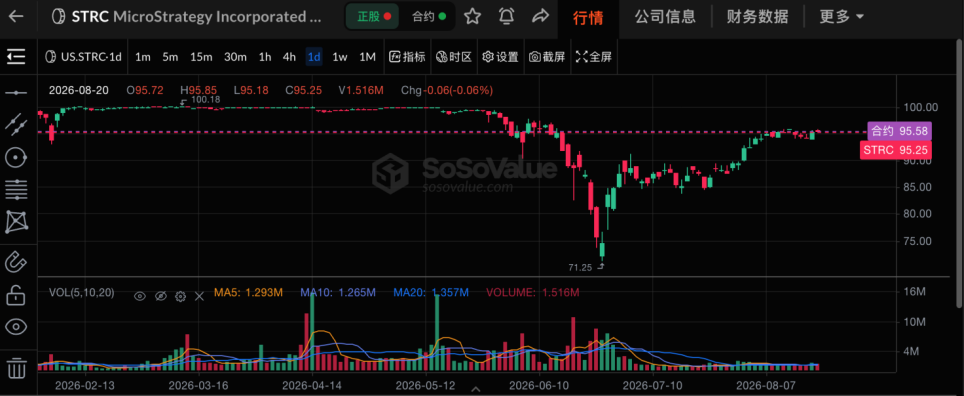
However, the fact that STRC has risen above $95 indicates that the funding window is closing, but it does not yet mean that new funds for buying Bitcoin have been secured. Strategy has not issued any STRC or made any new Bitcoin purchases in the past week, and is still working to repair its funding structure by selling MSTR, replenishing its dollar reserves, and repurchasing discounted STRC.
The next truly significant shift will occur when STRC approaches and stabilizes near $100, followed by Strategy resuming STRC issuance and Bitcoin accumulation. Once this cycle restarts, STRC funding could translate into direct spot Bitcoin buying, resonating with ETF inflows.
The fact that Strategy's holdings are approaching the break-even point also carries significant emotional implications. When Bitcoin's price is below its average cost, the market focuses more on balance sheet pressures, financing costs, and potential selling risks; once the price returns above the cost line, investors' attention shifts back to its financing and expansion capabilities. Whether Strategy can continue to recover thus becomes a leading indicator of when Strategy will once again become a major Bitcoin buyer.
Two institutional buying orders will determine whether the rise can continue.
The current Bitcoin rally has completed its first phase: favorable policies improved sentiment, expectations of macro liquidity drove valuation repair, and short covering accelerated the price breakout. The second phase requires continuous incremental funding from ETFs and Strategies.
Going forward, we can judge the strength of the market based on two data points:
• Can the US Bitcoin spot ETF continue to see net inflows of hundreds of millions of dollars and absorb market selling pressure after the short covering subsides?
• Whether STRC can steadily recover to its $100 face value and drive Strategy to resume preferred stock financing and increase its Bitcoin holdings.
If both funding channels strengthen simultaneously, Bitcoin's rally could evolve from a short-covering correction into a trend reversal driven by institutional funds. ETFs provide continuous spot demand, while Strategies convert capital market funds into Bitcoin buying through financing; the combined effect of these two factors could further raise the market price level.
If ETF inflows cool rapidly and the Strategy funding cycle fails to recover, profit-taking accumulated from the recent sharp rise could push the market into a period of high-level consolidation. The pace of regulatory legislation, US Treasury yields, and the dollar's performance will also continue to influence institutional investors' risk appetite.
Shift from single-point betting to combined bottom-fishing
For users who wish to participate in market recovery while mitigating the risks associated with a single token, SoSoValue's MAG7.SSI and DEFI.ssi offer a more efficient combination option.
MAG7.SSI covers the most representative core assets in the crypto market and can more fully absorb the overall recovery in risk appetite; DEFI.ssi focuses on high-value assets in the DeFi field and directly benefits from the improvement in on-chain transactions, liquidity and fund activity.
Compared to betting on a single token, users can use SoSoValue to trade MAG7.SSI and DEFI.ssi with one click, combining them to buy up the most representative high-value assets in the industry in batches, reducing the cost of token selection and the risk of volatility from a single project.
The market is currently showing signs of improved funding structures, but the trend still needs confirmation from both ETF and Strategy institutional buying. By strategically investing in MAG7.SSI and DeFI.ssi in stages, one can control the risk of individual assets while more comprehensively covering the current crypto market recovery.
This content is for informational and educational purposes only and does not constitute investment advice related to BTCC. BTCC makes every effort but cannot guarantee the truthfulness, accuracy, or originality of the content above.