Bernstein's Analysis: Samsung HBM4 Accelerates Sales Growth, Q3 Revenue May Surpass SK Hynix
 Blockbeats
Abstract: Bernstein uses South Korean export data as a leading indicator of HBM revenue, estimating that Samsung's HBM revenue in the third quarter may reach $12 billion, about 30% higher than previously predicted.
Samsung's exports to the region in July increased by 122% compared to April, with the unit value doubling, indicating that the growth may have been mainly driven by the production of high-priced HBM4.
SK Hynix's exports fell by about 27% compared to April. The baseline regression model points to a 20% quarter-on-quarter decline in HBM revenue in the third quarter, but monthly data and seasonal differences make the results highly uncertain.
Bernstein attributed SK Hynix's weakness to delayed shipments of Rubin-related HBM4, but this remains analyst speculation and not a confirmed causal relationship by Nvidia or SK Hynix.
HBM prices did not surge in tandem with traditional DRAM. The increase in Samsung's unit value reflects more the shift in product mix towards HBM4 than a significant price increase for products of the same specifications.
Bernstein remains bullish on Samsung, SK Hynix, and Micron, believing that the next round of profit revisions is more likely to come from HBM contract prices in 2027, rather than simply relying on this year's market share changes.
South Korea's July memory export data provides the first set of leading indicators for Samsung and SK Hynix's HBM business in the third quarter.
Bernstein has long tracked South Korea's multi-chip memory exports to Taiwan and Malaysia. The report suggests these exports are strongly correlated with the quarterly HBM revenues of Samsung and SK Hynix: Taiwan is a key location for CoWoS advanced packaging, while Malaysia hosts Intel's EMIB packaging facilities.
In July, South Korea's exports of multi-chip memory to Taiwan and Malaysia fell 32% from the record high in June. However, the report attributed this change primarily to seasonality within the quarter. Compared to April, the first month of the previous quarter, July's exports still increased by 13% and year-on-year by 64%, indicating that overall demand for HBMs has not weakened significantly.
However, while the overall volume remained strong, the export trends of the two South Korean memory manufacturers diverged: Samsung's exports continued to rise, while SK Hynix's data was significantly lower than Bernstein's expectations.
Samsung's third-quarter HBM revenue may exceed expectations by 30%.
Bernstein uses exports from South Chungcheong Province as a proxy for Samsung HBM's shipments because Samsung's related back-end production and packaging facilities are mainly located in that region.
In July, South Chungcheong Province's exports of multi-chip memory to Taiwan and Malaysia reached US$22 billion. While this represents a 35% decrease from the seasonal high in June, it is a 122% increase from April. Samsung's related exports have also surpassed SK Hynix's for the second consecutive month.
Based on the regression relationship between historical export data and HBM revenue, Bernstein estimates that Samsung's HBM revenue in the third quarter may reach approximately $12 billion, an increase of about 80% quarter-on-quarter, which is about 30% higher than its original forecast of approximately $9.3 billion.
If only recent data from the first quarter of 2025 is used for regression, the forecast will rise further to $12.6 billion, corresponding to a quarter-on-quarter growth of about 90%.
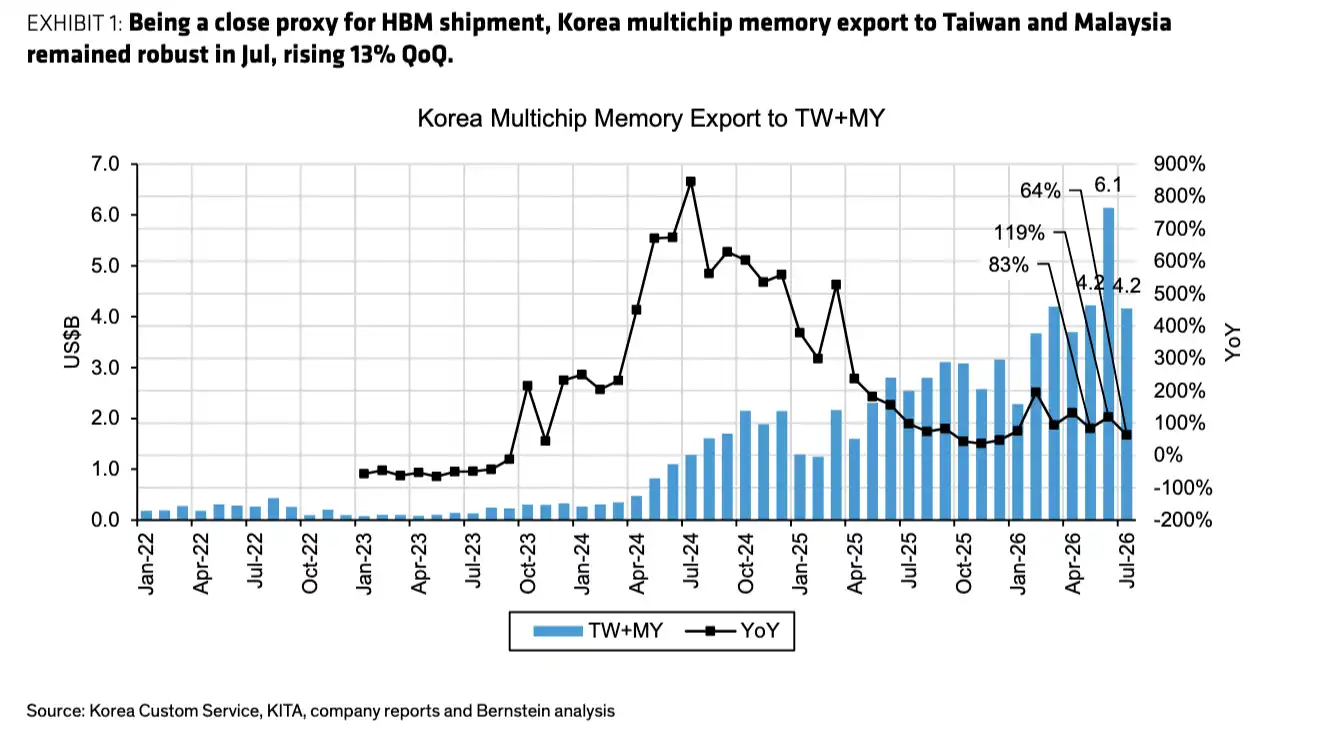
South Korea's monthly exports of multi-chip memory (HBM) to Taiwan and Malaysia (in USD billion) and year-on-year growth rate. While July's exports declined month-on-month due to seasonal factors, they still increased by 64% year-on-year, indicating that overall demand for HBM remains strong.
However, this figure is still a model estimate and not company guidance. Samsung's exports are typically concentrated in the last two months of the quarter, and since 2025, the first month of the quarter has accounted for less than 20% of the total quarterly exports on average. Therefore, whether third-quarter revenue will ultimately meet the model forecast will depend on actual shipments in August and September.
Bernstein believes that the July data is at least consistent with Samsung's previous direction: the company expects HBM4 sales to more than triple in the third quarter and account for more than 60% of HBM sales in the second half of 2026.
With its unit value doubling, HBM4 becomes Samsung's main growth driver.
In addition to the scale of exports, the unit value of Samsung's related products exported has also increased significantly.
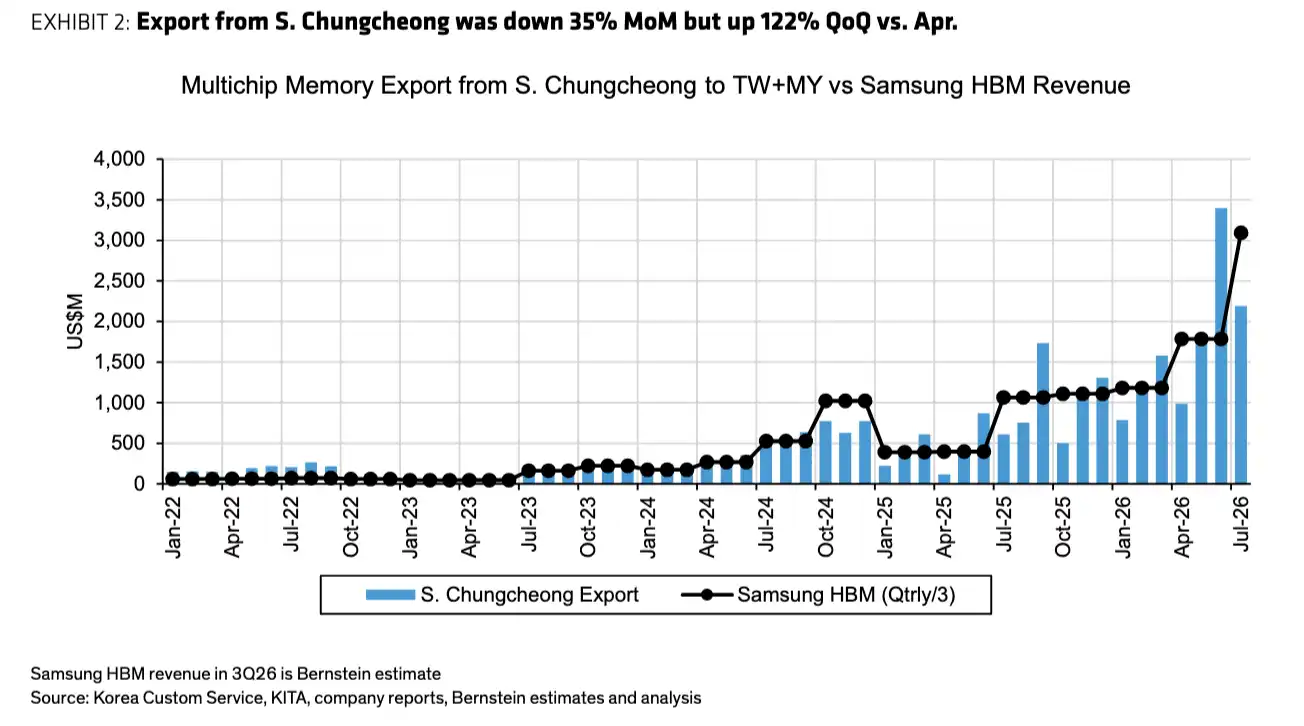
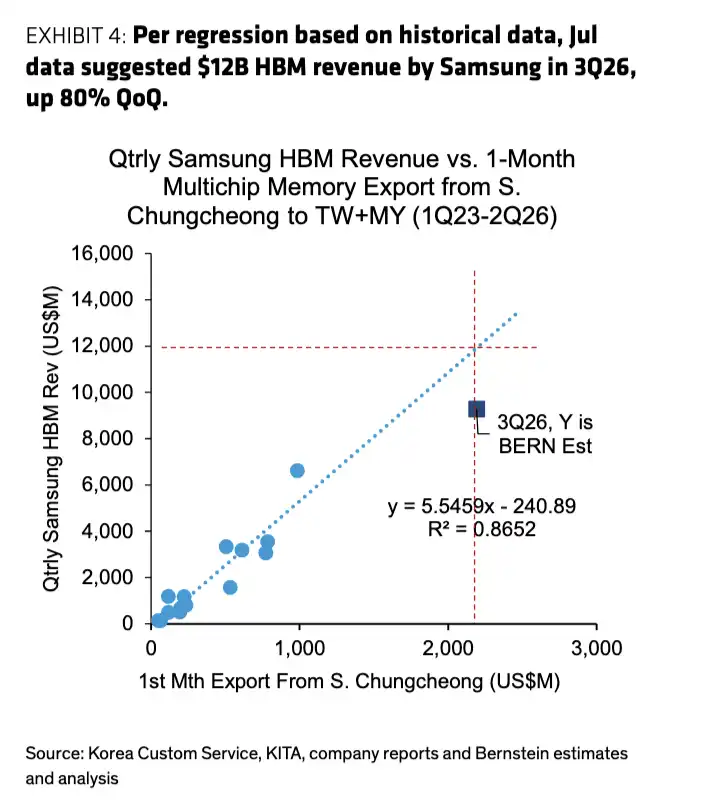
A comparison of multi-chip memory exports (in millions of USD) from Chungcheongnam-do (Samsung HBM's packaging location) to Taiwan and Malaysia with Samsung's quarterly HBM revenue (quarterly average). July exports reached $2.2 billion, a 122% increase from April, exceeding SK Hynix's figures for the second consecutive month. The chart on the right, based on historical data regression analysis, suggests that July's export data indicates Samsung's HBM revenue in the third quarter of 2026 may reach $12 billion, a quarter-on-quarter increase of approximately 80%, about 30% higher than Bernstein's original forecast.
In July, the unit value of multi-chip memory exports from South Chungcheong Province increased by 21% month-on-month, more than doubling the level in April and nearly four times that of SK Hynix's corresponding regions. Given the higher capacity, stacking layer count, and technological complexity of HBM4, Bernstein believes this change likely reflects a rapid increase in Samsung's HBM4 shipment share.
This does not mean that Samsung's price for the same HBM specification has doubled in a few months. The export unit value is also affected by product structure, capacity specifications, and packaging combinations, and can only serve as a directional indicator of average selling price. A more reasonable explanation is that Samsung is replacing some HBM3 and HBM3E with the more expensive HBM4, thereby increasing the overall export value.
This is also key to Samsung's potential regaining of market share. Previously, SK Hynix held a leading position thanks to HBM3E and a closer supply relationship with Nvidia; now, with the HBM4 cycle underway, the focus of competition is shifting to who can complete verification, improve yield, and achieve large-scale delivery earlier.
SK Hynix's exports have weakened, but single-month data cannot be directly equated with a reversal in market share.
In contrast to Samsung, SK Hynix's exports weakened significantly in July.
Bernstein uses exports from North Chungcheong Province and Icheon as a shipping indicator for SK Hynix HBM. In July, exports from these two regions decreased by 28% compared to June and by approximately 27% compared to April.
Based on the baseline regression model, SK Hynix's HBM revenue in the third quarter may only be $5.6 billion, a decrease of about 20% quarter-on-quarter, and 55% lower than Bernstein's original forecast. If this result comes true, Samsung's HBM revenue in the third quarter will significantly surpass that of SK Hynix.
However, the uncertainty surrounding this forecast is far greater than that for Samsung. The report also points out that if SK Hynix adopts its historically concentrated seasonal pattern of shipments in the latter part of the quarter, its third-quarter HBM revenue could still reach $12 billion, close to Bernstein's original forecast.
In other words, the same set of July data could correspond to a huge range of $5.6 billion to $12 billion under different seasonal assumptions. A more prudent assessment at this stage is not that "SK Hynix has lost its lead," but rather that its third-quarter start was weaker than expected, and whether it can catch up in August and September will determine its final market share.
Bernstein speculates that the weakness may stem from delayed shipments of HBM4 related to Rubin. SK Hynix previously stated that HBM4 began mass production in the second quarter and will ramp up production in the second half of the year. However, attributing the July export decline directly to Nvidia's Rubin progress is still an inference made by analysts based on industry trends and has not yet been explicitly confirmed by the relevant companies.
HBM did not follow the traditional DRAM price increase.
The report also points out that the price trends of HBM are diverging from those of traditional memory.
Since the third quarter of 2025, the price of traditional memory has increased approximately fivefold, but the export unit value of SK Hynix's related products has remained generally stable. Samsung's unit value has roughly doubled, mainly due to the increased proportion of HBM4, rather than a simultaneous significant price increase for existing products such as HBM3E.
This means that HBM's contract pricing, supply relationships, and product iteration cycles are partially decoupling it from traditional DRAM spot price fluctuations. Short-term price increases in traditional DRAM do not necessarily translate proportionally to HBM; the latter's profitability depends more on the proportion of next-generation products and annual customer contracts.
Bernstein believes that suppliers and customers have begun negotiating 2027 HBM contracts, and the expected price increases will drive Samsung and SK Hynix to further revise their profit forecasts for next year. Compared to the single-quarter market share changes in the third quarter, this may be a more significant pricing variable for the memory sector in the next phase.
The surge in Malaysian exports remains an unresolved variable in the supply chain.
In July, South Korea's exports of multi-chip memory to Malaysia rose 20% month-on-month to approximately $1.3 billion, continuing the rapid growth of the past few quarters. Samsung still accounted for the majority of these exports, but SK Hynix also saw a significant increase.
Bernstein speculates that these HBM chips may be destined for Intel's EMIB advanced packaging facility in Malaysia, used in server chips equipped with HBM. However, the report also acknowledges that it is currently difficult to explain why these exports increased so early, before mass production.
Therefore, exports to Malaysia are more suitable as a follow-up supply chain clue, rather than being directly equated with Intel customer orders or the volume increase of specific products.
Overall, the July data reinforced the logic of Samsung's catch-up in the HBM4 cycle, but it is not enough to confirm that the long-term market share structure has reversed. What really needs to be observed next is whether Samsung can continue its export growth in August and September, and whether SK Hynix can make up for the shipment shortfall at the beginning of the third quarter as HBM4 ramps up.
A market share reversal still requires waiting for August and September data.
July's export data reinforces the logic that Samsung is accelerating its catch-up in the HBM4 cycle: the export volume increased significantly, the unit value increased rapidly, and it is consistent with the company's sales guidance for HBM4.
However, these figures are not enough to confirm that Samsung has regained HBM's leading position over the entire year.
First, Bernstein uses a regression model between regional exports and company revenue, not actual order data. Second, if HBM packaging is moved outside of South Korea, or if some products are further packaged within South Korea, customs data may not be able to capture this completely. Finally, monthly exports are also affected by customer acceptance, shipping arrangements, and quarterly seasonality.
The next three variables to observe are: whether Samsung's exports can continue to grow in August and September, whether SK Hynix's exports and unit value will rebound as HBM4 ramps up, and whether the two companies can actually raise their HBM contract prices in 2027.
If Samsung's exports continue to grow and SK Hynix fails to catch up, HBM4 could drive more substantial changes in market share; if SK Hynix concentrates its deliveries in the last two months of the quarter, the divergence in July is more likely just a misalignment of delivery times.
Therefore, the current data does not truly change the fact that the HBM competition has reached a conclusion, but rather that Samsung is re-entering the market share battle at a speed that may be faster than the market previously expected.
This content is for informational and educational purposes only and does not constitute investment advice related to BTCC. BTCC makes every effort but cannot guarantee the truthfulness, accuracy, or originality of the content above.