Goldman Sachs is bullish on Changxin: With its capacity doubling in four years, can it cover half of China's DRAM demand?
 Blockbeats
Profit realization still depends on price, interest rates, and HBM progress.
summary
Goldman Sachs gave it a "buy" rating and a 12-month target price of 129 yuan, with its core bet on the combined effects of AI demand, capacity expansion, and domestic substitution.
Goldman Sachs predicts that Changxin's monthly production capacity will increase from 270,000 wafers in 2026 to 665,000 wafers in 2030, more than doubling in four years.
By 2028, Changxin's supply may cover about 50% of China's DRAM demand, but this still depends on capital expenditure, yield ramp-up and customer validation.
HBM is key to Changxin's profit upgrade, and Goldman Sachs expects its revenue share to rise from 2% in 2026 to 27% in 2030.
The target price of 129 yuan implies not only shipment growth, but also the assumptions of high DRAM prices, product structure upgrades, and an aggressive forecast of a gross margin of 82% by 2030.
Changxin DRAM, a leading Chinese DRAM manufacturer, received its first coverage from Goldman Sachs less than a month after its IPO.
In its report "CHIPS IV: China's Semiconductor Self-Sufficiency Accelerates," released on August 23, Goldman Sachs gave Changxin a "Buy" rating with a 12-month target price of RMB 129. At the time of the report's release, Changxin was trading at approximately 10 times its 2027 projected P/E ratio; Goldman Sachs' target price, however, implies approximately 24 times its 2027 projected P/E ratio.
Behind this pricing is a growth model that extends to 2030: doubling wafer capacity, continued expansion of traditional DRAM shipments, rapid growth in HBM revenue, and the combined effect of China's AI computing infrastructure development and diversified customer supply chains driving up domestic storage demand.
However, this model is also based on a series of optimistic assumptions. In addition to capacity expansion and yield improvement, Goldman Sachs also expects DRAM prices to remain high in a tight supply environment, and Changxin's gross profit margin to rise from 41% in 2025 to 82% in 2030. Therefore, the target price of 129 yuan is not just a bet on domestic substitution, but on the simultaneous development of capacity, price and product structure in a favorable direction.
Changxin Technology Co., Ltd. was listed on the STAR Market on July 27, with the stock code 688825. At the time of listing, the company's total A-share capital was approximately 66.881 billion shares, with the first batch of approximately 4.503 billion shares commencing trading. According to the prospectus, the funds raised will be mainly used for upgrading wafer manufacturing mass production lines, upgrading DRAM technology, and research and development of forward-looking technologies.
Goldman Sachs' new report further extrapolates these investments into a capacity leap that will continue until 2030.
With production capacity doubling in four years, it may cover half of China's DRAM demand by 2028.
Goldman Sachs predicts that Changxin Wafer's monthly production capacity will increase from 270,000 wafers in 2026 to 447,000 wafers in 2028, and reach 665,000 wafers in 2030, more than doubling from 2026.
Supporting the expansion is the continuous growth in capital investment. Goldman Sachs predicts that Changxin's average annual capital expenditure will reach 84 billion yuan from 2026 to 2030, higher than the approximately 50 billion yuan from 2022 to 2025; if compared only with 2024 to 2025, the average annual capital expenditure in the previous two years was approximately 60 billion yuan.
Driven by capacity expansion, yield improvement, and product specification upgrades, Goldman Sachs expects Changxin DRAM's total supply to grow at a CAGR of 34% between 2026 and 2030, reaching 98.37 billion GB by 2030.
By 2028, Changxin's traditional DRAM supply is expected to reach 41% and 50% of Samsung and SK Hynix's supply during the same period, respectively, up from 28% and 35% in 2025.
An even more impactful assessment is that Goldman Sachs predicts Changxin's supply will cover approximately 50% of China's DRAM demand by 2028. This is a forecast of future supply capacity and does not represent that Changxin has already secured half of the Chinese market share.
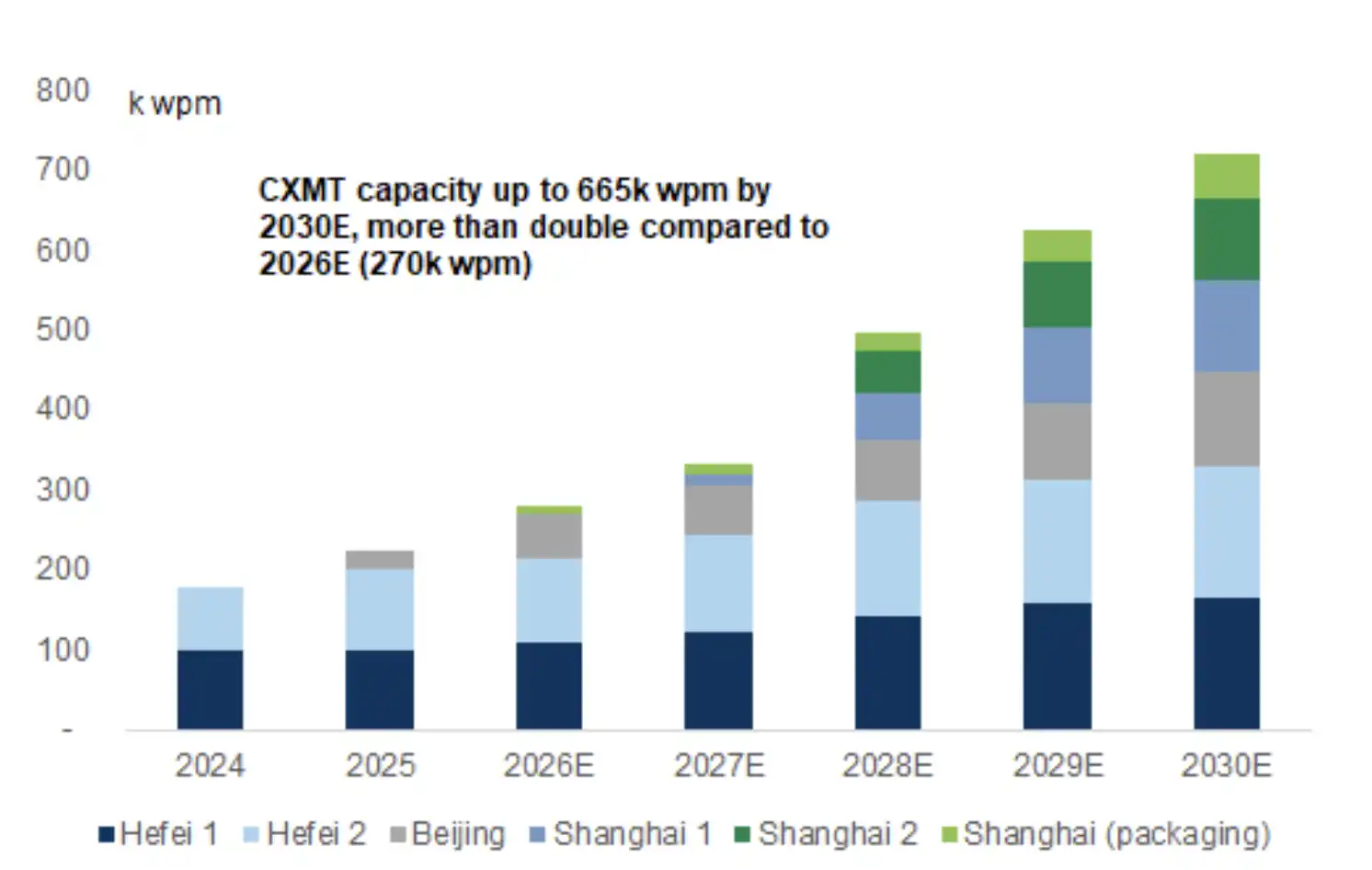
Changxin's monthly production capacity expansion trend from 2026 to 2030, with the core forecast being an increase from 270,000 wafers to 665,000 wafers.
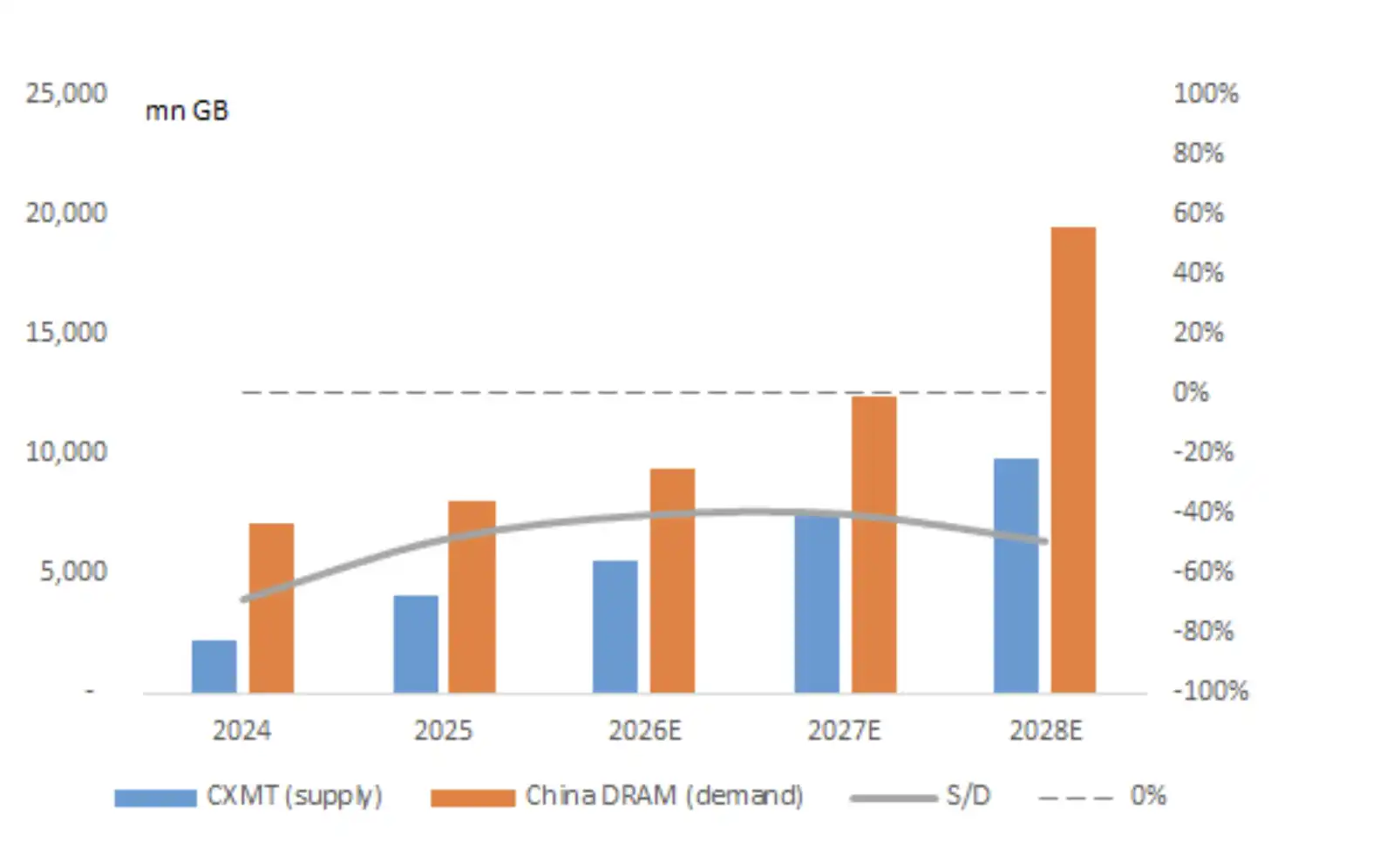
According to Goldman Sachs' forecast, Changxin DRAM will cover approximately 50% of China's DRAM demand by 2028.
AI is driving up storage demand in China, and also leaving room for Changxin to expand.
Goldman Sachs projects that China's DRAM market will grow at a CAGR of 50% between 2026 and 2028, reaching $2,570 billion by 2028. This growth will be primarily driven by shipments of AI servers, server DRAM, and HBM demand, with mobile phones, PCs, networking equipment, and automobiles also contributing to the underlying demand.
The supply side is also changing. As global memory manufacturers such as Samsung, SK Hynix, and Micron shift more resources to AI-related products like HBM, traditional DRAM supply is being squeezed. In an environment of rising prices and limited supply, consumer electronics manufacturers are also more motivated to bring in new suppliers to reduce the risk of relying on a single source.
Goldman Sachs believes that even though Changxin's technology nodes are still several generations behind the world's leading manufacturers, customers in the United States and other overseas countries are still likely to validate its mobile DRAM and traditional DRAM products, especially in the fields of smartphones and personal computers.
This constitutes two main lines of expansion for Changxin: on the one hand, to meet the domestic DRAM demand and domestic substitution in China; on the other hand, to fill the traditional DRAM gap left by global manufacturers shifting their production capacity to HBM.
However, whether overseas clients can make large-scale purchases remains influenced by geopolitical and trade restrictions. Willingness to validate products does not guarantee orders will materialize, which is one of the main risks listed by Goldman Sachs.
HBM will determine whether Changxin can move from scale expansion to profit improvement.
Traditional DRAM provides the scale foundation, while HBM determines whether Changxin can truly reap the high-value incremental benefits of AI storage.
HBM (Hybrid Memory Machines) provides AI accelerators with higher bandwidth, capacity, and energy efficiency by vertically stacking multiple layers of DRAM. However, compared to ordinary memory, HBM manufacturing involves multiple stages, including front-end DRAM wafers, high-precision silicon vias, advanced node logic wafers, thermal management, and reliability, resulting in significantly higher technological and supply chain barriers.
Goldman Sachs expects Changxin's HBM products to start contributing to revenue from the fourth quarter of 2026, with HBM revenue share rising from 2% in 2026 to 27% in 2030. Its HBM supply is projected to grow at a CAGR of 207% between 2026 and 2028, reaching 1.179 billion GB by 2028.
However, this is also the part with the greatest uncertainty in the entire model.
Goldman Sachs explicitly points out that Changxin HBM's technology maturity is still in its early stages, and it is expected to be difficult to penetrate the supply chains of US customers in the short to medium term. In contrast, overseas customers have a stronger willingness to validate mobile DRAM and traditional DRAM.
In other words, Changxin can quickly increase its traditional DRAM supply capacity by expanding production, but to enter the high-value HBM market, it still needs to solve problems such as manufacturing processes, the local packaging ecosystem, advanced logic wafers, heat dissipation reliability, and customer certification.
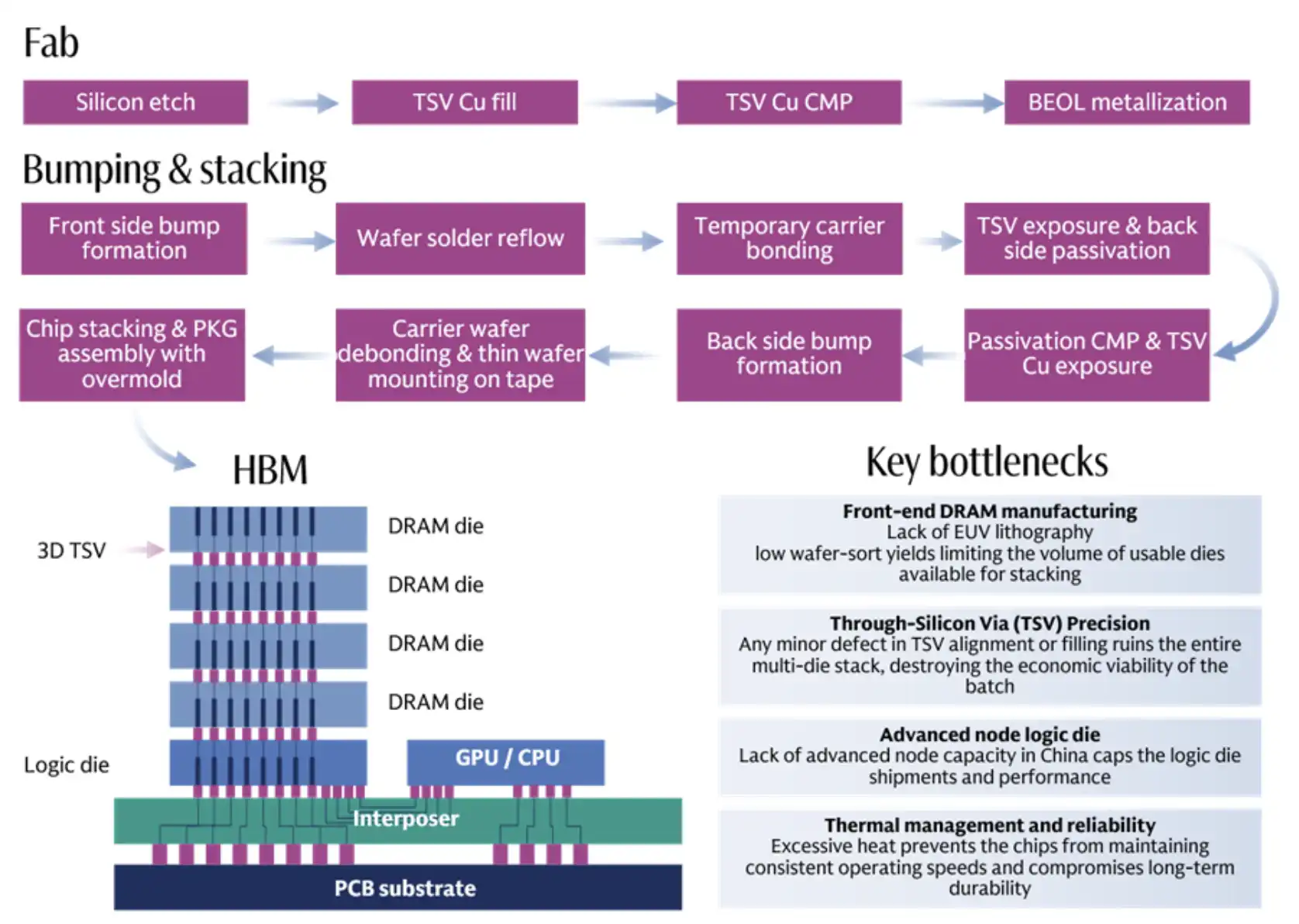
HBM manufacturing processes and key bottlenecks, including front-end DRAM manufacturing, high-precision TSVs, advanced node logic wafers, heat dissipation, and reliability.
A target price of 129 yuan is a bet on more than just shipment growth.
Goldman Sachs projects that Changxin's net profit will grow at a CAGR of 47% between 2026 and 2030, while traditional DRAM revenue will grow at a CAGR of 34% and HBM revenue at a CAGR of 166% during the same period.
The target price of RMB 129 is not directly derived by multiplying the 2027 earnings by a P/E ratio of 24. Goldman Sachs first assigned Changxin a target P/E ratio of 16.6 for 2030 based on the relationship between peer valuations and earnings growth, and then discounted it to 2027 using a cost of equity of 12.7%, ultimately arriving at a target price of RMB 129. This price implies approximately 24 times the projected 2027 P/E ratio.
There are three main factors supporting the upward revision of the valuation.
First, the expansion of China's AI infrastructure has driven demand for server DRAM and HBM; second, the global supply of traditional DRAM is squeezed by the expansion of HBM production, and consumer electronics customers are accelerating the diversification of suppliers; third, Changxin's scarcity as a large-scale DRAM manufacturer in China allows it to obtain a certain valuation premium for domestic semiconductors.
But the truly aggressive part of this valuation lies in the profit margin.
Goldman Sachs predicts that as DRAM prices remain high, shipment volumes expand, and the product mix upgrades to DDR5, LPDDR6, and HBM, Changxin's gross margin will rise from 41% in 2025 to 82% in 2030, while its operating expense ratio will decrease from 27.4% to 7.9% during the same period.
This means that the target price of 129 yuan not only requires wafer fabs to start production as planned, but also requires the new capacity to be successfully converted into shipments, the DRAM boom to continue, the HBM ratio to continue to increase, and ultimately to be realized as a significant improvement in profit margins.
From expanding wafer fabs to realizing profits, there are still many hurdles to overcome.
The memory industry remains a typical cyclical sector. When demand is strong, capacity expansion can simultaneously boost revenue and profits; however, when new capacity is released in a concentrated manner, a reversal in the supply-demand relationship can quickly depress prices and profitability.
For Changxin, the risks mainly come from three aspects.
First, global manufacturers such as Samsung, SK Hynix, and Micron are still expanding DRAM capacity and developing next-generation products, and stronger-than-expected competition could put downward pressure on Changxin's shipments and profits. Second, Goldman Sachs' profit margin model is based on strong DRAM demand and prices; if AI or consumer electronics demand falls short of expectations, both shipments and gross margins could be under pressure. Finally, the geopolitical environment may limit Changxin's access to global customer supply chains, weakening its overseas growth potential.
Changxin has completed the leap from "zero to one" for domestically produced DRAM to entering the open market. The more difficult part next is to turn the expanding wafer fab into a stable production line, and then extend the scale advantage of traditional DRAM to the performance, yield and customer certification of HBM.
Therefore, the target price of 129 yuan does not represent a realized result, but rather a concentrated bet on the simultaneous realization of capacity expansion, high prosperity in storage, domestic substitution, and HBM upgrades.
This content is for informational and educational purposes only and does not constitute investment advice related to BTCC. BTCC makes every effort but cannot guarantee the truthfulness, accuracy, or originality of the content above.