BTC Consolidates Near $80K as Three Major Tests Loom This Week

👉Click to Claim 30,000 USDT — Limited-Time Offer!
Bitcoin entered a period of high-level consolidation after a sharp rally, briefly breaking above $79,000 last week before pulling back to around $77,000. Meanwhile, risk appetite in traditional markets has cooled somewhat. U.S. stocks rebounded on Friday but still ended the week lower, while South Korean technology stocks came under renewed selling pressure. Oil prices also retreated ahead of a new round of U.S. sanctions on Iran.
This week, new U.S. sanctions on Iran, Nvidia’s earnings, and the Jackson Hole symposium will take center stage. Together, these events could determine whether BTC can challenge the $80,000 threshold and set the tone for the next phase of global risk assets.
Iran Sanctions Loom as Oil Prices Retreat
Markets are awaiting a new round of U.S. sanctions against Iran. U.S. Treasury Secretary Scott Bessent could announce specific measures at 2:00 p.m. ET on Monday. Ahead of the announcement, WTI crude fell about 1.7% to $85.35 per barrel, while Brent crude declined roughly 1.6% to around $91 per barrel. If the sanctions prove tougher than expected and revive concerns over supply disruptions, a rebound in oil prices could reignite inflationary pressure and amplify volatility across risk assets.
Another major focus will be Federal Reserve Chair Kevin Warsh’s speech at Jackson Hole on Friday. Markets will closely watch his comments on inflation, long-term interest rates, and the path of monetary policy. If Warsh continues to emphasize the need to contain inflation and keep rates elevated, Treasury yields and the U.S. dollar could strengthen again. A more dovish tone, by contrast, could support technology stocks and crypto assets.
U.S. fiscal pressures also remain unresolved. Federal government debt has surpassed $40 trillion, while annual interest expenses have exceeded $1 trillion, keeping long-term borrowing costs firmly in focus. Against this backdrop, Bitcoin’s “hard asset” narrative has regained momentum. Ray Dalio has warned that U.S. public debt could rise to between $55 trillion and $60 trillion over the next decade, while suggesting investors underweight bonds and hold a small allocation to Bitcoin.
Gold and BTC both advanced last week, but Bitcoin significantly outperformed. The divergence suggests that as the dollar weakens and concerns over fiscal sustainability intensify, some capital is moving toward higher-beta digital assets.
U.S. Stocks Rebound as Nvidia Earnings Put AI Boom to the Test
U.S. equities rebounded on Friday, with the Dow Jones Industrial Average gaining 0.98%, the Nasdaq Composite rising 0.43%, and the S&P 500 adding 0.43%. All three major indices, however, still finished the week lower. Strong U.S. services data and expectations that the Treasury could expand its buybacks of longer-dated government debt provided temporary support for risk sentiment.
Within the technology sector, investors remain cautious ahead of another major test for the AI trade. Nvidia is scheduled to report quarterly earnings after the U.S. market closes on Wednesday. Investors will focus on AI chip demand, data center revenue, progress on the Rubin platform, and whether AI infrastructure orders can continue to justify elevated valuations.
Rising long-term Treasury yields had previously weighed on semiconductor stocks, with the Philadelphia Semiconductor Index falling roughly 5% last week. This suggests investors have not abandoned the AI theme, but are becoming more demanding when it comes to valuations, financing costs, and returns on capital expenditure.
If Nvidia delivers another strong quarter and upbeat guidance, capital could rotate back into the AI hardware supply chain. If its outlook disappoints, semiconductor stocks could remain under pressure.
During Asian trading on August 24, South Korea’s KOSPI fell 3% intraday, with SK Hynix down 5.8% and Samsung Electronics falling more than 8%. Samsung’s shareholder return plan fell short of elevated market expectations, while profit-taking accelerated after the sector’s earlier rally. U.S. technology stock futures were also under pressure.
👉Click to Claim 30,000 USDT — Limited-Time Offer!
BTC Gains Over 23% in a Week as ETF Inflows Surge
As of August 24, BTCC market data showed BTC trading at $77,596, up 1.78% over the previous 24 hours. Bitcoin gained approximately 23.5% last week and briefly climbed above $79,000 before entering a consolidation range between $76,000 and $78,000. Momentum has slowed, but the broader high-level consolidation structure remains intact.
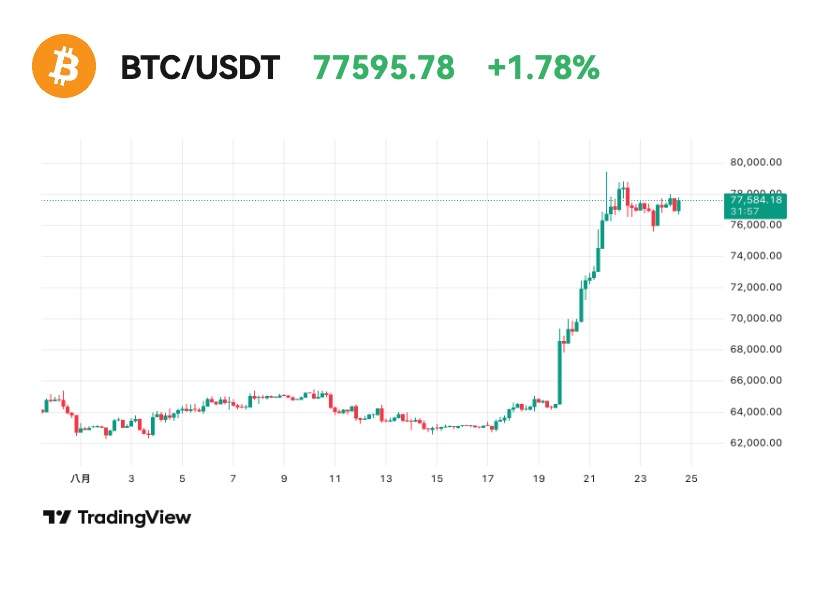
The latest rally has been driven primarily by three factors: shifting liquidity expectations following the U.S. Treasury’s buybacks of longer-dated government bonds, a weaker U.S. dollar, and improving expectations around crypto regulation. Once BTC broke through key resistance levels, short covering further accelerated the move.
Capital flows have also improved significantly. U.S. spot Bitcoin and Ethereum ETFs attracted approximately $2.6 billion in combined net inflows last week, the highest weekly total since October 2025. Spot Bitcoin ETFs recorded around $1.9 billion in net inflows, while spot Ethereum ETFs attracted approximately $697 million. Both categories posted their largest weekly inflows of 2026.
From a technical perspective, BTC has reclaimed its 200-day moving average, strengthening signs of a medium-term trend recovery. In the short term, $75,000 is an important support level. If BTC continues to hold above this threshold, another test of the 78,000–80,000 zone could follow. A drop below the 72,000–73,000 area, however, would increase the risk of profit-taking following the rapid rally.
ETH also performed strongly, gaining approximately 31.1% last week and currently trading near $2,450. XRP surged more than 50% over the week, while HYPE broke above $80 to reach a new all-time high, indicating that capital has begun rotating from BTC into higher-beta major tokens.
For now, however, BTC and ETF flows remain at the center of the rally. Confirmation of a broader altcoin season may require Bitcoin to first stabilize at elevated levels.
What to Watch Next
Three developments will dominate markets this week: whether Monday’s U.S. sanctions on Iran push oil prices higher, whether Nvidia’s Wednesday earnings validate continued AI demand, and whether Fed Chair Warsh’s Friday speech at Jackson Hole provides fresh signals on the future path of interest rates.
For Bitcoin, the trend recovery has become increasingly evident, but confirmation that a broader bull market has resumed will depend on several factors: whether ETF inflows remain strong, whether BTC can hold above $75,000, and whether the 50-day moving average eventually crosses above the 200-day moving average to form a “golden cross.”
Until these signals are confirmed, BTC may remain in high-level consolidation as investors wait for the next major catalyst.
Risk Warning: Some of the views in this article are drawn from public media sources and are for reference only. They do not constitute any investment advice or trading recommendation. Markets involve risks, and trading should be approached with caution. Please ensure you have appropriate risk controls in place.
👉Click to Claim 30,000 USDT — Limited-Time Offer!
This content is for informational and educational purposes only and does not constitute investment advice related to BTCC. BTCC makes every effort but cannot guarantee the truthfulness, accuracy, or originality of the content above.