Gold is approaching $4,600, and options trading is pushing the rally to the next level.
 Blockbeats
Over the past 48 hours, gold has once again become the focus of global macro trading.
After breaking through a resistance zone that had lasted for about six months, gold prices further climbed above the 200-day moving average and rose by about 15% from the mid-July lows, once approaching $4,600 per ounce. The driving force behind this rally has also begun to spread from central banks and physical buying to ETFs, macro funds, and the options market.
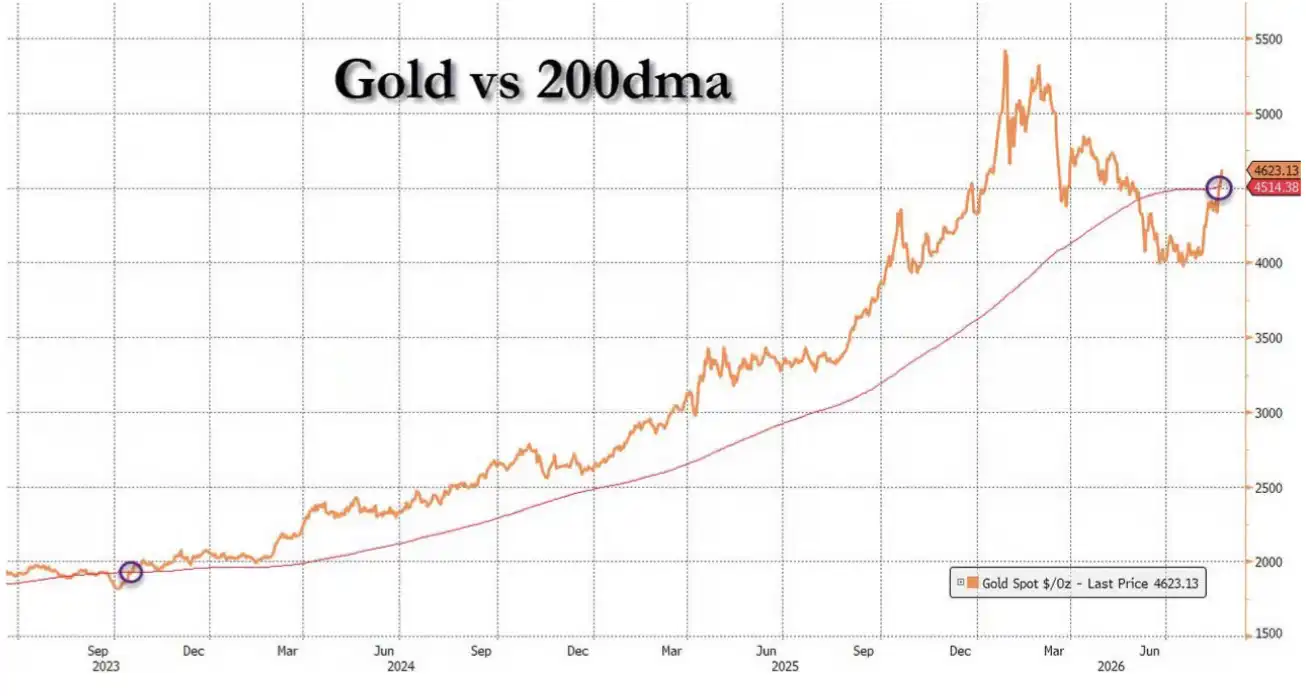
Gold broke through previous resistance and climbed back above the 200-day moving average, with prices briefly approaching $4,600 per ounce.
ZeroHedge, citing a report from Goldman Sachs strategists and trading desks, stated that demand for gold call options has risen significantly recently. In addition to central bank gold purchases, Chinese imports, and ETF fund inflows, options trading is adding a new price amplification mechanism to the gold market.
This means that the future movement of gold may no longer be entirely determined by traditional supply and demand. As prices approach dense option strike levels, traders' passive hedging could further push up gold prices; if the market reverses, the same mechanism could amplify the decline.
Call options are gaining traction; gold prices may break through $4,900.
Goldman Sachs has observed that investors are reverting to using gold call options to hedge global macroeconomic and policy risks.
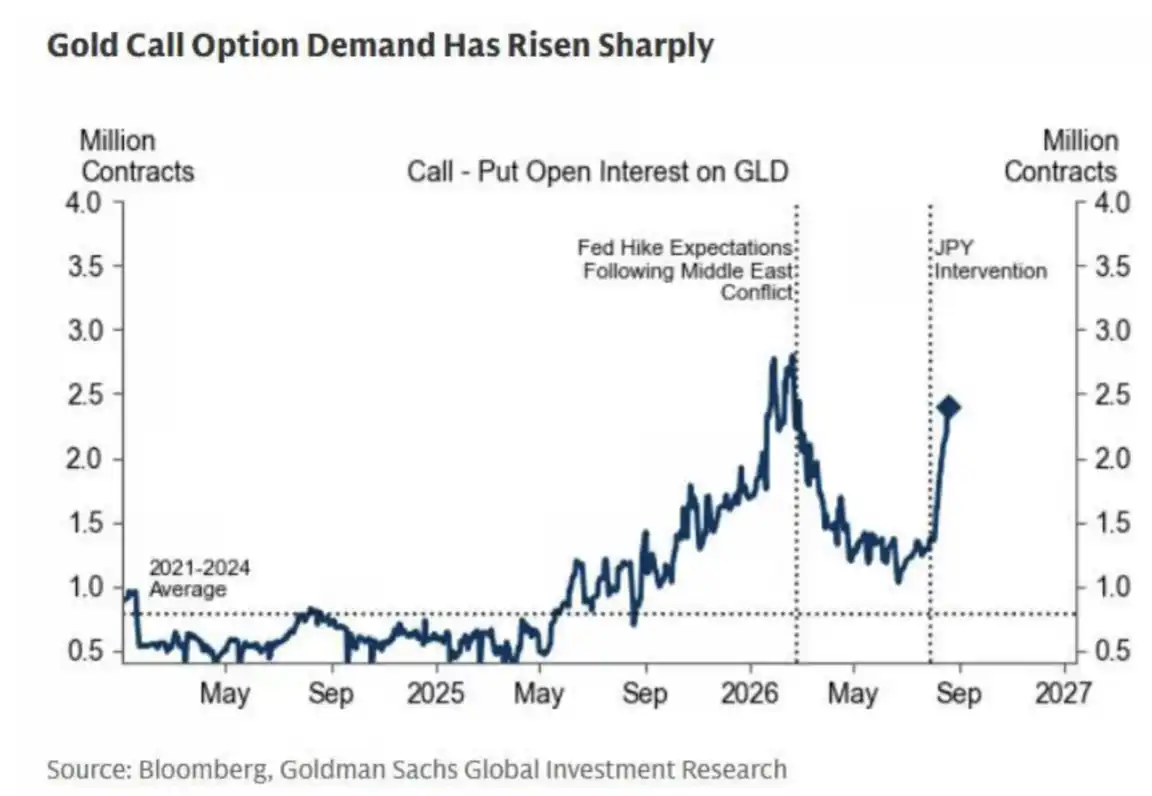
The gap between open interest in gold call and put options has widened rapidly, indicating a significant increase in investor demand for gold call options. Source: Bloomberg, Goldman Sachs Global Investment Research.
Sellers of call options typically need to dynamically adjust their risk exposure based on changes in gold prices. When gold prices approach key strike prices, traders who have sold options need to buy more gold or gold futures to maintain their hedging. This type of buying is not based on new fundamental judgments, but it can create additional demand during an upward trend, pushing prices closer to the next strike price range.
Goldman Sachs calls it a "mechanical price amplifier." If ETF funds continue to flow in and call option positions remain high, rising gold prices will encourage traders to increase hedging purchases, which in turn could push prices higher, creating a short-term positive feedback loop.
However, this mechanism is two-way. When gold prices fall, traders will unwind previously established hedging positions, thereby increasing selling pressure in the market. Therefore, the more concentrated the options positions, the more volatile gold prices may be near key price levels.
Goldman Sachs currently maintains its fair value forecast for gold at $4,900 per ounce by the end of 2026. This forecast is primarily based on two assumptions: continued strong demand for gold from global central banks; and renewed increases in gold ETF allocations by Western private investors as the Federal Reserve maintains its interest rates.
The report points out that the Federal Reserve kept interest rates unchanged in July, and coupled with weaker US employment and CPI data, market expectations for further rate hikes have cooled. This has weakened the main macroeconomic resistance that previously suppressed gold, leading to a recovery in COMEX net speculative positions and demand for interest rate-sensitive ETFs.
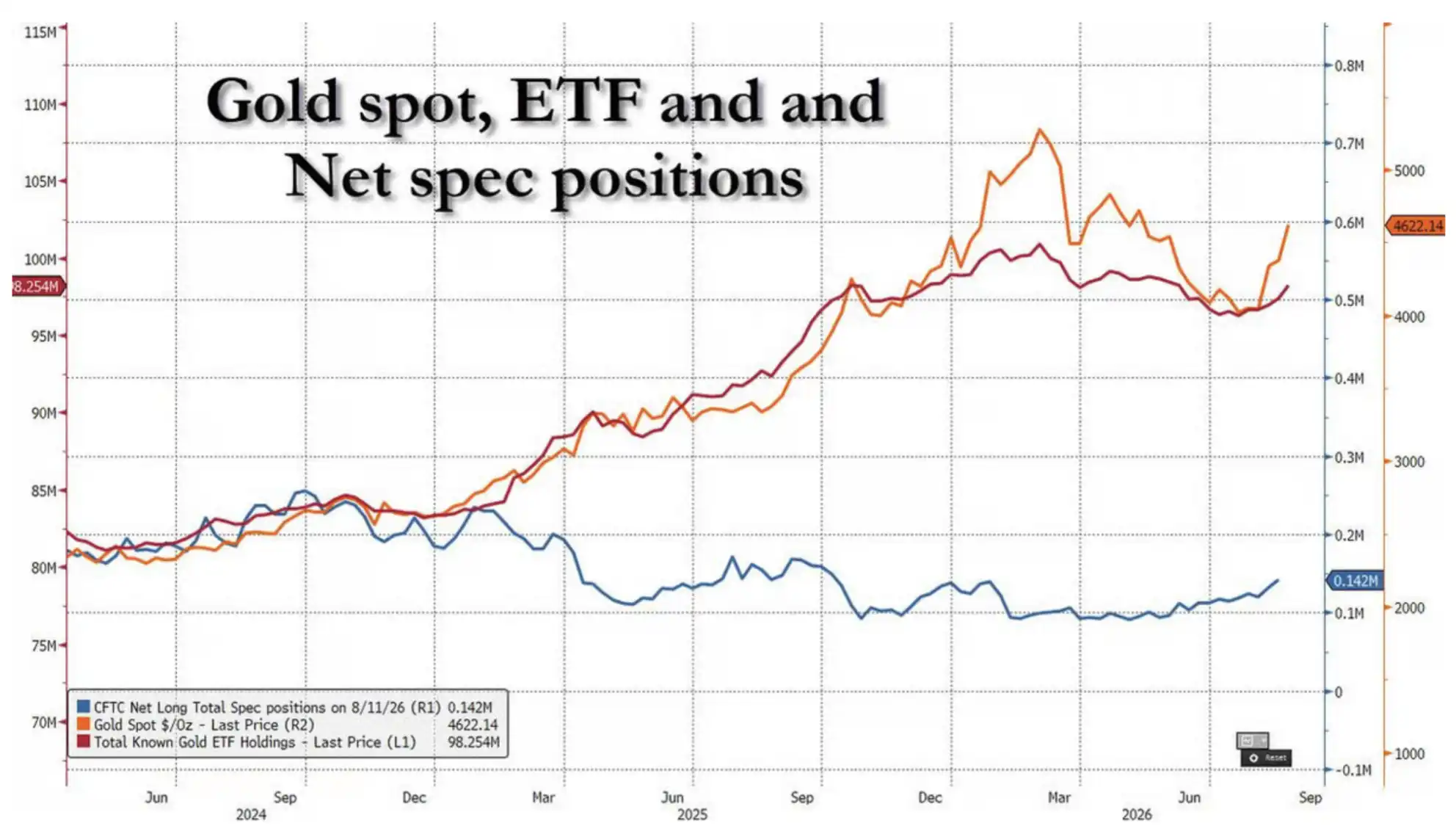
As expectations for a Federal Reserve rate hike cooled, holdings in gold ETFs and net speculative positions on COMEX began to recover, resonating with the rebound in gold prices.
It's worth noting that the $4,900 forecast did not take into account the continued rise in demand for gold call options. Goldman Sachs gold analyst Lina Thomas therefore believes that the current target price faces "significant upside risks." If Western investment demand continues to recover and resonates with central bank buying and macroeconomic policy hedging demand, traders' hedging activities near key strike prices could push gold prices significantly above $4,900.
Goldman Sachs' trading desk has also observed more aggressive fund flows. Client trading increased significantly this week, including both 3- to 6-month digital options and direct gold purchases, with targets concentrated between $4,800 and $5,500. The trading desk currently maintains a moderately high long position, while also targeting volatility, skewness, and directional risk.
It's important to distinguish here: $4,900 is Goldman Sachs' research team's year-end fair value forecast; while $4,800-$5,500 is the trading target observed by clients on the trading desk and should not be considered as Goldman Sachs officially raising its target price.
China, the central bank, and ETF buying jointly supported the market.
Before options funds entered the market, the bottom support for gold mainly came from China, the central bank, and ETF investors.
Goldman Sachs' trading desk noted that both Chinese funds and Western macro funds continued to buy gold this week, with buying accelerating further after the US Treasury expanded its long-term bond repurchase program. Some investors believe that the US Treasury's more active intervention in the supply and demand of long-term bonds may have a longer-term impact on the dollar and gold, rather than on US Treasury yields themselves.
Trading activity in the Chinese market is particularly evident. The Shanghai market recently recorded one of the top five two-day gains in the past five years, but China's total gold holdings are still about 25% below their historical high. Goldman Sachs judges that current positions have not yet reached an extremely crowded level.
Physical imports also remained high. Data shows that China's gold imports in July were 135 tons, lower than June's 173 tons and slightly lower than the monthly average of 144 tons in the first half of 2026. However, the decline was mainly due to a reduction in imports from bonded zones, while imports cleared through customs remained basically stable.
China's total gold imports have increased by 444 tons year-on-year, a rise of approximately 80%. Goldman Sachs believes this new demand is sufficient to offset the impact of announced central bank gold purchases and a slowdown in ETF inflows. CTA funds are also shifting; Goldman Sachs models show that trend-following strategies have covered their gold short positions and begun to increase long positions, with momentum indicators remaining positive.
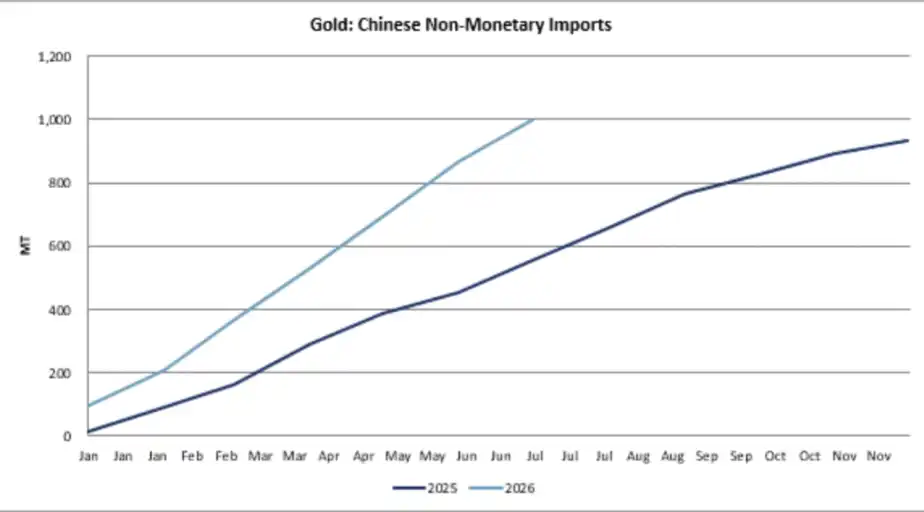
China's cumulative imports of non-monetary gold in 2026 are expected to grow significantly faster than in the same period of 2025, with physical demand continuing to support gold prices.
Central bank demand remains a key pillar of Goldman Sachs' long-term gold strategy, but official data is typically slow to be released and therefore difficult to reflect actual purchasing activity in real time.
Goldman Sachs uses UK gold exports to China as a proxy for official Chinese demand. In the second quarter of 2026, UK gold exports to China averaged 37 tons per month, significantly higher than the 15 tons per month in 2025.
Other reserve management institutions are also resuming purchases. Turkey is gradually buying back the gold it sold at the beginning of the conflict, and its swap-adjusted holdings are approximately 809 tons, close to the historical high of about 822 tons. Among the 55 reserve management institutions tracked by Goldman Sachs, only Russia is currently in a net reduction in holdings.
These figures cannot be fully equated with the real-time net purchases of central banks, but they at least indicate that the official sector's allocation trend toward gold has not yet reversed significantly.
Gold is too expensive, so funds are starting to bet on silver to catch up.
The rapid rise in gold prices has also driven some speculative demand towards silver.
Goldman Sachs trader Adam Gillard points out that when gold prices rise to higher levels, retail investors tend to turn to silver, which has a lower unit price. This substitution effect may be one of the reasons for the recent surge in silver options trading.
This week, the market saw demand for silver digital options with a three-month term and a strike price of $90/ounce. Digital options are products that pay a fixed return if the price reaches a specific level at expiration; they are typically used to bet on low-probability but highly volatile market movements.
Therefore, the more accurate meaning of "90 USD silver" is that some large clients are buying short-term options with a trigger price of $90, and it does not mean that Goldman Sachs predicts that silver will definitely reach $90 within three months. The lower implied volatility and higher option skewness make this type of tail bet attractive to some clients.
Compared to gold, silver lacks the structural demand from central bank purchases, and China is also a net exporter of silver. Therefore, the upward trend in silver prices relies more on the spillover effect from gold, the shift in retail funds, and the expansion of speculative positions, resulting in higher price volatility and lower certainty.
The current bullish sentiment in gold is built on several forces: continued central bank gold purchases, strong Chinese imports, recovering demand from Western ETFs, cooling expectations of a Fed rate hike, and options hedging amplifying the rally. A reversal of any of these factors could weaken the market.
The biggest macroeconomic risk remains a resurgence of inflation. If a rebound in inflation prompts the market to repric the Fed's rate hikes, real interest rates and the dollar could rise accordingly, and ETFs and speculative funds could withdraw from gold. At the same time, a drop in gold prices away from key strike levels will prompt traders to unhedge, turning what was originally a price-driving option mechanism into additional selling pressure, causing a more severe correction than usual.
The current change in gold prices lies in the fact that both long-term allocation demand and short-term trading funds are now pointing towards an upward trend. The target price of $4,900 corresponds to the basic scenario of a recovery in demand from central banks and ETFs, while client trading at $4,800-$5,500 and the $90 digital options for silver reflect funds betting on a more volatile tail-end rally.
What we really need to observe next is whether ETF inflows can continue, whether gold can approach its densely traded strike price range, and whether the buying power of the Chinese central bank can continue to support high prices. Options can make prices move faster, but they cannot replace the real funding needs that support market movements.
This content is for informational and educational purposes only and does not constitute investment advice related to BTCC. BTCC makes every effort but cannot guarantee the truthfulness, accuracy, or originality of the content above.