Wall Street doesn't understand Circle? Sister Wood keeps adding to her position as the price falls.
 PanewslabAuthor: Lockridge Okoth
Author: Lockridge Okoth, BeInCrypto
Compiled by: Chopper, Foresight News
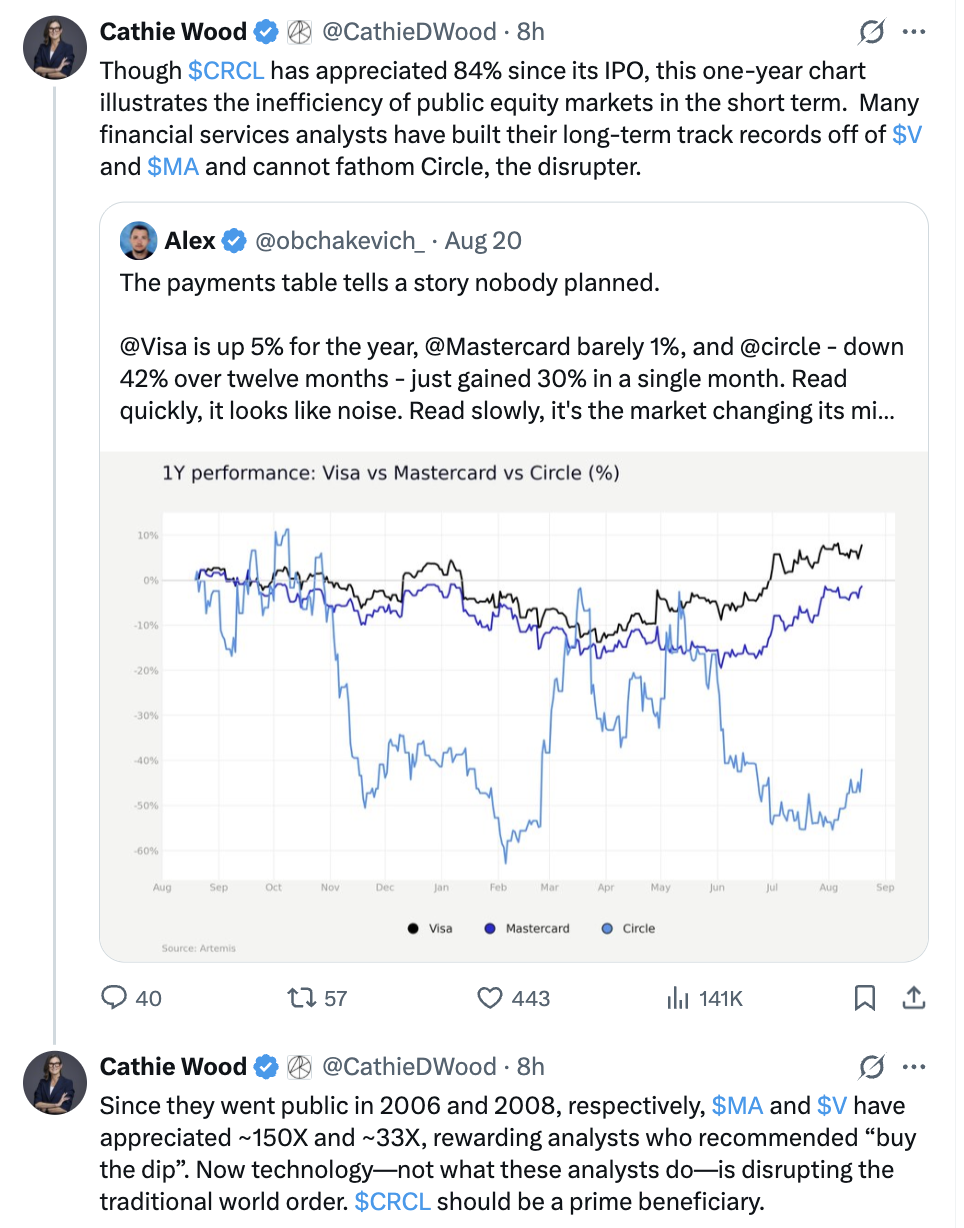
Cathie Wood, founder of ARK Invest, continued to increase her holdings in Circle's stock price despite it plummeting 42% over the past year. On Sunday, she revealed her reasons. She believes that a large number of Wall Street analysts have spent their careers at Visa and Mastercard, and therefore cannot understand Circle as a company.
Circle is the issuer of the stablecoin USDC, a digital dollar backed by reserves of cash and short-term U.S. Treasury bonds. Wood heads ARK Invest, and Circle has become one of the most heavily invested crypto assets in her flagship fund.
Wood refutes the views of Wall Street analysts
Wood made this statement in response to a chart based on Artemis data. Analyst Alex Obchakevich published the chart, indicating a shift in market perception regarding who is actually profiting from the stablecoin business.
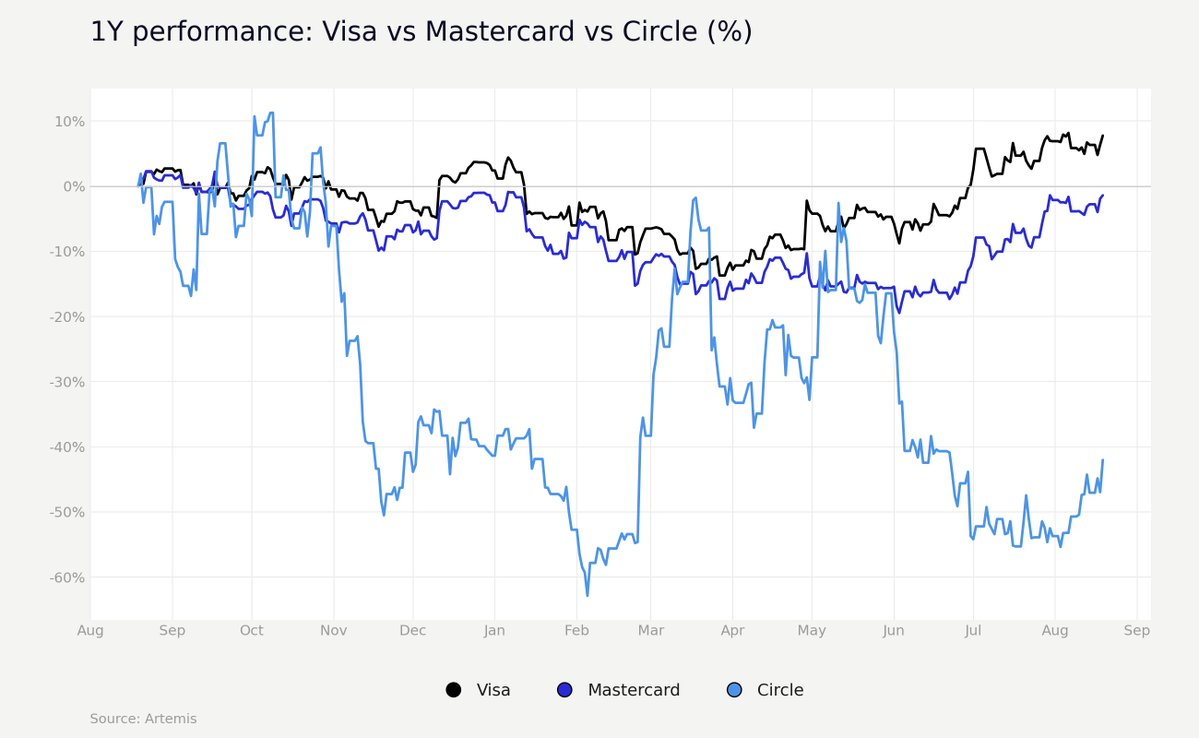
The chart shows the stock performance of three payment companies over the past year: Visa rose by about 5%, Mastercard rose by about 1%, while Circle fell by 42%.
Wood wrote on the X platform, "Although CRCL (Circle's stock code) has risen by 84% since its IPO, this one-year chart precisely illustrates the short-term inefficiency of the public stock market. Many financial services analysts' long-term performance is built on studying Vias and Mastercard; they cannot understand a disruptor like Circle."
She then cited historical examples, noting that Mastercard's stock price has increased approximately 150 times since its IPO, while Visa's has increased approximately 33 times.
"The analysts who advised clients to buy these two companies when the price was low seem to have had excellent foresight. But now, it's technology, not analysts' expertise, that's reshaping the payments industry, and Circle deserves to grow."
The historical analogy is valid, but there is a discrepancy in one piece of data.
The percentage increase figures for the two traditional payment giants cited by Wood have been verified and are largely accurate.
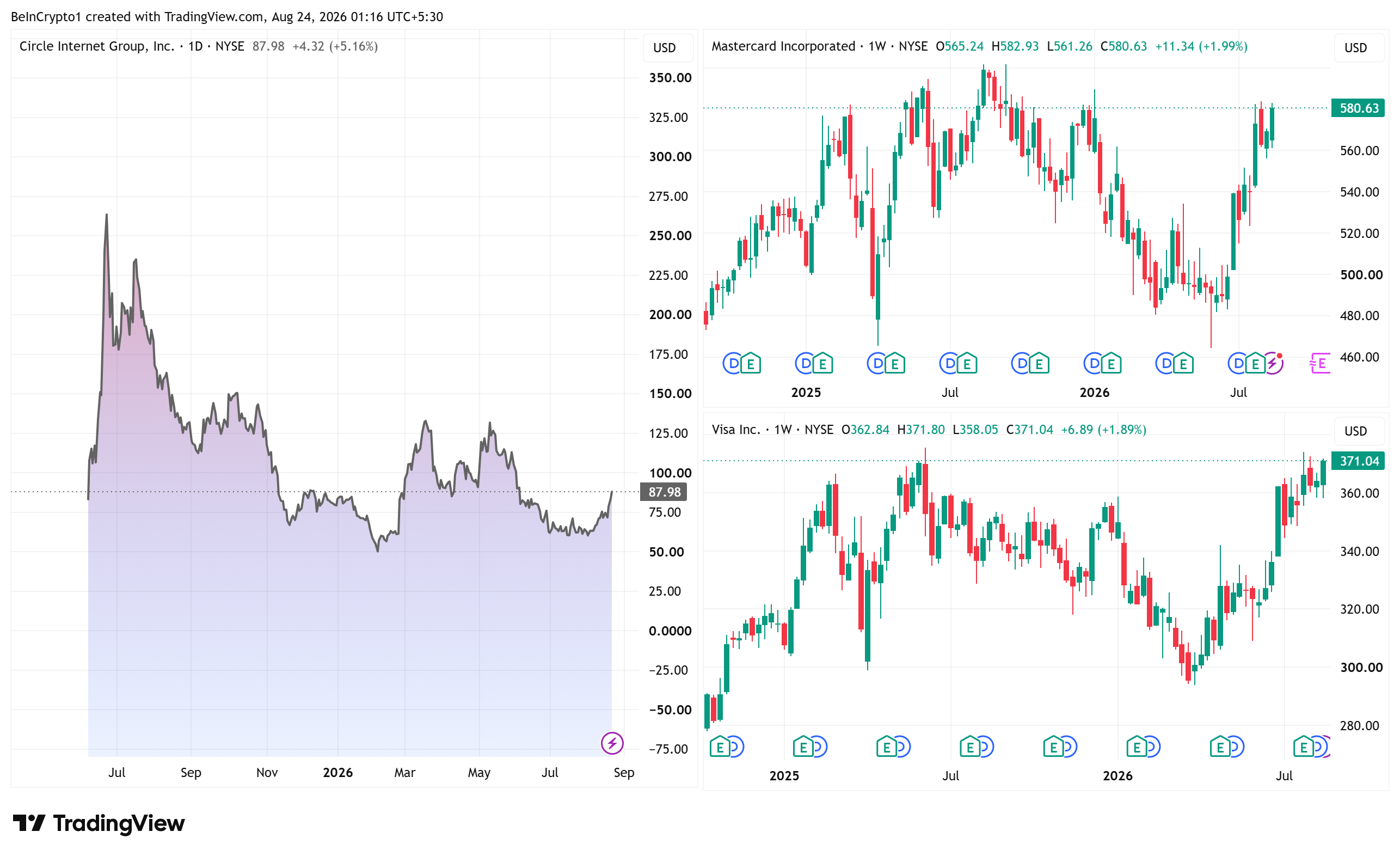
Mastercard's IPO price in 2006 was $39, followed by a 1-for-10 stock split, translating to $3.90 per share. Compared to last Friday's closing price of $580.63, this represents an increase of approximately 149 times.
Visa's IPO price in March 2008 was $44. In 2015, it completed a 1-for-4 stock split, adjusting the share price to $11. Last Friday's closing price was $371.04, representing an increase of approximately 34 times. Wood's calculations in this part are correct.
However, her data regarding Circle is incorrect. Circle went public in June 2025 with an offering price of $31, and closed at $87.98 last Friday, representing an actual increase of approximately 184%, not the 84% she stated.
Wall Street has significant disagreements regarding Circle's valuation.
The fact that Wall Street analysts are not ignoring Circle weakens some of Wood's arguments. Of the 21 analysts covering the stock, 11 have a strong buy rating, 2 have a buy rating, 5 have a hold rating, and 3 have a sell rating.
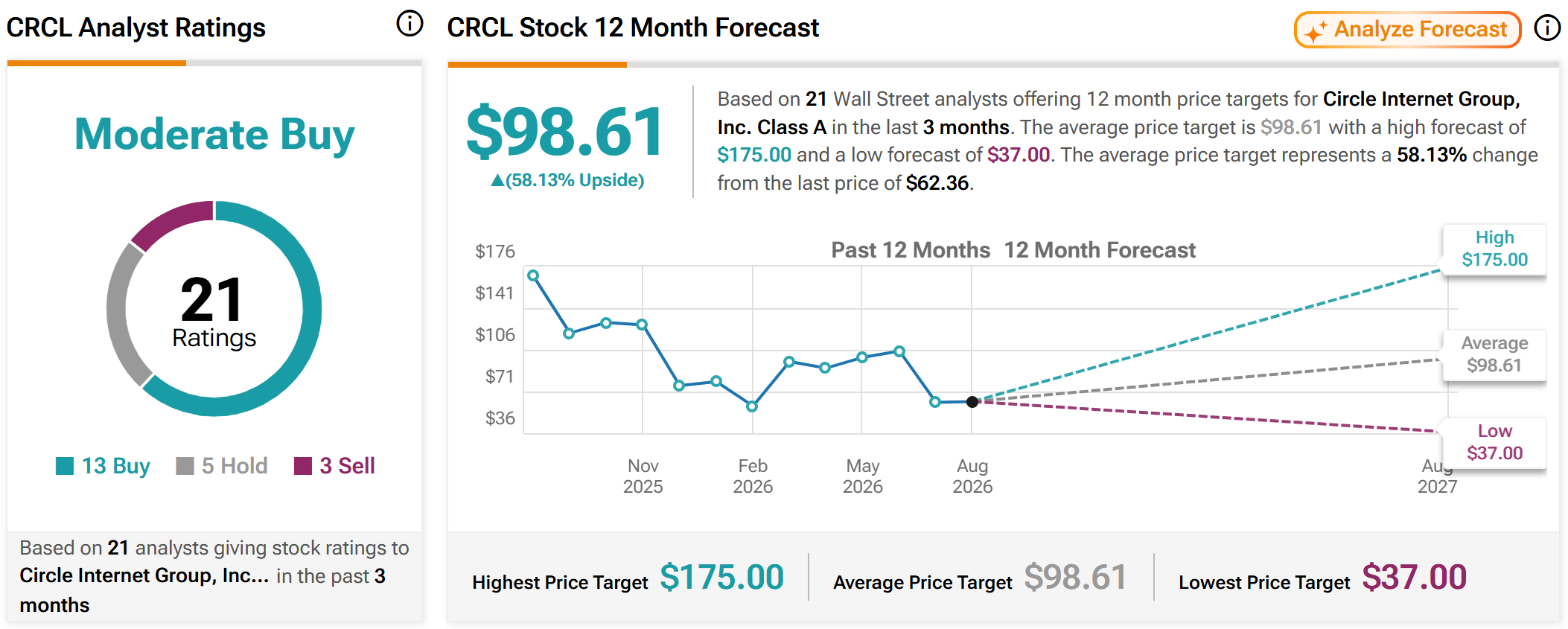
The differences in the target prices given by various analysts for CRCL are even more astonishing, with the most optimistic target price being $173 and the most pessimistic target price being only $37. The target prices for the same company on the same day differed by a factor of 4.7, and the average target price from analysts was $98.61.
For mature payment networks, analysts would never have such a wide-ranging disagreement. There is no unified valuation framework for Circle. A large portion of Circle's revenue comes from reserve interest, which shrinks as interest rates decline; the remaining revenue is highly dependent on the adoption rate of stablecoins.
Circle's financial report also confirms this contradiction. The Q2 2026 financial report released in early August showed that the company's revenue grew by about 37% and it had already achieved profitability, but its market value still fell by 30%.
The competitive landscape is becoming increasingly uncertain. Circle is building its technology stack on its own Arc blockchain; meanwhile, the OpenUSD consortium, comprised of more than 140 institutions, is also vying for the same underlying payment platform.
Wood did not hedge. Last Friday, ARK's flagship fund held 3,931,968 Circle shares, worth $329 million, representing 5.14% of the fund's portfolio, a larger proportion than Coinbase. Future developments may prove Wood right. However, the current starkly different target prices of $37 and $173 precisely illustrate one thing: the market has not yet reached a consensus on Circle's true value.
This content is for informational and educational purposes only and does not constitute investment advice related to BTCC. BTCC makes every effort but cannot guarantee the truthfulness, accuracy, or originality of the content above.