AI Capital Hub? Nvidia FY2027 Q2 Earnings: Growth Still Accelerating, AI Supercycle Enters Multi-Track Phase

We had grown accustomed to a gradually solidifying narrative: AI infrastructure spending was shifting from "buying chips" to power, cooling, and cloud providers' own custom silicon, and Nvidia, as the most expensive link in this chain, was seeing its data center growth momentum slowly diluted. Over the past few quarters, bears repeatedly used "high base" and "peak growth" to pre-set Nvidia's ceiling, compounded by the accelerating push of hyperscalers' in-house ASICs and persistent doubts about whether the AI capex cycle has peaked, causing market expectations for Nvidia to gradually converge.
Ahead of this earnings report, the consensus estimate from 41 analysts was only 1.2% above the company's own guidance, almost signaling that Wall Street merely wanted to confirm Nvidia's data center growth had not stalled. Nvidia had beaten expectations for five consecutive quarters, but the magnitude of each beat was narrowing, leading the market to increasingly wonder whether this curve would eventually reach its inflection point.
After the U.S. market close on Aug. 26, Nvidia delivered a report card that shattered all expectations. The data center business remained the absolute growth engine, with both revenue and Q3 guidance far exceeding consensus. Jensen Huang's first sentence in the earnings statement set the tone for the quarter: "AI has reached its inflection point. It is doing useful work. Its tokens are productive and profitable. Now, compute is revenue."
A Year of Transition from Supplier to Capital
Over the past year, Nvidia has gradually become a major AI infrastructure investment company. Gaming GPUs have become a footnote in its history, and being a data center supplier in the AI industry chain is just one of its many roles. On Sept. 18, 2025, Nvidia invested $5 billion in Intel as a strategic move, a rare investment in a competitor that made the relationship between the two old rivals even more nuanced. This came just one month after the U.S. government acquired about 10% of Intel for $8.9 billion. The combination of government stake and Nvidia's capital injection ignited market imagination about the legacy chip giant's return to the table, sending Intel's stock soaring 23% that day, its biggest one-day gain since 1987. On Dec. 29, 2025, the deal officially closed, with Nvidia purchasing over 214.7 million Intel shares through a private placement.
In the eleven months since, Nvidia has embarked on an almost uncapped investment spree. On Sept. 22, 2025, Nvidia committed up to $100 billion to OpenAI, just four days after the Intel investment. In Jan. 2026, Nvidia invested $10 billion in xAI, and in Jul. 2026, it increased its commitment to OpenAI, bringing the total to $250 billion. Most recently, on Aug. 20, Nvidia completed its most structurally complex investment deal, doing three things simultaneously: first, paying $6 billion to license Poolside's AI model Model Factory; second, investing an additional $1 billion at a $12 billion pre-money valuation; and third, extending job offers to over 100 Poolside employees, who will join Nvidia's Nemotron open-source model project.
It can be said that Nvidia has once again extended its capital influence into a frontier AI model company. Notably, Poolside specifically stated in a letter to investors: this is not an acquisition, nor an acqui-hire; the company will remain independent, and the three co-founders will stay on. If it were to continue competing independently in open-source model development, it would need more Nvidia hardware than realistically possible. In other words, the scarcity of compute ultimately pushed this company into Nvidia's embrace.
The continuous stream of capital moves is blurring the boundaries of the entire AI industry: supplier, shareholder, creditor, customer—these once clearly distinct roles now coexist in Nvidia, which sits in multiple seats at the table. This capital loop also makes the "circular financing" criticism more concrete. Nvidia invests in customers, customers use that money to buy Nvidia GPUs, and that money returns to Nvidia's financials as revenue; revenue growth drives the stock price up, and a higher stock price gives Nvidia more capital to invest in the next customer. The oft-repeated "Nvidia invests $100 billion in OpenAI, and OpenAI pays it back to Nvidia" refers to this cycle. More specifically, Nvidia, Microsoft, and Oracle are all investing in AI developers, who then become major buyers of their cloud services, causing the same capital to circulate among multiple companies and be recorded as revenue at each stop.
If the ultimate commercial returns of AI infrastructure fail to materialize in time, this seemingly efficient capital cycle will break at its weakest link. The risk is that every link in this chain is built on the assumption that "the next link can continue to pay": whether OpenAI can earn back data center costs with its models, whether cloud providers can rent out compute, whether AI startups can find a profitable model before burning through funding. If any node's revenue falls short—for example, customers cut purchases—Nvidia's orders will decline, leading to a write-down in the book value of its equity investments, and the funds and guarantees previously deployed to support these customers could turn into potential bad debts.
The defense's logic is this: these investments are incremental and tied to actual deployment milestones. Take the OpenAI deal: each gigawatt deployed triggers a new investment—$1 billion at the first gigawatt, with subsequent tranches priced at OpenAI's valuation at the time. This means if deployment doesn't actually happen, the investment doesn't happen either; there is no room to "manufacture revenue out of thin air."
This has been the market's ongoing debate over Nvidia's capital strategy for months, and concerns about AI infrastructure leverage have even risen to the bond market. In 2026 to date, hyperscalers and related entities like Nvidia have issued $225 billion in bonds, a staggering 973.7% year-over-year increase! Whether or not these risks materialize, they will be stumbling blocks on Nvidia's stock price ascent.
Another Quarter of Beating Expectations
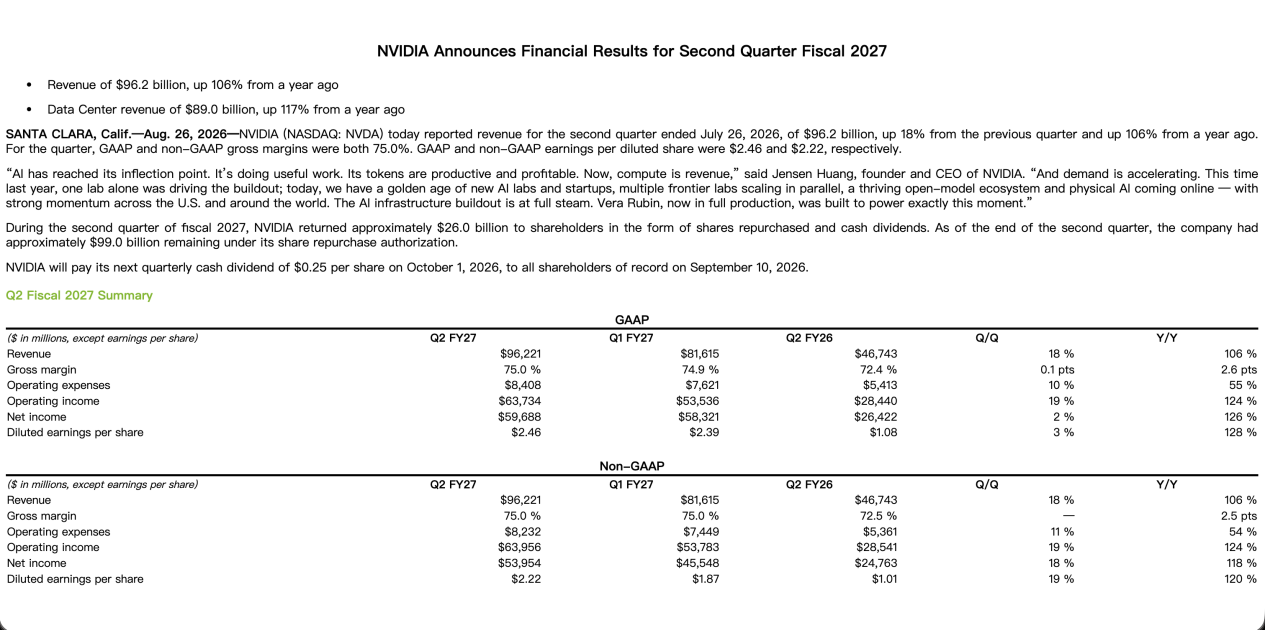
Nvidia's FY2027 Q2 earnings were flawless by any traditional standard. Revenue was $96.221 billion, up 106% year-over-year and 18% quarter-over-quarter—the highest year-over-year growth since Q2 of fiscal 2025. It beat the midpoint of the company's own guidance by $5.2 billion and exceeded analyst expectations by over 4%. Adjusted EPS was $2.22, up 120% year-over-year, beating expectations by nearly 6%. Non-GAAP operating profit was $63.956 billion, up 124% year-over-year, corresponding to an operating margin of about 66%, higher than the $61.19 billion analysts expected. Operating expenses were $8.232 billion, below the expected $8.32 billion—revenue beat while cost control was also stronger than expected. However, after the earnings release, Nvidia's stock initially rose slightly in after-hours trading, then quickly turned negative, falling as much as 4%.
Data center revenue was $89 billion, up 117% year-over-year and 18% quarter-over-quarter, above the $85.8–85.9 billion analysts expected, accounting for about 92.5% of total revenue. Hyperscaler revenue was $48.71 billion, far exceeding the expected $43.55 billion—a beat of nearly $5.2 billion. AI cloud, industrial, and enterprise revenue was $40.31 billion, below the expected $41.96 billion. Edge computing revenue was $7.2 billion, up 27% year-over-year and 13% quarter-over-quarter, above the expected $6.61 billion. This structure shows that the beat was primarily driven by hyperscalers, while the pace of expansion in enterprise, industrial, and some AI cloud demand was slightly below market expectations.
This is a signal that warrants caution. The market (including many analysts) had tended to believe Nvidia's customer base was rapidly diversifying and enterprise demand was taking over, but this quarter's data shows the four major cloud providers remain the absolute primary growth engine, and enterprise-side volume has not yet fully caught up. Compute & Networking revenue was $88.3 billion, also above the expected $84.69 billion, reflecting the same logic: large-scale cluster construction remains the core form of current demand.
On gross margin, Q2 GAAP and non-GAAP gross margins were both 75.0%, flat from the previous quarter and up about 2.5 to 2.6 percentage points year-over-year. Maintaining a 75% gross margin with revenue approaching $100 billion and a highly strained data center supply chain shows Nvidia's pricing power in the AI accelerated computing market remains extremely strong. However, Q3 guidance is 74.0%, down about 1 percentage point from Q2 and below the 75% analysts expected. There are various drivers behind this, including yield fluctuations and cost disruptions typical in the early ramp of new platforms, and rising supply chain costs—such as HBM, advanced packaging, and substrates—which share the same root cause as Apple's earlier memory crisis.
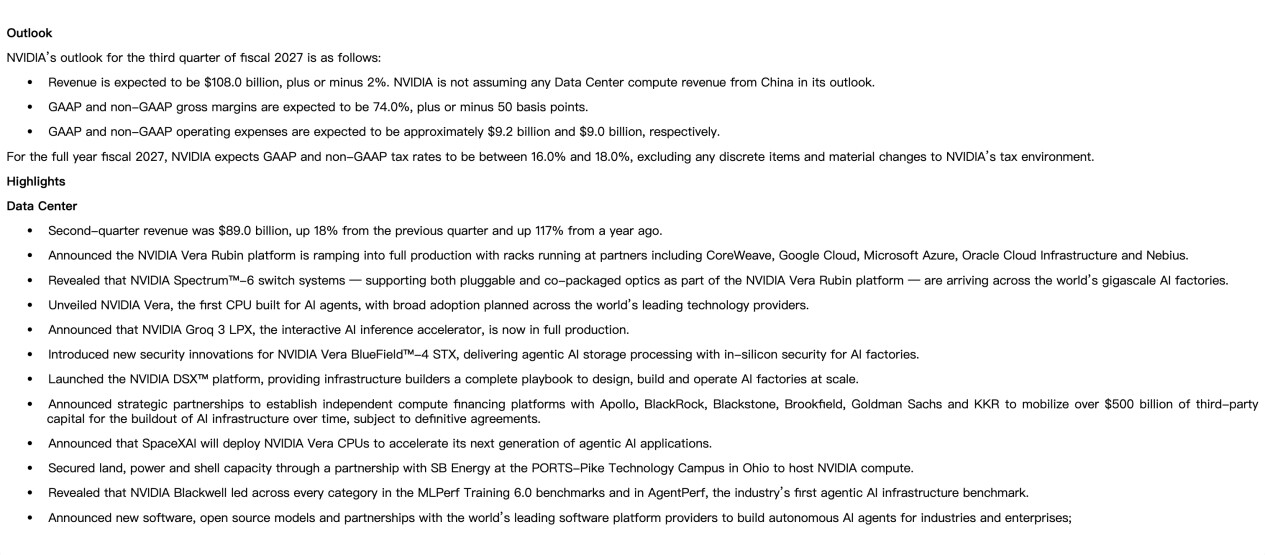
Changes in product mix may also make this decline the start of a longer-term trend. As the share of full rack system deliveries increases, the cost structure differs from selling GPUs alone. The most important product signal in the earnings report is that Vera Rubin is accelerating into full production. Racks are already running at partners including CoreWeave, Google Cloud, Microsoft Azure, Oracle Cloud Infrastructure, and Nebius. This detail matters—it means Rubin is already operating in real customer data centers. This new system-level architecture, combining Vera CPUs, Rubin GPUs, Spectrum-6 networking, BlueField, security, storage, software toolchain, and the DSX platform, will be the core pillar of its growth narrative in the coming quarters. Nvidia repeatedly uses the term "AI factory" to emphasize that it supplies not chips but complete systems for building, operating, and scaling AI compute infrastructure. This is crucial for the valuation narrative: one of the market's biggest concerns was whether Nvidia could smoothly transition to the next-generation platform after peak Blackwell demand. Rubin's smooth ramp directly extends the visibility of the growth cycle. But product transitions also bring short-term uncertainty—new platform ramps typically involve changes in supply chain, delivery schedules, customer acceptance, and cost structure, which may be one reason for the lower Q3 gross margin guidance.
From this earnings report, it's clear that the quality of Nvidia's core business growth is real, possibly even better than the headline numbers. Excluding $7.77 billion in equity investment gains, non-GAAP net income was $53.954 billion, with an operating margin of 66%, indicating that the core business's profitability is extremely strong and not embellished by investment gains. Cost control was also better than expected; while ACIE missed by $1.6 billion, indicating that customer diversification is progressing more slowly than the market had imagined. This means the risk of over-reliance on the four major cloud providers has not eased in the short term. Declining gross margin, sharply reduced free cash flow, surging accounts receivable, and an expanding investment portfolio paint a picture of a company using a heavier balance sheet and longer cash conversion cycle to support faster growth.
AI Narrative, Competitive Landscape, and Supply Chain: Three Parallel Lines
Nvidia's fundamentals remain solid, but the three pillars supporting them are each undergoing changes. First, the AI narrative. We know Wall Street's focus on the AI investment cycle has shifted from "compute expansion" to "return validation." Jensen Huang's long-term view is that AI infrastructure spending could reach $3 trillion to $4 trillion annually by the end of the decade, driven by the widespread adoption of agentic AI—not simple Q&A bots, but AI systems that can make continuous decisions, invoke tools, and execute multi-step tasks.
This judgment itself is not controversial. The disagreement lies in the timeline and return path. No one today is debating whether investing in AI is investing in the future; cash flow and return urgency are the market's focus. As mentioned earlier, risks are being amplified in the bond market, and the real, rapid realization of input-output ratios is the core issue for the entire AI industry chain—and the ultimate test of its business model.
Additionally, the accelerating custom ASIC track will continue to erode Nvidia's ceiling in the AI chip market. Data-wise, custom silicon's share of the total AI chip market is expected to rise from 20.9% in 2025 to 27.8% in 2026—the fastest-growing competitive threat in the AI chip market. Google TPU, Amazon Trainium, Meta MTIA—the three major cloud providers are all accelerating in-house chip development. Broadcom, one of the biggest beneficiaries in this space, has reached a quarterly AI revenue run-rate of about $10.8 billion.
What makes this threat unique is that its driver is not performance but bargaining power. Cloud providers know their in-house chips cannot match Nvidia in generality and software ecosystem. But they are willing to sacrifice some performance to reduce dependence on a single supplier, gain supply chain autonomy, and have leverage in procurement negotiations. This is why this thread won't overturn Nvidia's position in the short term, but needs continuous tracking in the long term. The key is not whether TPU can beat Blackwell, but how much of their capex cloud providers are willing to divert away from Nvidia.
On the supply chain front, the fact that data centers are in short supply—across their entire lifecycle—shows no signs of easing. The tone for the year was set in the Q1 earnings report. Nvidia raised total supply to $145 billion in Q1, with management explicitly stating they are not immune to supply challenges but are confident in supporting customer growth. He expects Nvidia to remain supply-constrained throughout Vera Rubin's lifecycle.
This statement can be interpreted in two ways, with completely different implications for investors. For bulls, demand is so strong that chipmakers cannot keep up with capacity, and supply shortages mean solid pricing power and extremely high order visibility. But supply shortages are also a marketing narrative—they continuously create a sense of scarcity and urgency, prompting customers to lock in orders early and avoid waiting. Whichever interpretation holds, the supply chain—especially TSMC's CoWoS advanced packaging capacity and HBM memory capacity—remains the most critical variable determining Nvidia's growth ceiling.
This also explains why, in this AI hardware cycle, upstream suppliers are in the most certain beneficiary positions: TSMC controls advanced process and packaging, Micron and SK Hynix control HBM capacity, and their capacity allocation determines how much Nvidia can ship, which in turn determines the revenue ceiling of the entire AI infrastructure chain.
Putting these three threads together—business fundamentals, earnings expectations, and the three undercurrents—a clear structure emerges: demand, capacity, and capital are the core variables sustaining the system's growth.
Nvidia is still Nvidia. Having completed the leap from chip supplier to builder of the compute world, it is now laying the groundwork for an era that has not yet fully arrived. The growth story continues, and it still stands in the brightest spotlight of this era. But the brighter the spotlight, the longer the shadow it casts. The unresolved questions it leaves for the market will become one of the most important main threads for U.S. stocks in the coming quarters.
This content is for informational and educational purposes only and does not constitute investment advice related to BTCC. BTCC makes every effort but cannot guarantee the truthfulness, accuracy, or originality of the content above.