The Second Form of Tokenized US Stocks Is Loading: Which Targets Are Worth Watching?
 BlockbeatsAuthor: Cookie
Regarding US stock memes, BlockBeats has discussed extensively and predicted early on that this narrative would have huge potential:
At the same time, we have been thinking about the development direction of US stock memes. Just as during the previous AI meme craze, when people first speculated on AI memes like $GOAT and then moved to AI frameworks like ElizaOS, US stock memes may only be the first form of on-chain tokenized US stock speculation.
Some approaches have already emerged in the past, such as applying the on-chain card-drawing mechanics from Pokémon to tokenized US stocks, where opening US stock card packs could yield higher-value tokenized US stock assets. Or holding a certain asset (token or NFT), with fee income used to purchase tokenized US stocks and airdrop them to holders.
These approaches are actually somewhat lacking and have not provided the imaginative space for composability that bringing US stocks on-chain could offer. The reasoning is that using meme coins to drive on-chain US stock trading volume is interesting and has not yet reached its ideal ceiling, but the ultimate goal of bringing US stocks on-chain is to make stock assets a truly global asset on-chain, capturing users worldwide to trade US stocks around the clock on-chain.
A completely new form of stock trading, where each chain effectively becomes a new stock trading platform—that is the ultimate goal. From this ultimate goal perspective, the current DeFi infrastructure for stocks or RWA assets on various chains is still very underdeveloped.
The surge of NetNet $NET has shown us some early signs of RWAfi gaining momentum on Robinhood's chain.
NetNet: The Rebirth of OHM on Robinhood
Nowadays, when mentioning OlympusDAO, the star project from the DeFi Summer era, many people may not be familiar with it. So rather than saying it is a project that borrows from the OlympusDAO v1 architecture, it is better to explain from scratch what this project actually does.
Let's look directly at the statistics on the NetNet official website:
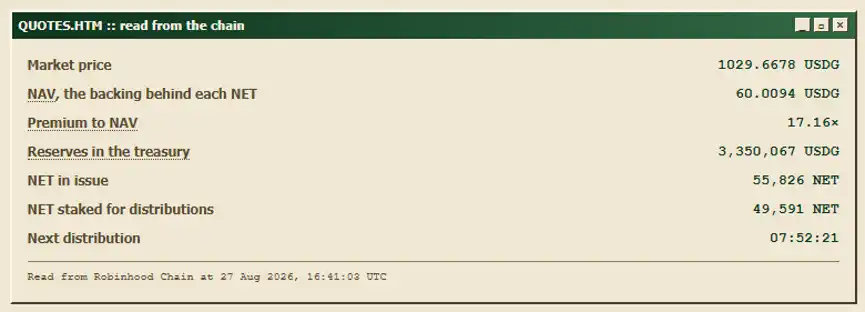
Market price is the current price of $NET, about $1,030 per token.
NAV is the asset backing value per $NET, meaning that the current $NET, valued at about $1,030, is actually backed by about $60 in real value.
The next two data points are the premium multiple and total reserves. The premium multiple is 17.16x, and total reserves are about $3.35 million.
This is the starting point for understanding NetNet's mechanism: why would anyone pay a 17x premium for $NET?
The reason is simple: people believe that NetNet's treasury can earn more money, and this premium is essentially a bet on the future.
NetNet's ways of making money include:
- USDG yield. Depositing idle cash into the on-chain lending market Morpho to earn yield, with up to 70% of the treasury's USDG deployable and at least 30% liquidity retained; income belongs to the treasury.
- $NET trading fees. A 5% fee is charged on both purchases and sales. After 30 days from launch, this 5% trading fee goes entirely to the treasury; before 30 days, part of it is used for project operating expenses.
Of course, it has many other products, but for some reasons they are not currently counted in NAV; we will discuss them later.
So, the value proposition of $NET is the opposite of many project tokens. For example, the token of Pons, the launchpad on Robinhood, needs to prove itself with its own revenue and market share; people are buying its current revenue-generating ability. $NET is the opposite—it is a bet that the treasury behind this project will grow larger and larger.
Then, NetNet also regulates this expectation. If panic selling or extreme market conditions drive NAV particularly low, the protocol will buy back $NET and burn it. If $NET rises excessively, driving NAV particularly high, the protocol will mint additional $NET and sell it to the market, giving the treasury more USDG.
Holders can stake $NET to get $sNET, which is distributed every 8 hours according to rules. This staking yield actually fluctuates based on NAV: the higher the premium of $NET price relative to NAV, the more new $NET is distributed. When the market price is below or equal to NAV, no new issuance occurs to prevent further dilution of value.
Because of this staking mechanism, NetNet's two-sided spiral is amplified. If the staking rate is high, the circulating supply of $NET is low, and the price can pump quickly. If income falls short of expectations and bearish sentiment is strong, unstaking and dumping can also happen quickly.
Beyond this core gameplay, its relationship with US stock assets includes many US stock-related features:
- Real World Bonds. Users subscribe to $NET at a discount and receive the subscribed $NET gradually over 2 days, while the project uses this money to buy US stocks. This discount is about 11.2% of the $NET market price. The best case is that $NET rises and stock prices fall during these two days.
- SpaceX Invaders/MSFT Flight Simulator: Essentially probability games that can be played like arcade games, with bets and rewards in $SPCX/$MSFT (after starting with USDG, the system automatically purchases the corresponding US stocks). There are also TURBO and TURBO BLACKJACK, which are similar—small games with tokenized US stocks as bets and rewards, with some playability.
The reason this part is not counted in NAV is that US stock assets are currently independently custodied by the team, not in a permissionless treasury. There is no automatic, contract-based path to use stock value for $NET buybacks, redemptions, or floor support. These rules are not hardcoded or automatically executed; they depend on the team's willingness and actual planning, so this income is unrelated to NAV.
This coin has surged recently, mainly due to Ansem giving it a direct shill. Essentially, this project is an optimized OHM combined with a US stock gambling mini-game platform. You might think that the US stock gambling gameplay mentioned at the beginning of this article is no different. Indeed, the current main narratives are more due to the price increase, such as "not trading US stocks, but gamifying US stocks." The main driving force is still a self-reinforcing flywheel and celebrity shilling, rather than real innovation in US stock DeFi.
So let's look at another new project, Down to Finance, whose current price performance is far behind NetNet. This one better fits our requirements for US stock asset DeFi gameplay.
Down to Finance: Build Your Own OlympusDAO with Any Asset
This project's mechanism is very complex. Many discussions categorize it as a "decentralized index fund launchpad," which is intuitive but not complete.
Down to Finance supports packaging various assets into a strategy token, called DETF (Decentralized ETF). The underlying asset portfolio can include tokenized US stocks, stablecoins, Uniswap V4 LP positions, Morpho lending positions, and other types of vaults/assets.
In other words, anyone can launch an index fund on this platform. This index fund is not just about including tokenized US stocks; it also includes the strategic assets we mentioned above, such as Uniswap V4 LP positions, Morpho lending positions, and vaults. Simply put, your on-chain strategy can itself be used as a building block, creating a recursive structure where you can operate tokens that operate other tokens.
Each DETF itself can be considered an OlympusDAO. When we introduced NetNet above, its architecture was 1 protocol, 1 treasury, and 1 token ($NET). In Down to Finance, it becomes 1 protocol (launchpad), countless DETFs (treasuries), and each treasury's own reserves and strategies.
This is why I view it as a "decentralized OlympusDAO launchpad."
The default launch mode "Policy" for each DETF is described as follows:
When the price is significantly above the target price, minting occurs; when significantly below, burning occurs. Near the target price, minting and burning operations pause. You can still trade in the Uniswap V4 pool.
This supply adjustment mechanism follows the same principle as NetNet's regulation mentioned earlier.
Each "fund" can be bought and sold, and you can provide single-sided liquidity. The protocol automatically mints DETF shares corresponding to the single-sided deposit and adds them to the fund's reserves. If you provide single-sided liquidity, you receive an NFT certificate. Each time the fund mints new shares, holders of this NFT receive a portion of the newly minted shares.
Of course, the above is still a somewhat rough introduction. Because it is really complex, let's summarize in one sentence: "Asset portfolio launchpad, where each combined asset (fund) is an OlympusDAO," and the protocol's revenue is used to buy back $DTF.
Ansem supports $NET, and bonkguy supports $DTF. Besides bonkguy's support, Down to Finance's dev is @NCyotee, the original developer of Olympus, which is also a positive sign. Of course, risks exist: the contract is still under audit, and only the frontend is live. Historically, protocols with mixed assets are more prone to security issues.
But if all features can be implemented without a hitch, this project, in my view, has a higher ceiling. Returning to the beginning, if the chain can become a new RWA asset trading platform, the supporting infrastructure needs to keep up. People will trade stocks, buy funds, and also adopt other high-yield investment strategies.
Only by making RWA assets composable on-chain will the advantages of the chain be fully realized.
This content is for informational and educational purposes only and does not constitute investment advice related to BTCC. BTCC makes every effort but cannot guarantee the truthfulness, accuracy, or originality of the content above.