HIP-4 Battle Begins: Who Will Become the Next trade.xyz?
 Odaily
Original | Odaily News (@OdailyChina)
Author | Azuma (@azuma_eth)

On Aug. 29, Outcome, a prediction market project in the Hyperliquid ecosystem, officially announced that it had completed deployment on the Hyperliquid mainnet as the first permissionless HIP-4 Builder project. To secure this entry ticket, the Outcome team staked 500,000 HYPE as collateral, worth approximately $42 million at the time.
Outcome's launch marks Hyperliquid's first shot in permissionless HIP-4 deployment, and also signals that Hyperliquid's expansion into the prediction market sector has officially entered the Builder era.
With leading platforms like Kalshi and Polymarket already commanding significant user bases and market mindshare, Hyperliquid clearly cannot catch up by simply creating a few markets on its own. The path it has chosen is to open up its core strengths—on-chain trading, order books, margin, and settlement infrastructure—and delegate the tasks of finding users, operating products, and creating markets to third-party teams within the ecosystem.
This is the same path that HIP-3 once took. Today, custom markets created by third-party Builders have become an important part of the Hyperliquid ecosystem, with trade.xyz standing out as one of the most representative success stories.
Now the same question confronts HIP-4: When Hyperliquid opens the prediction market stage to third-party players, who will be the first to find users, establish liquidity, and ultimately become the trade.xyz of prediction markets?
Aside from Outcome, which has already launched, teams like Unit, Skew, and trade.xyz have also expressed intentions or begun positioning for HIP-4. A battle for the entry point, liquidity, and users of Hyperliquid's prediction markets has now begun.
What is HIP-4? (Skip if familiar)
In simple terms, HIP-4 is Hyperliquid's "Outcome Markets" mechanism, which allows users to trade on the outcome of future events.
Taking the simplest binary market as an example, users can trade on "whether something will happen." If the final result is "yes," the contract settles at 1; if "no," it settles at 0. The first markets launched on the Hyperliquid mainnet were intraday binary contracts related to BTC prices, where users could trade on whether BTC would be above a specified price at a certain time.
From a product perspective, this makes HIP-4 naturally capable of supporting a wide range of trading scenarios such as prediction markets and binary options. However, one of the biggest differences from platforms like Polymarket is that HIP-4 does not attempt to build a standalone prediction market; instead, it is built directly on Hyperliquid's HyperCore trading infrastructure, sharing the underlying trading and settlement system with existing spot and perpetual contracts.
Permissionless deployment is the most critical change in the next phase of HIP-4. In the future, validators will no longer need to review each specific event market individually. Instead, they will first approve standardized templates, and third-party Builders can create specific markets within these template frameworks, sharing fee revenue with Hyperliquid. As the cost of obtaining this permission, deployers need to stake 500,000 HYPE (same as HIP-3), with a 6-month lock-up requirement, and bear corresponding responsibility for the normal operation and settlement of the markets.
In other words, Hyperliquid's goal is not just to become the next Polymarket itself, but rather to build a set of underlying trading infrastructure for prediction markets, allowing different teams to compete on the same foundation.
HIP-3 has already proven that this model can cultivate trade.xyz; now it's HIP-4's turn, and new Builders are already entering the arena.
Outcome: First Mover Advantage
As the first team to complete deployment, Outcome is clearly the fastest-moving player in the HIP-4 ecosystem.
As early as May this year, Outcome publicly stated that it had self-raised 500,000 HYPE; and after HIP-4 permissionless deployment opened, it quickly announced that it had become the first team to deploy markets on the mainnet. According to the Outcome team, these 500,000 HYPE are staked as collateral, providing over $42 million in economic security for market integrity.
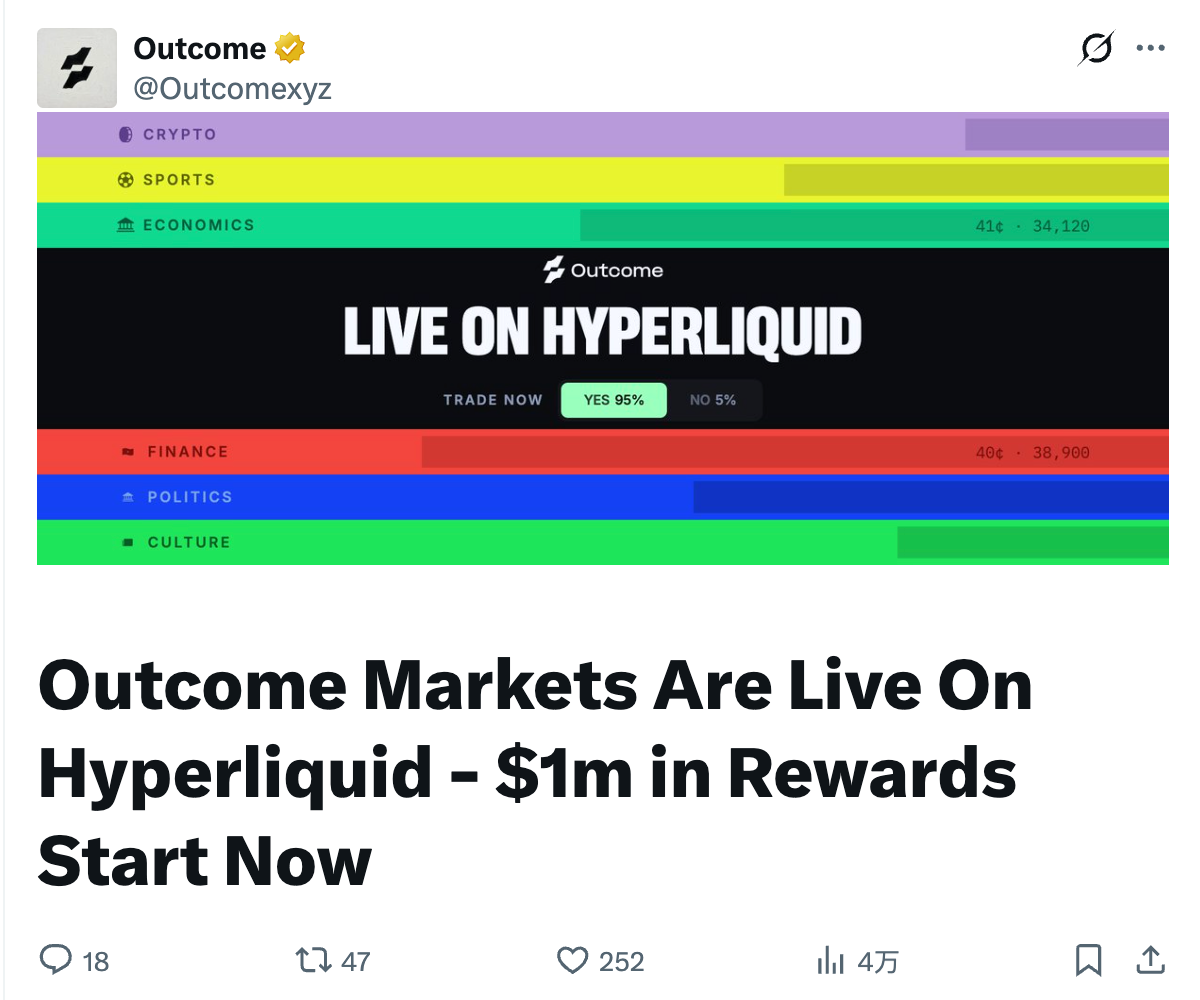
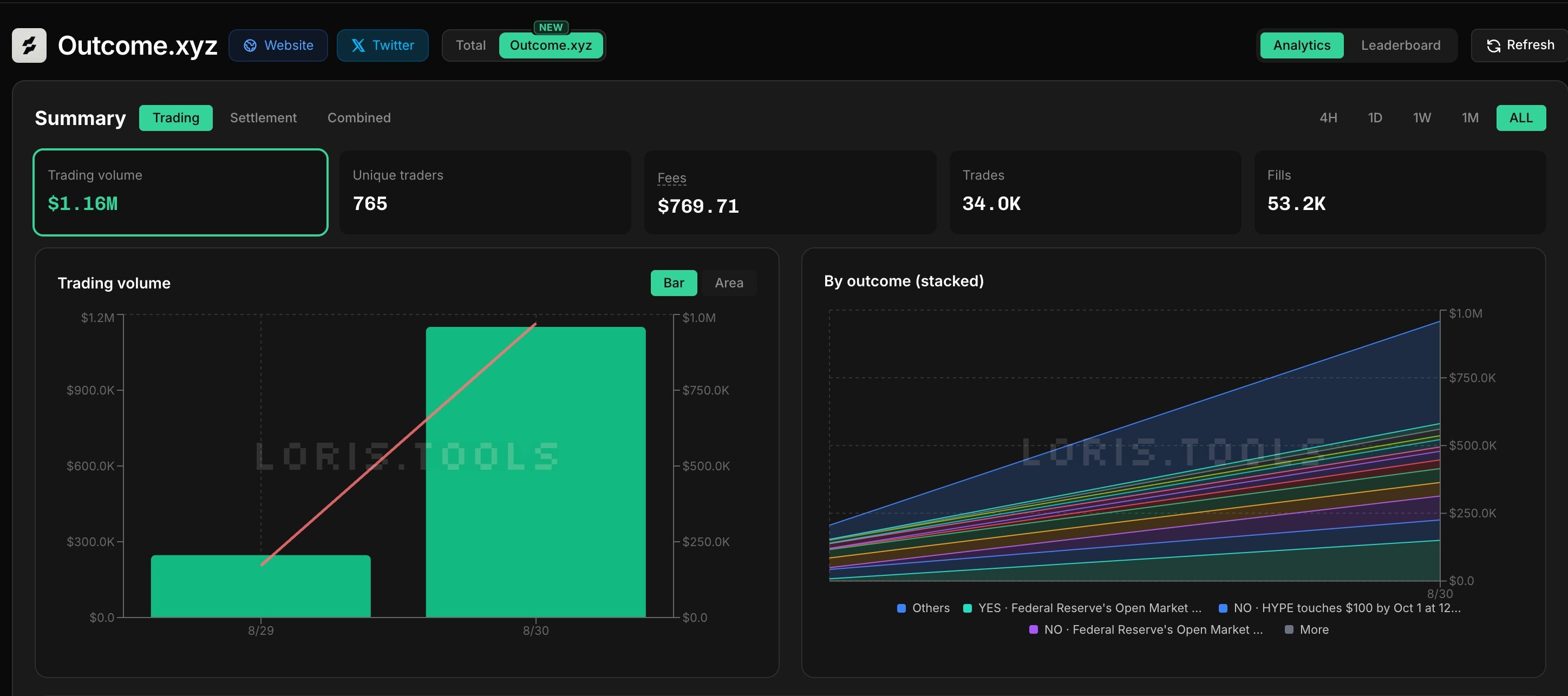
In terms of product direction, Outcome's current plans cover cryptocurrencies, stocks, indices, commodities, and sports events. It has already launched 28 prediction events, with cumulative trading volume reaching $1.16 million within two days of launch. To capture early liquidity, Outcome has also launched a trading rewards program totaling over $1 million.
In summary, Outcome's biggest advantage is being first—it no longer needs to explain to the market "what it is preparing to do," but has already entered the actual operational phase.
However, being "first" does not necessarily mean becoming the largest. The real challenge of prediction markets is not just deploying contracts, but continuously creating markets with trading value and solving liquidity, user acquisition, and market distribution problems. What Outcome needs to prove next is whether it can turn the "early bird" label into a true scale advantage.
Skew: The Second Project to Launch
Following Outcome, another HIP-4 Builder project, Skew, completed the deployment of its first event contract on the Hyperliquid mainnet this morning.

Skew's biggest advantage is its partnership with Nasdaq-listed company Hyperion DeFi, which will provide 500,000 HYPE to meet the staking requirement. Notably, Hyperion DeFi and Skew's collaboration in July was still focused on HIP-3, aiming to build perpetual contract markets for institutional clients, but by August they quickly pivoted to HIP-4.
According to Skew's disclosures on official social media, the project had previously opened test qualification registration, and as of Aug. 6, over 40,000 unique users had registered to apply for Skew's private beta.
While these 40,000 test registrants do not fully represent final active users, and the actual conversion rate remains to be seen, it at least indicates that Skew has accumulated some potential demand before the official product launch.
trade.xyz: The Previous Champion Enters the Fray
trade.xyz is the most unique presence in this competition. The question posed in this article is "who will become the new trade.xyz," but interestingly, the development team behind trade.xyz, Unit Labs, is already being viewed by the market as a potential HIP-4 participant.
Community monitoring has found that Unit Labs recently made a significant purchase of HYPE, and then adjusted its HYPE staking structure in the sensitive round number of "500,000 tokens":
- First, the address that deployed trade.xyz HIP-3 withdrew 500,000 HYPE from the Infinitefield validator node and staked it to the Hyperliquid Strategies × Unit validator node.
- Subsequently, the same address unstaked another 500,000 HYPE (totaling exactly 1 million HYPE), with these tokens expected to arrive on Sept. 5.
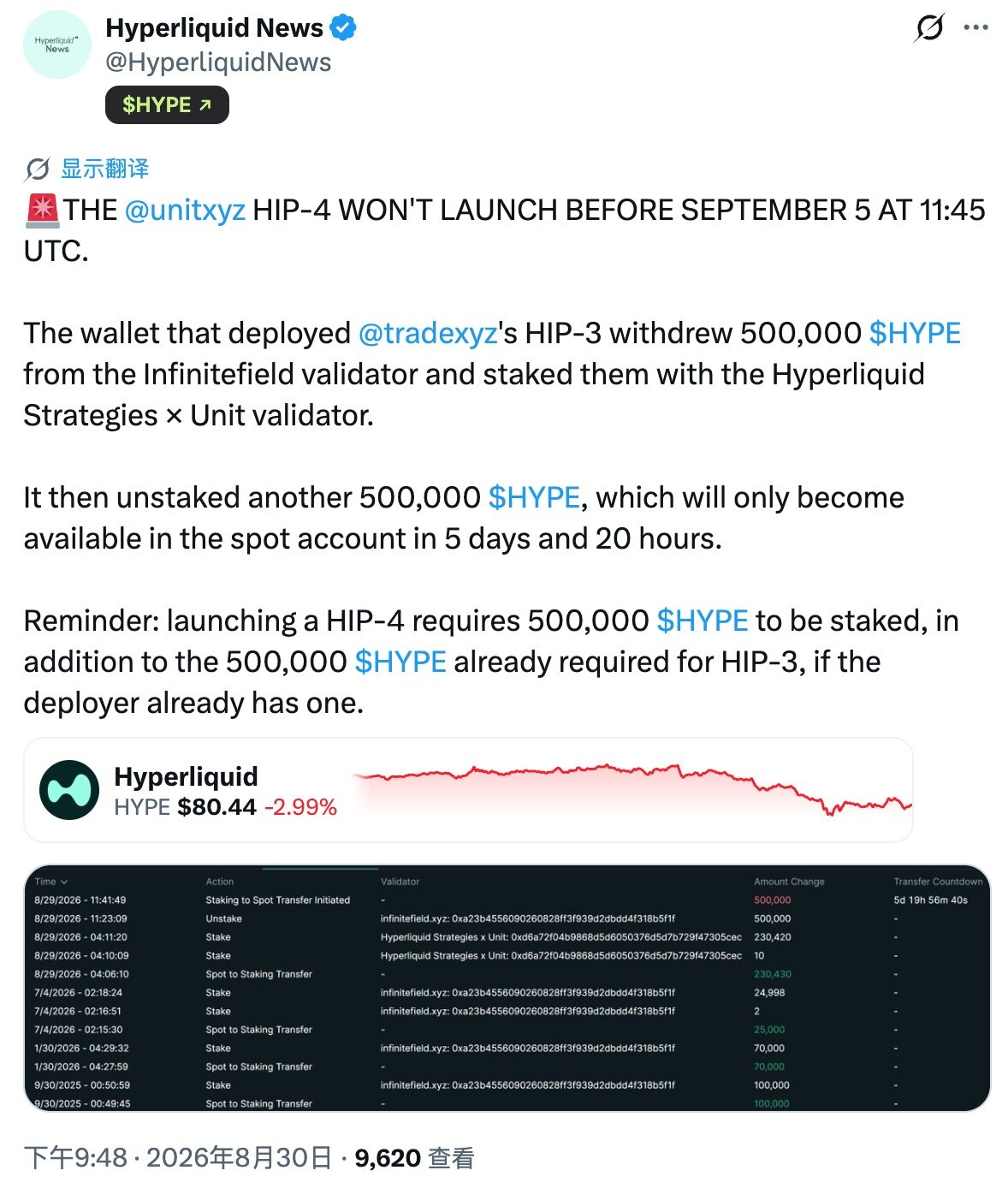
Since launching HIP-4 requires staking 500,000 HYPE, and if the deployer has previously deployed HIP-3, an additional 500,000 HYPE is required. Based on the above on-chain movements, Unit Labs is likely targeting HIP-4, but it is currently uncertain whether the new HIP-4 will use the trade.xyz name (more likely unit.xyz).
trade.xyz itself is one of the most successful cases of the HIP-3 model, and Unit Labs has already proven that it can turn Hyperliquid's underlying infrastructure into a trading product that people actually use.
If HIP-4 replicates the success of HIP-3, then trade.xyz and Unit Labs clearly have the most mature experience and user base. trade.xyz's existing stock, index, and commodity trading businesses can naturally synergize with related event markets—traders trading a particular asset may also want to trade outcome markets around earnings reports, price breakouts, or macro events.
However, as of now, further attention is needed on Unit Labs' specific product plans and deployment progress for HIP-4. Compared to Outcome and Skew, which have already launched, their biggest advantage is having "won once before," but whether they will fully commit to this new competition remains the key to determining if they can emerge as the winner.
The Battle Has Just Begun
From Outcome to Skew, and to trade.xyz (Unit Labs), which is suspected to be preparing to enter, the first batch of HIP-4 Builders has begun to emerge. But as of now, this competition is still in an extremely early stage.
The two projects that have completed deployment are just getting started, with market counts, trading volumes, and user scales still quite limited; and the specific product form of trade.xyz (Unit Labs) has not even been revealed yet. It is clearly too early to judge who will ultimately win, and whether HIP-4 can replicate the success of HIP-3 also remains unanswered.
But precisely because it is still early, HIP-4 leaves ample room for Builders. Prediction markets themselves are a sufficiently large sector, from financial assets and macro data to sports events and breaking news—theoretically, almost any event with a clear outcome can become a trading market. Hyperliquid provides unified trading and settlement infrastructure, while what Builders truly need to compete on is how to design markets, acquire users, and solve liquidity.
This is also the biggest challenge for HIP-4 going forward. Opening up deployment does not equal success; whether a prediction market can ultimately take off still depends on whether enough traders are willing to participate and whether buyers and sellers can continuously provide liquidity. More markets may also mean further fragmentation of liquidity; finding a balance between "rapidly creating new markets" and "concentrating limited liquidity" will be a problem all Builders must face.
HIP-3 has already proven that Hyperliquid's permissionless model can indeed produce success stories like trade.xyz. Now, the HIP-4 track has just opened—who will become the trade.xyz of prediction markets? There is no answer yet—but what is certain is that as more Builders enter, what Hyperliquid is competing for this time is no longer just the perpetual contract market, but the broader "trade everything" market.
This content is for informational and educational purposes only and does not constitute investment advice related to BTCC. BTCC makes every effort but cannot guarantee the truthfulness, accuracy, or originality of the content above.