Rate-Hike Expectations Rise as Gold Ends Five-Week Winning Streak, With $4,400 Emerging as Key Support
 BTCCAuthor: jett
Gold reversed sharply last week. Spot gold briefly approached $4,700 an ounce before falling as low as $4,445 on Friday, a decline of more than $250 in just a few days. Prices ultimately closed near $4,454.39, down roughly $147 on the day and nearly 3% for the week, ending a five-week winning streak.
During Monday’s Asian session, gold extended its decline, falling more than 1% intraday and briefly slipping below $4,400. After Federal Reserve Chair Kevin Warsh delivered a hawkish-leaning message at Jackson Hole, the market-implied probability of a September rate hike climbed to 57%, up from 36% before the speech. The two-year U.S. Treasury yield rose to around 4.33%, while the U.S. Dollar Index remained near 99.6, continuing to pressure gold.
Rate expectations are creating short-term headwinds, while U.S. debt and fiscal risks continue to support medium- and long-term demand for gold. The $4,400 level could now become a key dividing line between bulls and bears.
Warsh’s Speech Reshapes Rate Expectations
At the start of last week, gold was still supported by fiscal concerns and safe-haven demand. Investors continued to assess the impact of the U.S. Treasury’s bond-buyback program on the long-term Treasury market, while weaker U.S. consumer confidence also pushed some capital into gold. Prices extended their rise from around $4,618 and reached a weekly high of $4,697 last Tuesday.
Momentum then began to fade. Core PCE inflation and second-quarter U.S. GDP data showed that the economy remained resilient while inflation pressure had yet to ease materially. As Treasury yields rebounded, gold fell through short-term support around $4,600 and $4,555, while investors reduced risk exposure ahead of the Jackson Hole speech.
Warsh said the Fed needs to be confident that underlying inflation is returning to 2% at a clear and sufficiently rapid pace, or further action may still be required. He also said the Fed is currently placing greater emphasis on price stability than on signs of labor-market cooling. The CME FedWatch Tool subsequently showed that the market-implied probability of a September rate hike rose from 36% before the speech to 57%.
Rising rate-hike expectations pushed both the dollar and Treasury yields higher, increasing the opportunity cost of holding non-yielding assets. Gold’s substantial previous gains and stretched technical readings also made it more sensitive to shifts in policy expectations. Warsh’s comments accelerated the correction, although signs of weakening upside momentum had already emerged as gold approached $4,700.
Gold Falls Below the 20-Day Moving Average and Enters an Order-Block Zone
During Monday’s Asian session, gold briefly fell below $4,400 and touched its daily 20-day moving average. However, the MA20 remains upward sloping, and price showed some signs of stabilizing around that level.
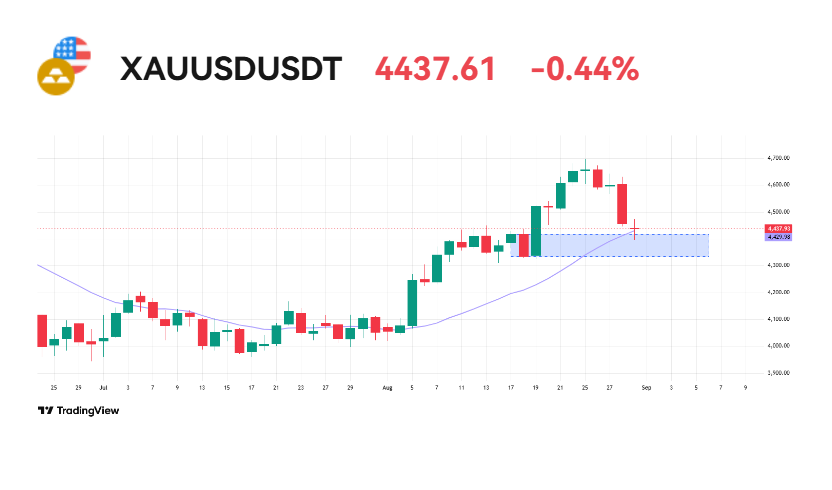
At the same time, an order block is roughly located between $4,330 and $4,410. This area corresponds to the consolidation range formed before gold previously accelerated above $4,500, and technical traders typically view it as a potential demand zone.
The long upper wick and large bearish candle formed near $4,690 indicate that selling pressure has increased at elevated levels. After gold entered the order-block zone on Monday, it has yet to produce a bullish engulfing move of comparable strength. Whether the technical structure can stabilize will depend on subsequent closing levels and candlestick formations.
If future closes decisively break below $4,330, the support provided by the previous consolidation zone would weaken significantly and the correction could deepen further.
High Interest Rates and High Debt Still Support Gold
U.S. federal debt has already exceeded $40 trillion. Higher interest rates are negative for gold in the short term because a stronger dollar and rising Treasury yields increase the opportunity cost of holding the metal. Over a longer horizon, however, high rates also increase the U.S. government’s refinancing costs and interest expense, making debt sustainability a more prominent concern and supporting investor allocations to hard assets such as gold.
Larry Lepard, managing partner at Equity Management Associates, believes that even one or two additional Fed rate hikes would be unlikely to remove the longer-term pressures created by expanding debt and inflation. Rich Checkan, president of Asset Strategies International, similarly argues that the Federal Reserve and U.S. Treasury need to prevent financing costs from spiraling out of control, while efforts to suppress long-term borrowing costs could come with greater inflation risk.
Debt is a slow-moving macro variable and cannot provide a clear short-term floor for gold. A stronger dollar, higher Treasury yields or still-crowded positioning could prolong the correction. Fiscal concerns can explain long-term allocation demand, but they do not rule out substantial drawdowns during a broader uptrend.
After the sharp decline, professional investors remain divided. A Kitco survey of 21 analysts found that 48% expect gold to rise this week, 29% are bearish and 24% expect sideways trading. Among retail respondents, 59% remain bullish. While that share has cooled from previous levels, it still exceeds bearish and neutral sentiment.
Payroll Data Could Shift Rate Expectations Again
Warsh has placed inflation at the center of the policy debate, meaning whether the Fed raises rates in September will still depend on incoming data. U.S. nonfarm payroll growth has fallen short of economists’ expectations in each of the past three months. If the labor market continues to cool, traders could scale back current rate-hike pricing.
This week’s JOLTS job openings, ADP private-sector employment report and initial jobless claims will provide clues ahead of Friday’s nonfarm payroll report. ISM manufacturing and services data will also help determine whether economic growth and pricing pressure are strengthening at the same time. Economists currently expect August nonfarm payrolls to increase by around 58,000, following a decline of 23,000 in July, while the unemployment rate is expected to remain at 4.1%.
If employment data come in stronger than expected, the probability of a September rate hike could rise further, continuing to support the dollar and Treasury yields. Gold could then test lower support levels. If payrolls miss expectations for a fourth consecutive month, however, markets may reassess the need for further tightening and gold could attempt to reclaim $4,700.

This content is for informational and educational purposes only and does not constitute investment advice related to BTCC. BTCC makes every effort but cannot guarantee the truthfulness, accuracy, or originality of the content above.