Rate-Hike Odds Surge, Oil Rises — Why Has BTC Barely Fallen?


👉 Try Copy Trading & Get 50 USDT
On August 31 (Monday), markets turned cautious again. Renewed clashes between the U.S. and Iran over the weekend pushed oil prices higher, while Federal Reserve Chair Kevin Warsh struck a hawkish tone at Jackson Hole, prompting markets to raise the probability of a September rate hike to 60%. U.S. stock futures and Japanese and South Korean equities came under pressure at one point on Monday, but BTC remained relatively resilient, holding above $78,000 after a brief pullback and underscoring the crypto market’s continued resilience.
Macro: Warsh Turns Hawkish as Oil Prices Rebound
Renewed clashes between the U.S. and Iran over the weekend sent international oil prices sharply higher in early Asian trading on Monday. According to BTCC market data, WTI crude rose to around $85.50, while Brent crude returned to $90, with both gaining more than 2% on the day. The rebound in oil prices renewed concerns over energy inflation and weakened expectations for easing rate pressure following the earlier cooling in PCE inflation.
Meanwhile, Federal Reserve Chair Kevin Warsh struck a hawkish tone in his Jackson Hole debut, emphasizing that inflation remains the primary risk and suggesting that further rate hikes could still be possible if inflation fails to cool quickly. Markets immediately repriced the policy outlook, with the probability of a September rate hike rising from around 35% to nearly 60%. Expectations for two rate hikes by March 2027 also increased.
Against this backdrop, U.S. stocks broadly declined last Friday. The Dow fell 0.02%, the Nasdaq dropped 0.52%, and the S&P 500 lost 0.25%. The U.S. Dollar Index rose 0.55% to 99.62.
On Monday, U.S. stock futures were mixed. Nasdaq 100 futures rose 0.07%, while S&P 500 futures fell 0.19% and Dow futures declined 0.23%. In Asian markets, the Nikkei 225 dropped 0.39%. South Korea’s KOSPI opened lower and briefly fell more than 3% before reversing its losses to close up 0.46%, while SK Hynix and Samsung Electronics both gained more than 1%.
BTC Finds Support at $77K as Near-Term Buying Holds
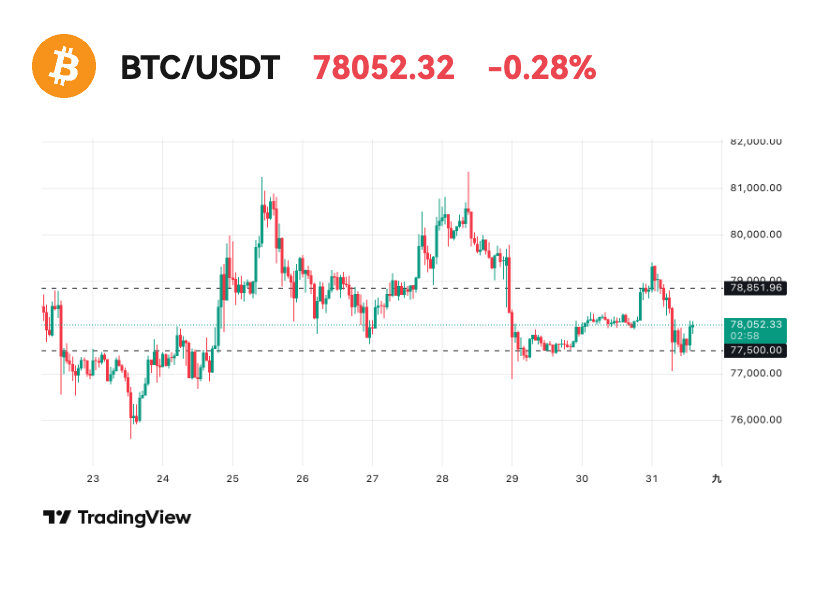
Bitcoin briefly moved lower in early Monday trading before trimming its losses. According to BTCC market data, BTC was trading at $78,052, down 0.28% over the past 24 hours. The chart shows BTC finding support near $77,500 before recovering toward $78,000, suggesting that the market has not seen panic selling. BTC’s total trading volume also increased by 70% over the past 24 hours.
👉 Try Copy Trading & Get 50 USDT
In the near term, $77,200 is the first key support level. If it fails to hold, BTC could retest the $76,000–$77,000 range. On the upside, BTC needs to reclaim $78,300 before another attempt at $80,000–$81,000 becomes possible. BTC remains in a high-level consolidation phase, with the next directional move requiring further confirmation from trading volume and ETF flows.
On-chain capital flows are still showing positive signals. Analysts said whales have accumulated nearly $3 billion worth of BTC over the past week, suggesting that large investors continue to build positions near current highs. Strategy has also signaled that it may resume BTC purchases. If subsequent filings confirm another round of buying, it could provide additional spot demand in the $76,000–$78,000 range.
However, spot demand still needs to be confirmed. CryptoQuant analyst Darkfost noted that despite BTC gaining around 30% in August, spot trading activity on centralized exchanges remains near historically low levels, similar to those seen in September 2023. If further price gains are accompanied by a meaningful increase in spot trading volume, it would provide stronger confirmation that a new bull-market cycle is underway.
ETF Flows Diverge as ETH Shows Greater Resilience
ETF flows showed short-term divergence. U.S. spot Bitcoin ETFs recorded around $200 million in net outflows last Friday, ending their previous streak of consecutive inflows. Meanwhile, spot Ethereum ETFs recorded around $100 million in net inflows for the day and have continued to attract capital for several consecutive sessions. ETH ETFs saw approximately $820 million in net inflows last week, marking their highest weekly total of 2026.
On Monday, ETH fell more sharply than BTC intraday and briefly approached $2,395, but remained relatively resilient with support from ETF inflows. In the near term, $2,400 is the key support level. If ETH holds above this level, it could retest $2,500–$2,530. A break below $2,390, however, would shift attention to the $2,300–$2,350 support zone.
Among major altcoins, UNI stood out today, gaining more than 10% and briefly climbing above $5.40. ZORA surged 65% to around 0.0103 USDT, potentially reflecting renewed attention toward the Base ecosystem, SocialFi, and on-chain content assets.
Trading Outlook:
The market is currently in a phase where the broader trend remains strong, but macro uncertainty is increasing. BTC continues to hold key support, but rebounding oil prices, a stronger U.S. dollar, and rising rate-hike expectations have increased near-term volatility risks.
Traders should avoid blindly chasing rallies during high-level consolidation. For BTC, the key levels to watch are support at $77,200 and a breakout above $78,300. If BTC reclaims $78,300 on strong volume, attention can shift back toward resistance above $80,000. If it falls below $77,200, the risk of a pullback toward $76,000 will increase. For ETH, the key level is $2,400. If ETF inflows continue, ETH may still have room for catch-up gains.
BTCC continues to offer its “First Copy Trade, Losses Covered” promotion. New users can try following strategies from experienced traders, but position sizing remains important, especially in highly volatile markets where excessive leverage can amplify risk.
This Week’s Focus:
A busy week of U.S. macroeconomic data lies ahead. Tuesday will bring the ISM Manufacturing PMI and JOLTS job openings, followed by ADP employment data on Wednesday. Thursday will feature initial jobless claims and the ISM Services PMI, while the U.S. August nonfarm payrolls report will be released on Friday.
Friday’s nonfarm payrolls report will be the final comprehensive employment report before the Federal Reserve’s September 16 policy meeting, making it a key test for expectations of a September rate hike. If the labor market remains strong, the U.S. dollar and Treasury yields could move higher. If employment cools significantly, however, rate-hike pressure could ease, providing room for BTC and technology stocks to recover.
👉 Try Copy Trading & Get 50 USDT
Risk Warning: Some of the views in this article are drawn from public media sources and are for reference only. They do not constitute any investment advice or trading recommendation. Markets involve risks, and trading should be approached with caution. Please ensure you have appropriate risk controls in place.
This content is for informational and educational purposes only and does not constitute investment advice related to BTCC. BTCC makes every effort but cannot guarantee the truthfulness, accuracy, or originality of the content above.