Strategy Sold Bitcoin Low and Bought It Back Higher. Why the Losing Trade May Still Have Been the Right Move
 BTCCAuthor: jett
On price alone, Strategy appears to have made a poor trade over the past two months.
From late June through early August, the company sold 6,916 Bitcoin for approximately $429 million at an average price of around $62,000. Between August 24 and August 30, Strategy then spent $369.7 million to buy 4,603 Bitcoin at an average price of $80,318.
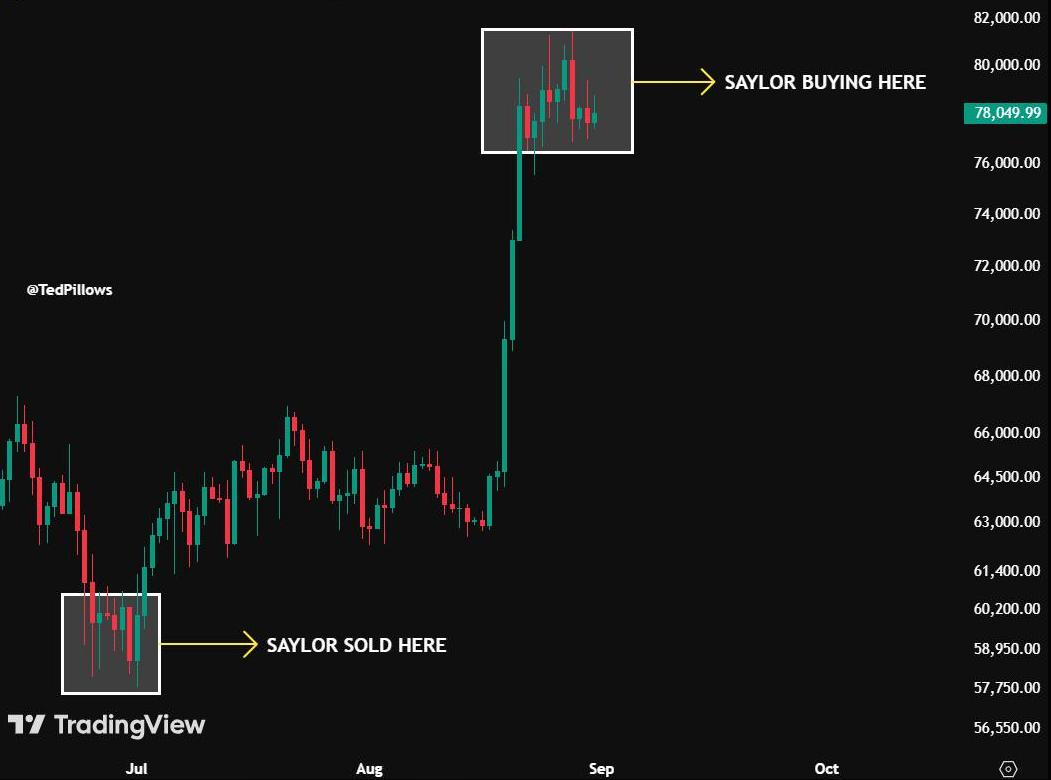
On a simple price comparison, Strategy paid nearly 30% more to buy BTC back. Roughly speaking, if the company had retained 4,603 of those Bitcoin instead of selling and later repurchasing them, it could have avoided around $84 million in additional cost.
But when Strategy sold Bitcoin, its main problem was not the direction of BTC prices. It was constrained access to financing. The company tapped part of its Bitcoin reserves to bolster dollar liquidity, repurchase discounted preferred stock and preserve confidence in its capital structure. The transaction was therefore closer to a balance-sheet adjustment than a conventional attempt to time the market.
Strategy Depends on More Than the Price of Bitcoin
The market often treats Strategy as a publicly listed Bitcoin fund, but its capital structure is far more complex than that of an ETF.
Bitcoin serves as the underlying asset, while MSTR common stock, convertible debt and multiple classes of preferred stock function as financing instruments. Over the past several years, Strategy has raised dollars through securities issuance and used the proceeds to acquire Bitcoin. As its Bitcoin holdings grew, the company’s valuation and financing capacity also increased, creating the conditions for subsequent rounds of capital raising.
Whether this model can continue depends not only on Bitcoin’s performance, but also on Strategy’s ability to obtain dollars at an acceptable cost.
This summer, the pressure was concentrated in STRC. STRC is a floating-rate perpetual preferred stock issued by Strategy, and management aims to keep its price close to $100 per share. Under company policy, Strategy does not issue additional STRC while it trades below $100. If the shares remain at a sustained discount, this funding channel aimed at yield-oriented investors effectively closes.
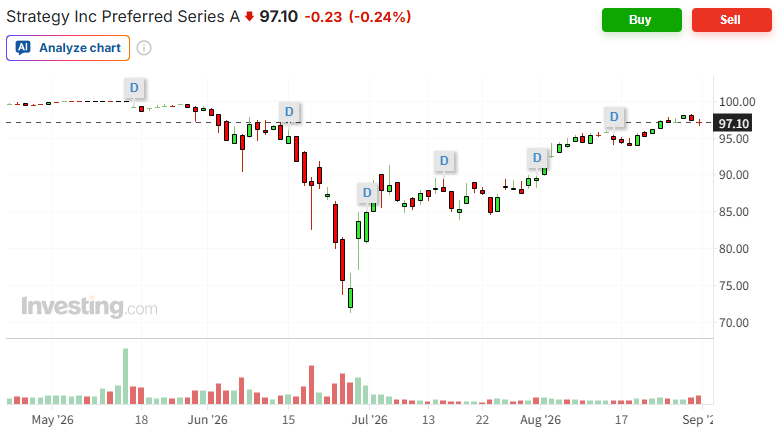
In late July, STRC fell into the low-$80 range. Strategy subsequently committed to ongoing repurchases and maintained a 12% annualized dividend rate until the price stabilized. For a company that must continuously service preferred dividends and debt interest, a discount in preferred shares raises funding costs and can undermine investor confidence in the broader capital structure.
Bitcoin Begins to Function as a Liquidity Tool
On June 29, Strategy introduced its “Digital Credit Capital Framework,” raising its dollar-reserve requirements and authorizing $1 billion in repurchases of digital credit securities and another $1 billion in MSTR common-stock buybacks. The new framework also introduced a BTC Monetization Program, allowing the company to sell Bitcoin under certain circumstances to replenish cash, pay dividends and interest, or repurchase securities.
The arrangement broke with Strategy’s long-standing practice of buying Bitcoin without selling it. Bitcoin remains the company’s core reserve asset, but when external financing becomes too expensive, it can also be used as a source of liquidity.
That shift is consistent with the financial logic of a public company. Strategy has to manage dividends, interest payments and securities prices. It cannot place a commitment to “never sell Bitcoin” above solvency and funding stability.
In late July, Strategy’s first round of STRC repurchases was completed at an average price of approximately $86.52. Buying preferred shares back at a substantial discount to their $100 par value reduces the amount outstanding and lowers future dividend obligations. In that context, management had to compare the potential return from continuing to hold Bitcoin with the immediate value of repairing a financing channel.
Keeping all of its Bitcoin might have produced higher paper gains. But if STRC had remained deeply discounted, Strategy would have faced both elevated dividend costs and weaker financing capacity. The pressure could also have spilled over into MSTR’s valuation, reducing the company’s ability to raise capital through the common-equity market.
Once Financing Recovered, Strategy Returned to Buying Bitcoin
As of August 30, Strategy’s USD Reserve had increased from $2.55 billion at the end of June to $5.1 billion. The company also held $1.61 billion in USD Cash, bringing the combined total to $6.71 billion.
These additional dollar assets did not primarily come from Bitcoin sales. The earlier BTC disposals generated around $429 million, while most of the new funding came from at-the-market, or ATM, issuance of MSTR common stock. Bitcoin mainly served as supplemental liquidity during periods of elevated financing pressure.
Strategy has used approximately $635 million of its authorized capacity to repurchase preferred stock. Between August 24 and August 30 alone, the company spent $151.8 million to buy back 1.557 million STRC shares. Of the previously authorized $1 billion digital credit securities repurchase program, approximately $364.8 million remains available.
STRC’s price has also recovered. On August 31, the preferred shares closed at $97.10, up roughly 12% from the $86.52 average price of the first repurchase round in late July and within 3% of the $100 target level. The recovery cannot be attributed entirely to Strategy’s buybacks, but it at least suggests that pricing pressure on the security has eased.
During the same week, Strategy sold approximately 4.531 million MSTR shares, generating $602.8 million in net proceeds. Of that amount, $369.7 million was used to purchase 4,603 Bitcoin, $151.8 million went toward STRC repurchases, $50.7 million funded STRC dividends, and another $30 million was added to USD Cash.
The allocation shows that Strategy is once again able to rely on the common-equity market to buy Bitcoin, repurchase preferred stock, pay dividends and increase cash reserves at the same time. Two months earlier, Strategy had needed to sell Bitcoin to ease financing pressure. By the end of August, external capital markets had once again become its primary source of funding.
It May Not Have Been the Wrong Trade
With Bitcoin rising from around $62,000 to $80,000, Strategy gave up roughly $84 million in potential gains. Continued issuance of MSTR common stock also dilutes existing shareholders. Meanwhile, STRC has not fully returned to $100, and its 12% annualized dividend rate indicates that this financing channel is not cheap.
The model also depends on capital markets remaining open. If MSTR’s valuation falls sharply, preferred shares again trade at a deep discount, and Bitcoin simultaneously enters a severe bear market, Strategy’s funding costs could rise rapidly. Under those conditions, the company may no longer be able to issue common stock and simultaneously fund Bitcoin purchases, security repurchases and cash reserves as it does today.
As of August 30, Strategy held 845,050 Bitcoin acquired for approximately $63.73 billion, at an average cost of $75,412 per BTC. Going forward, the company will need to demonstrate that the long-term appreciation of its Bitcoin holdings is sufficient to offset common-stock dilution, preferred-stock dividends and debt interest.
That is why reducing the entire episode to “selling low and buying high” misses the financing constraints Strategy faced at the time. The company did sacrifice part of the upside generated by Bitcoin’s rally. In exchange, however, it regained control over its capital allocation.
This is why the trade may have been a loss from a pure trading perspective, yet still not have been the wrong decision from the standpoint of Strategy’s overall capital management.
This content is for informational and educational purposes only and does not constitute investment advice related to BTCC. BTCC makes every effort but cannot guarantee the truthfulness, accuracy, or originality of the content above.