The Space Dog ASTEROID meme is experiencing another wave of popularity splits. Why doesn't the meme have a value judgment system yet?
 Blockbeats
"Diversion" has always been a hotly debated topic in Meme Coin and even the entire cryptocurrency market.
The majority of players abhor this phenomenon, mainly for the following reasons:
Finding a sufficiently broad narrative angle is not easy, especially in a market environment with poor liquidity and no Meme coin having a market capitalization of over $1 billion for a long time. This diversion of funds makes the market more chaotic and trading more difficult.
In most cases, this diversion of funds is caused by calls from influential figures. Retail investors believe these influential figures, with their advantages in capital and trading, should join forces to propel already trending stocks to even higher levels, rather than refusing to "carry the load" simply because the price is already high.
During the diversion process, the comments of influential figures almost inevitably involve "comparison and denigration," which, while draining liquidity, causes even greater damage to the original target.
People die for wealth, birds die for food. The long-standing debate surrounding "capital diversion" has been logical, but the final outcome is often a "logically driven emotional outpouring." Retail investors, already in a passive position, suffer profit erosion or even losses due to capital diversion, so their complaints are entirely justified. But when we calmly consider this, is there any way to overcome this phenomenon of "capital diversion"? Will this ongoing debate in the cryptocurrency world ever come to an end?
How do we determine what is considered "orthodox"?
If we hope that one day there will be no more "splits", we need to solve a problem first - how do we determine the "legitimacy" of a token?
Let's start with the recent "space dog split." This topic was considered the biggest meme coin opportunity recently because Musk agreed to make Asteroid, the "space dog," SpaceX's mascot. The split revolves around the two corresponding $ASTEROID meme coins on ETH and SOL:
- $ASTEROID ETH: $ASTEROID on the Ethereum mainnet began operating in September 2024, but its official Twitter account became less active after March 2025, updating only once every few months. The website linked in the Twitter bio is also inaccessible. They donated 0.5% of their tokens to St. Jude Hospital, the same recipient as creator Liv Perrotto's Asteroid Shiba plush toy sales, to fund childhood cancer treatment. However, this was back in 2024. Nevertheless, their charitable acts cannot be forgotten, and the funding recognized the community's past efforts. Before Musk tweeted that Asteroid could be used as SpaceX's new mascot, its market capitalization had already surpassed $160 million.
- $ASTEROID SOL: Creator Liv Perrotto's mother, Rebecca Perrotto, claimed about 2013 SOL in $ASTEROID fees on SOL, which was launched through the Bags platform, and the total fee income has now reached 2291 SOL. Rebecca Perrotto has stated explicitly that all income received on the Bags platform will be used to establish a foundation in memory of Liv Perrotto
From a speculative perspective, both sides actually have their own reasoning, especially $ASTEROID on ETH, which aligns more with a long-standing unwritten rule in the community — recognizing the OG, recognizing the community.
But looking at it rationally, the root of the "fork" actually lies in Rebecca Perrotto, Liv Perrotto's mother, claiming the SOL $ASTEROID fee income and declaring it would be used to establish a foundation in memory of Liv Perrotto, which provides the perspective of the "fork".
After Liv Perrotto's passing, Rebecca Perrotto, as the current owner of the IP, her attitude is the upper limit of this perspective. Regarding $ASTEROID on ETH, she actually had expressed her attitude under a tweet for Aster listing ETH $ASTEROID:
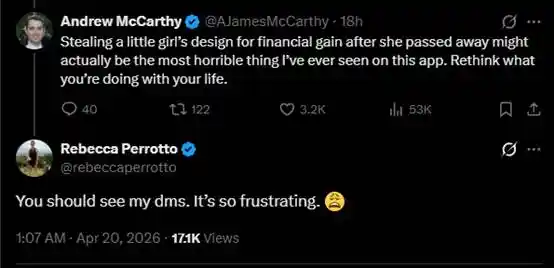
@AJamesMcCarthy stated that profiting off the creative design of a deceased little girl is a despicable act. Rebecca Perrotto replied, "This is truly disappointing."
Here, the author does not make any subjective and emotional judgments on this attitude itself. I can only assume that, in Rebecca Perrotto's unfamiliarity with cryptocurrency, she may not have fully understood the good deeds that had been done with $ASTEROID on ETH.
As for $ASTEROID on SOL, she was able to directly receive fee income from it, and there may have been some communication in between. When her Bags account was hacked, Bags team members also responded promptly:
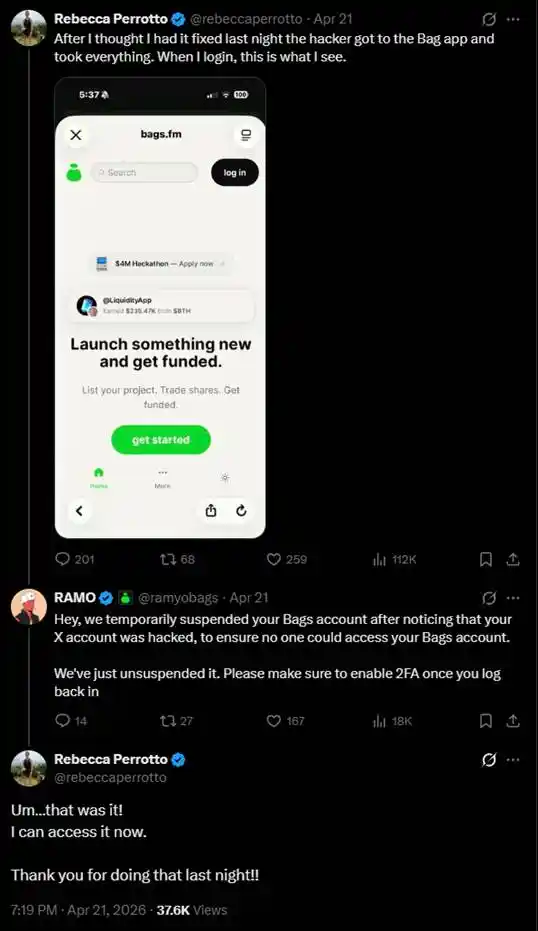
Rebecca Perrotto noticed the $ASTEROID on SOL back in August of last year. At the time, she clarified her relationship with him and made no further comment regarding the transaction fees.
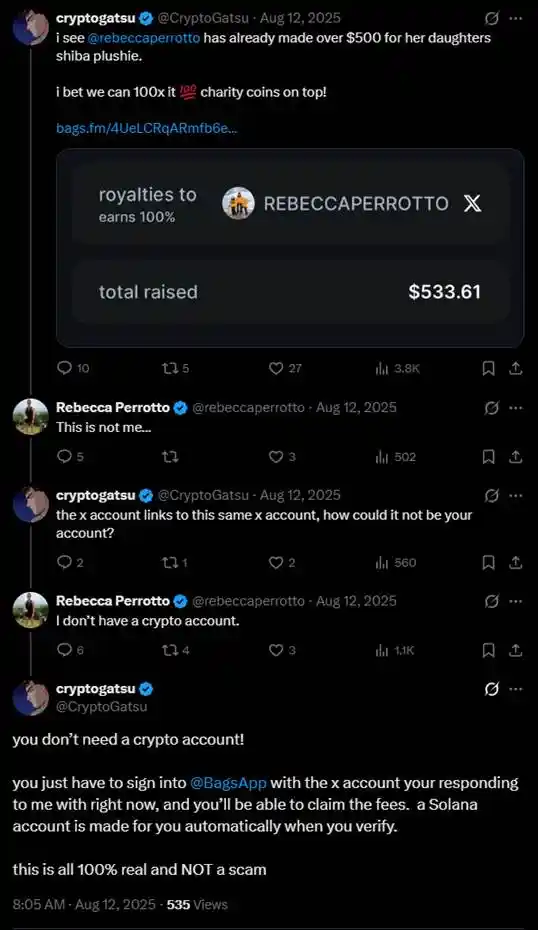
You might ask, what does Rebecca Perrotto's stance matter? Our on-chain funds have already been allocated to $ASTEROID on ETH. She can express her opinion, so why can't we unite and not split?
In the short term, price fluctuations are indeed unimportant. If SpaceX doesn't officially announce Asteroid as its new mascot on social media, neither ETH nor $ASTEROID on SOL may be able to reach new heights.
But if it's officially announced and the coin is indeed listed on an exchange, it's very important to know who Rebecca Perrotto, as the IP owner, will authorize.
Let's review the final outcome of the Neiro debate (quoted from @0xVeil):
In April 2025, the Neiro CTO project ushered in the most significant milestone in its development history: through cooperation with OwnTheDoge's decentralized autonomous organization (DAO), it officially obtained a global exclusive intellectual property (IP) license for the Neiro name and image from kabosu mama himself, becoming the sole legal successor to the legendary meme Doge.
The most direct impact of this incident is that the legal team of the Neiro CTO project issued copyright infringement notices to major trading platforms, demanding the removal of all unauthorized "Neiro" token contracts. In fact, the target is only one thing: NEIRO ETH. Although it is not listed on Binance spot, it is listed on various other secondary exchanges, including Binance contracts.
Major trading platforms responded swiftly, successively announcing the removal of the infringing Neiro perpetual contracts or spot trading pairs. With this, the NEIRO ETH issue is completely over.
Whoever owns the copyright can not only legitimately list their tokens on exchanges, but also legitimately prevent other tokens with the same name and concept from being listed. Therefore, our discussion here about "how to determine legitimacy" is not an attempt to determine which is superior, $ASTEROID, on ETH or SOL. This debate over legitimacy based on a main IP is not actually a current squabble among industry insiders trying to promote their tokens and compete for existing funds, but rather a "realistic problem that must be faced should the ceiling truly be broken."
Whether it's $ASTEROID on ETH or SOL, they should establish good communication with Rebecca Perrotto as soon as possible to explain their operational ideas and philosophy. It's not necessarily about purchasing a license, but at least establishing a kind of "tacit approval" like $PEPE—yes, $PEPE has never obtained a license from Matt Furie, the creator of the Pepe IP, but Matt earned approximately $600,000 by selling $PEPE tokens given to him by the community. He has never commented on $PEPE, nor has he taken any legal action. It's worth noting that he previously successfully used the DMCA to have OpenSea remove several unauthorized Pepe NFT projects (such as Sad Frogs District in 2021, with a transaction value of $4 million) related to other Pepe-related crypto assets.
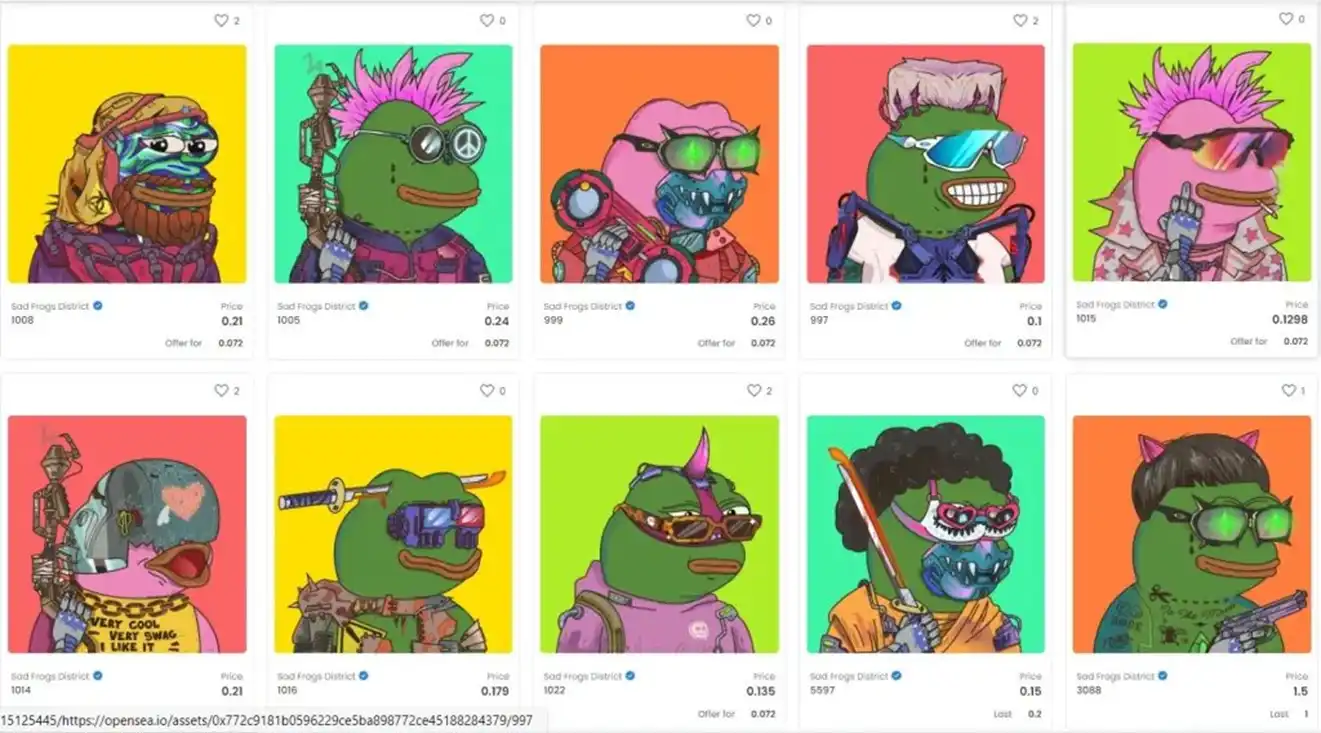
The former Sad Frogs District
Returning to the title of this section, how do we determine what is "legitimate"? Here, my first answer is not actually a definition, but a suggestion—for memes with clear IP ownership, if you are truly determined to build a meme coin with a market capitalization of one billion US dollars and listed on Binance, please call on and assist the token community you support to negotiate IP-related matters.
How can we determine the "legitimate" status of an unclaimed IP address?
Many memes are actually "ownerless".
For example, Wojak is a typical anonymous internet meme with no single verifiable creator or legal copyright holder. Its origins can be traced back to the Polish image board Vichan around 2009, first appearing with the filename "ciepłatwarz.jpg (warm face.jpg)," and it only became popular on platforms like 4chan after being promoted by an anonymous user with the username "Wojak" on Krautchan (a now-defunct German image board) in 2010.
Because it originated from the anonymous/pseudonym imageboard culture, the images themselves are products of rapid sharing and modification within the community, without formal author attribution, copyright registration, or public statements. Wikipedia, KnowYourMeme, and related analytical articles all clearly point out that the original author is unknown, it is difficult to trace the definite copyright owner, and it is essentially a meme in the public domain, belonging to the public cultural heritage of collective creation on the Internet.
For example, NEET, a typical descriptive term in public policy/sociology, was first coined in 1996 by a senior civil servant at the UK Home Office to replace previously controversial terms. Copyright laws in various countries explicitly exclude "idea/fact/short phrases," meaning no individual, company, or organization can claim exclusive intellectual property rights (copyright, trademarks, etc.), essentially classifying them as public domain memes.
In this situation, let the market decide who is the "legitimate" one. In fact, if we look beyond Meme Coin, truly powerful crypto assets are never afraid of "diversion":
In the battle for large blocks, "OG" Bitcoin still emerged victorious.
Ethereum's rollback and transition to PoS ultimately triumphed, with "OG" Ethereum still emerging victorious.
Milday not only doesn't restrict derivative series on each chain, but also encourages such ideas to "plant their flags" on chains outside the Ethereum mainnet.
Here we have another question – how do we establish a winning standard that is accepted by the market and recognized by all?
Only by solving this problem can the "diversion" issue be eradicated.
An exploration to eradicate "diversion"
Meme Coin is not without value. We won't discuss the specific value of Meme Coin here, but rather consider another question—why do people keep saying that Meme Coin has no value?
Because for so many years we have never established a value assessment system for Meme coin.
While retail investors have some unwritten rules, such as valuing OG coins, community activity, and cultural influence, these rules are fragmented. Since pump.fun significantly lowered the issuance cost of Meme coins, people have become more accustomed to quick in-and-out trading, and these unwritten rules are on the verge of becoming ineffective.
Murad proposed a great "meme coin supercycle" theory, but unfortunately, this theory has only become a short-term "perspective" now, rather than a consensus on trading logic like looking at the price-to-earnings ratio or industry outlook for stocks.
Some platforms have taken measures to address the "split" problem, such as prohibiting the deployment of new tokens with the same ticker for a certain period of time. However, this is difficult to promote because it does not meet the needs of the bundlers to launch new schemes that manipulate token prices, nor is it conducive to the platform's own profitability.
As the largest liquidity hubs in the cryptocurrency market, centralized exchanges (CEXs) are best positioned to lead the establishment of a value assessment system for meme coins. We have seen some attempts at listing coins through voting, but this approach is subject to interference from too many factors.
By establishing a strict listing mechanism for Meme Coin, CEXs are capable of guiding Meme Coin towards a serious market development and leveraging cultural influence to demonstrate its positive externalities from a consensus perspective.
The measures I can think of are:
For meme coins with clearly defined IP addresses, centralized exchanges (CEXs) use resolving IP address ownership as a crucial listing criterion, especially when traffic splitting occurs.
- For meme coins without an IP address, a sufficiently long pre-listing observation period should be established, using multiple dimensions such as theme and culture, social media data, and community activity to conduct long-term tracking and observation.
- For all listed Meme coins, a complete listing research report will be published.
Developing a convincing value assessment system for Meme Coin marks the beginning of Meme Coin's development into a serious cryptocurrency sector and even a cultural industry.
This content is for informational and educational purposes only and does not constitute investment advice related to BTCC. BTCC makes every effort but cannot guarantee the truthfulness, accuracy, or originality of the content above.