Polymarket’s Silent Gold Rush: How Crypto Traders Extract Risk-Free Alpha

Prediction markets are bleeding value—and sharp traders are getting rich.
While retail speculators chase meme coins, Polymarket whales exploit price inefficiencies with surgical precision. The platform’s 16% arbitrage gap isn’t a bug—it’s a feature for those who know how to game it.
Here’s the kicker: These profits require zero directional exposure. No praying for Bitcoin’s next ATH. Just cold, quantifiable edge—the kind that makes traditional finance quants seethe with jealousy.
One trader’s ‘risk-free’ opportunity is another’s unhedged liability. But hey, that’s crypto markets for you—where the house always wins… until it doesn’t.
Polymarket Arbitrage: How Risk-Free Profits Emerge
Few platforms have attracted as much intrigue or profit potential as Polymarket in the decentralized prediction markets.
Polymarket has quietly become a battleground for a new breed of crypto-native arbitrage players exploiting micro-inefficiencies in human sentiment and market timing.
A recent Cornell University research described it as an arbitrage engine, not a casino. Dependent outcome prices on Polymarket can sometimes add up to less than $1, creating a guaranteed profit opportunity.
If an event offers four possible outcomes, say, “interest rate cut,” “no change,” “rate hike,” and “other,” and their combined prices total $0.995, traders can buy one share of each and earn $0.005 when one resolves. That’s a 0.5% risk-free return; while it is tiny, it becomes meaningful at scale.
“Don’t underestimate that 0.5%,” said a veteran Polymarket player known as Fish in an interview with BlockBeats. “If you invest $10,000 and do dozens of these trades daily, the annualized return can be astonishing.”
However, these fleeting inefficiencies, often lasting seconds, are now largely dominated by bots running on Polygon nodes.
These automated systems monitor thousands of markets, instantly executing trades the moment prices fall out of balance. What sounds like a clean arbitrage loop has developed into a high-frequency arms race of latency, coding skill, and on-chain execution speed.
Endgame Sweep: Time for Certainty
Another favorite among seasoned players is the “Endgame Sweep” strategy. It entails buying outcomes that have surged to NEAR certainty, typically priced between $0.95 and $0.99, and waiting for final market resolution.
“The logic is simple: time in exchange for certainty,” said Fish. “When retail investors rush to cash out at $0.997, they leave a few basis points for whales to scoop up.”
Yet even this supposedly SAFE play carries “black swan” risk. Events that seem settled can suddenly reverse, a misjudged sports call, a last-minute legal challenge, or a scandal upending a political forecast.
Whales can also manipulate sentiment by dumping large orders or seeding misinformation in Polymarket’s own comment section, where traders often post long, emotional analyses.
Arbitrage as Market-Making
Ultimately, these profit loops are not just parasitic. Rather, they perform a function similar to market-making. Arbitrageurs rebalance odds, tighten spreads, and improve liquidity.
“From this perspective, Polymarket can actually be considered very friendly to market makers,” Fish noted, estimating that liquidity providers earned more than $20 million in the past year alone.
As Polymarket continues to expand, with a 4% yield program for the 2028 US election market and speculation of a future IPO or token airdrop, the game is only getting bigger. Each new market brings more liquidity, more inefficiency, and more arbitrage space.
Still, the playing field is steeply tilted. Data from BlockBeats shows that only 0.51% of users have profits above $1,000, and just 1.74% trade over $50,000 in volume.
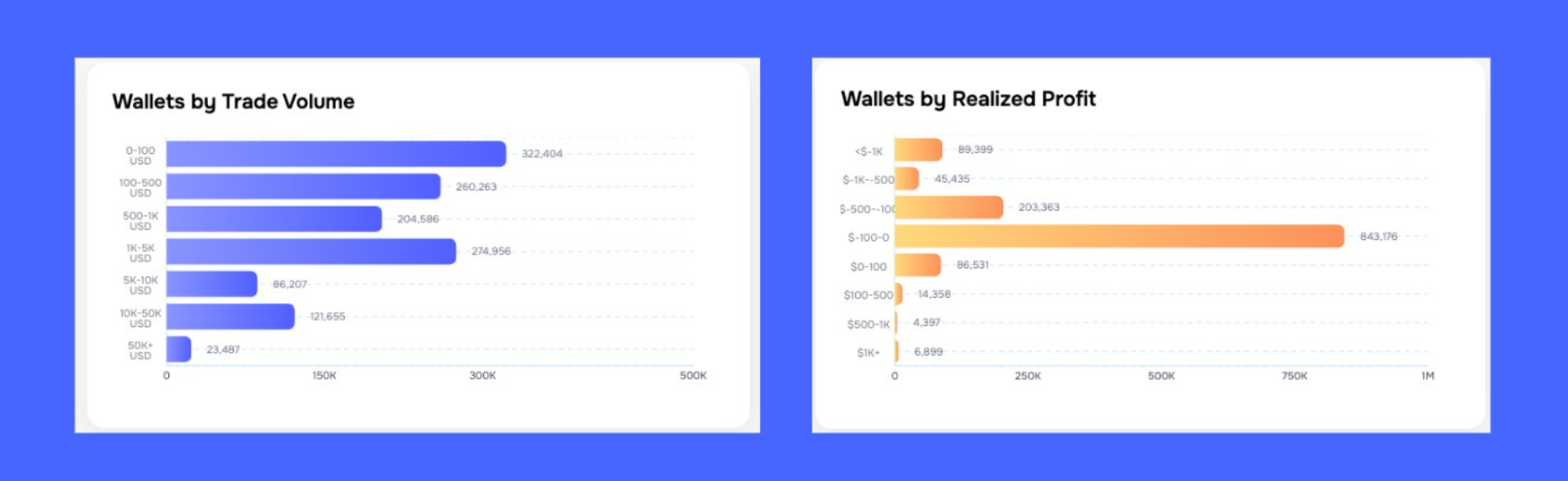
Most traders lose money, while a silent minority scripts, monitors, and sweeps their way to quiet, consistent returns.
“Arbitrage on Polymarket isn’t gambling, it’s engineering. You’re not betting on outcomes. You’re betting on inefficiency itself,” wrote Jeremy Whittaker on Medium.
