Kalshi Bets Big on Solana to Ignite Tokenized Event Trading Revolution

Kalshi just threw a match on the gas-soaked kindling of tokenized event trading—and Solana is the spark.
Why This Move Matters
The prediction market platform is ditching the old rails. By building on Solana's high-speed, low-cost infrastructure, Kalshi isn't just upgrading its tech stack—it's declaring war on the friction that's kept event-based derivatives a niche play. Think real-time election bets, instantaneous sports wagers, and weather derivatives that settle before the storm clears. The traditional finance gatekeepers, with their T+2 settlements and paperwork labyrinths, just got served notice.
The Solana Edge
Speed is the new alpha. Solana's architecture, built for sub-second finality, is the perfect engine for a market where milliseconds can mean the difference between profit and a missed opportunity. It bypasses the congestion and fee volatility that have plagued other chains, offering a trading experience that feels closer to a traditional exchange than a crypto experiment. For traders, that means no more watching a potential payout evaporate while waiting for a transaction to confirm.
A New Frontier for Speculation
This isn't just about betting on who wins the Super Bowl. Tokenized event contracts could democratize exposure to everything from inflation reports and corporate earnings to geopolitical risk—turning the news cycle into a tradable asset class. It's a hedge fund strategist's dream, repackaged for the retail trader. Of course, turning global chaos into a clean P&L has always been Wall Street's favorite parlor trick; now they just have a faster ledger to do it on.
The final bell hasn't rung on whether tokenized events will go mainstream or remain a crypto-native curiosity. But by picking Solana, Kalshi is making a clear bet: the future of speculative trading won't be built on legacy systems—it'll be written in transactions per second.
Solana Lands Kalshi’s First Fully Tokenized Event Markets
“The tokenized versions of the contracts work the same way as the regular ones found previously on Kalshi’s platform,” the company told CNBC. The key difference is market structure. By trading the tokens rather than the contracts themselves, users can operate with greater pseudonymity and more flexibility in how they custody and MOVE positions, putting Kalshi “on par with Polymarket, which allows users to trade directly on-chain.”
Support for these tokenized wagers is already live on Solana. Decentralized finance protocols DFlow and Jupiter are onboarding as institutional conduits, effectively bridging Kalshi’s off-chain orderbook into Solana’s liquidity. That link is designed to let crypto-native traders discover, route and size positions through the DeFi stack while Kalshi continues to run its core matching and settlement infrastructure in a regulated environment.
The timing coincides with a sharp upswing in prediction market activity. Combined trading volume in prediction markets reached almost $28 billion through October 2025, with a weekly record of $2.3 billion in the week of October 20, according to data cited from Crypto.com’s research arm. Kalshi’s thesis is that the next leg of growth will be driven by the digital asset market, which it pegs at roughly $3 trillion and heavily populated by traders already comfortable with on-chain risk.
“There’s a lot of power users in crypto,” said John Wang, Kalshi’s head of crypto. “This is about tapping into the billions of dollars of liquidity that crypto has, and then also enabling developers to build third party front ends that utilize Kalshi’s liquidity.”
Founded in 2018, Kalshi was the first exchange to roll out federally regulated event contracts on US congressional races for American traders in late 2024, following a years-long legal battle with the Commodity Futures Trading Commission. Since then, it has expanded to roughly 3,500 markets, raised more than $300 million at a $5 billion valuation, and grown its footprint to over 140 countries, according to the company.
That regulatory and capital advantage is being tested as Polymarket moves to relaunch in the US and other competitors scale. Kalshi’s leadership is effectively betting that deeper liquidity is the decisive differentiator — and that crypto traders are the marginal source of that liquidity.
Digital asset holders tend to trade prediction markets at higher volumes than non-crypto users, Wang said, arguing that their funds can meaningfully thicken orderbooks and sharpen pricing across Kalshi’s markets. “If you have a market with no liquidity, then you don’t really have a market,” he said. “People can’t really trade size or get the prices that they want.”
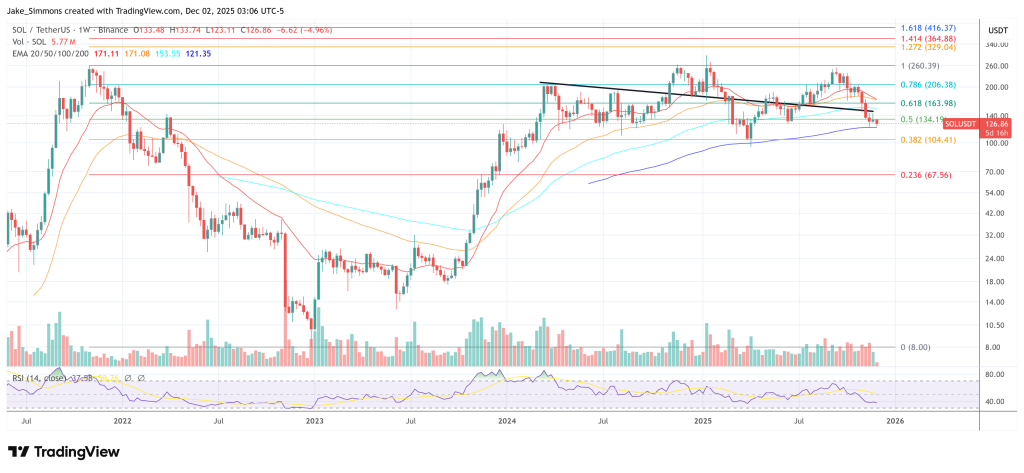
At press time, solana (SOL) traded at $126.86.