VanEck’s 2026 Bitcoin Forecast: No Melt-Up, No Crash - What’s Next?

Asset manager VanEck just threw cold water on the crypto community's wildest hopes and deepest fears. Their latest analysis suggests 2026 won't deliver the explosive, euphoric melt-up many bulls are praying for. It also won't bring the catastrophic crash bears are salivating over.
The Middle Path
Instead, the firm paints a picture of a more measured, potentially grinding trajectory. Think consolidation, not combustion. This forecast challenges the binary thinking that dominates crypto Twitter—where every prediction is either a rocket to the moon or a plunge to zero.
A Dose of Reality for the 'Number Go Up' Crowd
For investors conditioned to boom-bust cycles, this is a sobering outlook. It implies that the easy money from simply 'hodling' through parabolic rallies might get harder to find. The next phase could demand more nuance than diamond hands.
Of course, in an asset class where 'financial advisors' are often just guys with animated profile pictures, a forecast for stability is perhaps the most shocking prediction of all.
Bitcoin Prediction For 2026: What To Expect
“That pattern suggests 2026 is more likely a consolidation year. Not a melt-up. Not a collapse.” The more interesting part is the “why,” because VanEck isn’t leaning on a single factor. Sigel describes three lenses shaping the outlook, and they are not uniformly supportive. “Global liquidity is mixed. Likely rate cuts provide support. US liquidity is tightening somewhat.”
He ties that tightening to a specific macro dynamic: “AI-driven capex fears” colliding with a more fragile funding market and pushing credit spreads wider. Put differently, even if policy rates drift lower, the broader cost-of-capital environment can still work against risk-taking at the margin — especially where refinancing needs are persistent and investor selectivity is rising.
Against that backdrop, the portfolio guidance is measured. VanEck favors a “disciplined 1 to 3% bitcoin allocation,” built through dollar-cost averaging, with adds during leverage-driven dislocations and trims into speculative excess. It’s positioning for a market that oscillates, not one that trends cleanly.
Sigel also flags a topic that has shifted from niche to mainstream inside the Bitcoin community: quantum security. VanEck doesn’t present it as an imminent risk to the chain, but it does treat it as an organizing question that could draw serious attention.
“Quantum security has become an active topic. It’s not an immediate threat. A coordinated response could resemble the first blocksize debates.”
That last line matters more than it sounds. The blocksize era wasn’t only a technical dispute; it was a public process that pulled in new stakeholders, forced trade-offs into the open, and hardened long-term norms. VanEck’s suggestion is that, if quantum planning becomes a sustained coordination exercise, it could have a similar “transparent and technically rich” dynamic, messy, visible, and ultimately strengthening engagement.
Where VanEck is most constructive for 2026 is not necessarily spot BTC, but the capital cycle around Bitcoin mining. Sigel argues the strongest opportunity sits in what he calls the “capital-intensive pivot” as operators try to finance both hash-rate expansion and AI/HPC infrastructure simultaneously.
That combination is stretching balance sheets and widening dispersion across the sector: miners with hyperscaler partnerships can raise straight debt on comparatively favorable terms, while weaker names are pushed toward dilutive converts or selling BTC into weakness.
“This creates the cleanest consolidation setup since 2020 to 2021. The best risk-reward is in miners transitioning into energy-backed compute platforms. Credible HPC economics, advantaged power, and financing paths that avoid serial dilution.”
A second opportunity set is digital payments and stablecoin settlement, but VanEck is selective. Sigel sees stablecoins moving into real B2B payment flows, improving working capital management and lowering cross-border settlement costs.
“The more investable angle may sit in fintech and e-commerce platforms that can unlock margin leverage by shifting supplier payments, payouts, and cross-border settlement onto stablecoins. High-throughput chains will support much of this activity, and a few tokens tied to genuine usage may benefit, but we believe the most durable opportunity may lie in the operating companies enabling adoption rather than in broad token exposure,” Sigel writes.
The overall message is not bearish, and it is not euphoric. It is, in a very deliberate way, a call for discipline: expect range-bound conditions, look for dislocations, and focus on parts of the ecosystem where balance-sheet stress and real-world adoption can create asymmetry.
At press time, Bitcoin traded at $87,423.
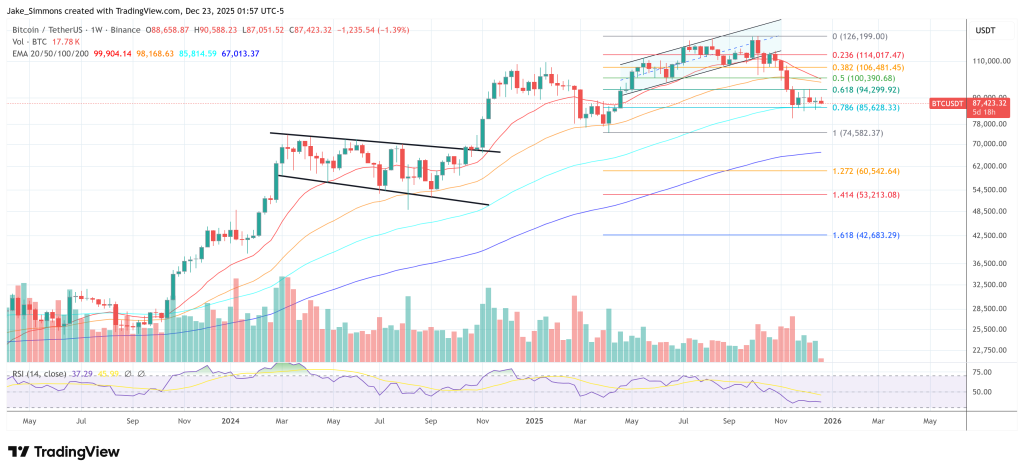
Featured image created with DALL.E, chart from TradingView.com
