Bitcoin’s Cooling Network Activity: The Market’s Most Honest Signal Just Flashed

Bitcoin's blockchain just got quiet. Too quiet. The network's cooling metrics aren't just a technical footnote—they're a real-time, unfiltered read on trader sentiment, and the signal is flashing amber.
Decoding the On-Chain Whisper
Forget the hype on financial news networks. The most honest gauge of crypto market health lives on the blockchain itself. When network activity—new addresses, transaction volume, miner engagement—starts to dip, it's not a glitch. It's capital taking a breath. This cooling phase often reflects a market in consolidation, where the fever pitch of a rally gives way to cautious evaluation. It's the digital asset equivalent of a crowded trading floor suddenly falling silent.
A Pause, Not a Breakdown
This isn't a failure of the protocol. Bitcoin's network is designed for these ebbs and flows. A cooling period can signal a healthy digestion of recent gains, shaking out speculative froth—the kind that gets celebrated as 'genius' in a bull market but magically becomes 'unforeseen risk' when the tide goes out. It builds a stronger foundation for the next leg up, as only committed capital remains.
The data doesn't lie. While headlines chase price swings, the network's underlying rhythm offers a clearer story. A lull in activity confirms the market's present state of watchful waiting. It's a reminder that in crypto, sometimes the loudest message is the one sent in silence.
Network Activity Slows Down Amid Waning Bitcoin Price Action
With Bitcoin’s price persistently demonstrating bearish performance, on-chain activity appears to have undergone a crucial shift. What appeared to be a typical decline is now exposing more profound shifts in on-chain activity, long-term holdings, and traders’ behavior.
Presently, Bitcoin’s network activity is entering a noticeably calmer phase, which provides a clear picture of the market’s current status. In the quick-take post, GugaOnChain revealed the BTC Bull-Bear Cycle indicator and the MA_30D below the MA_365D (-0.52%), both of which confirm that the BTC market remains in a bear market.
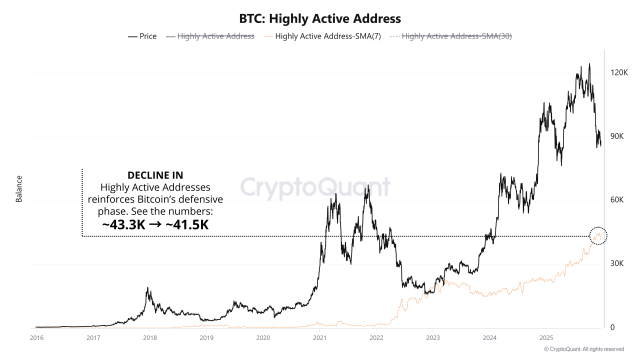
However, the platform’s analysis of the current market state is mainly centered on the bitcoin Highly Active Address metric. This key metric points to a slowdown in the BTC Network. A look at the chart reveals a steady drop in the highly active BTC addresses, reinforcing lower speculative activity and suggesting that higher volatility lies ahead.
Following the sharp pullback, highly active BTC addresses have declined from 43,300 to 41,500, indicating that large players are exiting the market, consistent with a defensive phase. Historically, whenever highly active addresses shrike, it signals a retreat by traders and institutions, which supports the transition into quiet accumulation phases that lead to future volatility.
Furthermore, the data shows that the total number of transactions on the network has fallen from 460,000 to 438,000 over the past few days. GugaOnChain highlighted that when there is a lower transaction count, there is a reduction in speculative use.
It is worth noting that dropping transaction counts were an obvious symptom of waning speculative interest in previous down cycles, and the Bitcoin network operated at reduced volumes until fresh catalysts emerged.
Another aspect that has experienced a decline is the network fees. Data shows that the fees fell from 233,000 to 230,000, suggesting a less congested network. During previous bear markets, lower fees often coincided with periods of weaker demand, showing that users were not vying for block space and fostering a low-pressure environment.
How Does The Current Trend Go Against The 2018 Market Cycle
According to the platform, the current data from the metric is similar to that observed in the 2018 bear market. During the period, there were also fewer active addresses, fading transactions, lower fees, and the retreat of major players, as seen in the current state of the market.
However, the Bitcoin user base today is larger, with over 800,000 compared to the 600,000 in 2018; a sign of structural resilience. Meanwhile, low activity frequently precedes increased volatility, just as it did in the past.
GugaOnChain stated that the indicators confirm a defensive scenario, and future comparisons with 2018 indicate that periods of low activity typically precede more volatility. Nonetheless, the larger user base of today indicates increased ecological resilience.
