Ethereum’s On-Chain Stalemate: Muted Flows Signal Market Indecision Ahead of 2026

Ethereum's blockchain is whispering what traders won't say—everyone's waiting.
The network's vital signs have flatlined. Transaction volumes aren't crashing, they're just... hovering. New capital isn't fleeing, but it's not exactly rushing in either. It's the financial equivalent of a room full of people all waiting for someone else to make the first move.
The Data Doesn't Lie, It Just Shrugs
Check the chain and you'll find a story of pure equilibrium. No giant whale movements sucking liquidity from the pool. No retail stampede creating network congestion. The metrics show a market perfectly balanced between fear and greed—which is another way of saying it's paralyzed by both.
This isn't a technical problem. The network hums along, processing transactions at its usual pace. The smart contracts execute flawlessly. The issue is purely human: collective uncertainty about what comes next.
Breaking the Limbo
Markets hate vacuums. This stalemate won't last. It typically breaks one of two ways—a surge of new development and adoption that pulls price higher, or an external shock that triggers the sell-off everyone's secretly preparing for. The on-chain data will show the shift weeks before the headlines catch up.
For now, Ethereum trades sideways while its blockchain keeps perfect minutes of the market's indecision. It's a masterclass in how decentralized ledgers record not just transactions, but trader psychology—complete with all the hesitation of traditional finance, just with better transparency and slightly fewer suits making nervous jokes about their yacht payments.
Muted Layer-2 Flows Reflect Ethereum’s Stalemate
A recent report from CryptoOnchain highlights that Ethereum’s price stagnation is being closely mirrored by on-chain behavior. Weekly ETH netflows on Arbitrum, one of Ethereum’s most important Layer-2 networks and a common proxy for smart-money positioning and DeFi activity, remain subdued and highly choppy.
Rather than showing a clear inflow or outflow trend, the data reflects a market operating without strong conviction, reinforcing the idea that larger participants are choosing to remain on the sidelines.
This lack of directional FLOW suggests that capital is not aggressively entering or exiting the ecosystem. Instead, investors appear to be waiting for clearer macroeconomic signals or a definitive shift in market structure before committing.
In previous cycles, sustained expansions in Arbitrum netflows have often coincided with periods of renewed risk appetite or decisive trend changes. The current inactivity stands in sharp contrast to those environments.
The alignment between compressed price action around key support levels and dormant on-chain activity points to a buildup of latent energy within the market. Ethereum is effectively coiling. While this equilibrium can persist for extended periods, it rarely resolves quietly. When the balance breaks, moves tend to be swift and forceful.
Arbitrum netflow is now a critical metric to watch. A sudden and sustained expansion in flows could act as an early signal that this prolonged phase of indecision is nearing its resolution, potentially setting the direction for Ethereum’s next major move.

Ethereum is trading near the $2,970 level on the daily chart, attempting to stabilize after an extended decline from the $4,800 highs recorded earlier this cycle. While recent candles show modest recovery attempts, the broader structure remains fragile. ETH continues to print lower highs and lower lows, signaling that bearish momentum has not yet been invalidated despite short-term relief bounces.
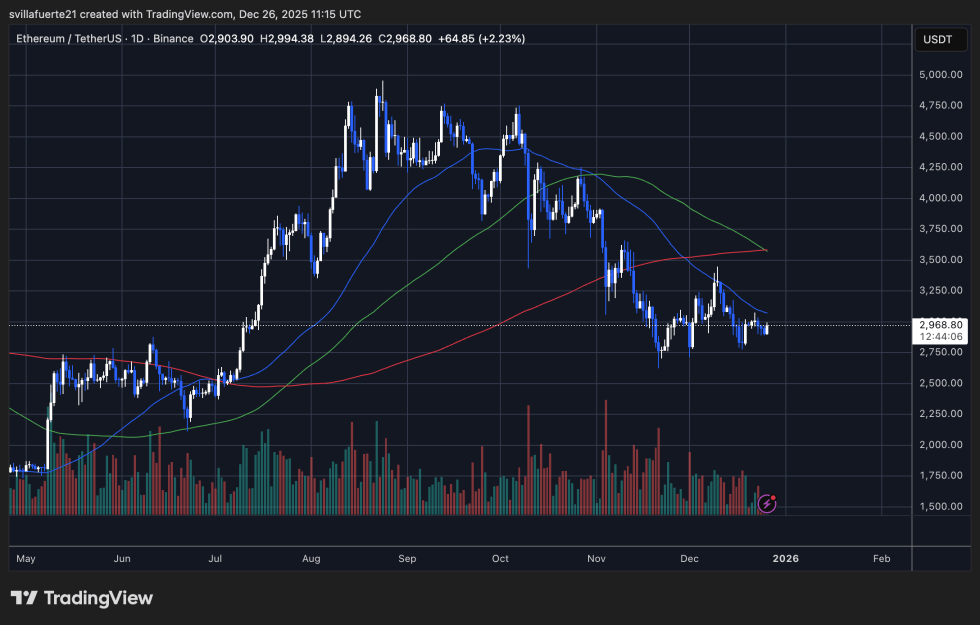
Technically, price remains below its key daily moving averages. The faster moving average has rolled over sharply and is acting as immediate resistance, while the 111-day and 200-day simple moving averages converge in the $3,300–$3,600 range. This cluster forms a heavy overhead supply zone, limiting the probability of a sustained upside MOVE unless volume and momentum expand meaningfully.
The recent bounce from the $2,800–$2,900 area has helped Ethereum avoid a deeper breakdown for now. However, this move has occurred on relatively muted volume, suggesting a lack of conviction from buyers. In contrast, the initial leg lower was accompanied by strong selling pressure, reinforcing the idea that the dominant trend remains to the downside.
From a structural standpoint, the $2,800 level remains critical support. A decisive break below this zone WOULD likely accelerate losses and confirm bearish continuation. Conversely, for Ethereum to shift momentum, price must reclaim $3,200–$3,300 and hold above its declining daily averages.
Featured image from ChatGPT, chart from TradingView.com
