Samourai Co-Founder Writes From Prison After Surrender: ’Confusing And Unnatural’ - Inside the Crypto Privacy Crackdown

From behind bars, a key architect of crypto privacy breaks his silence.
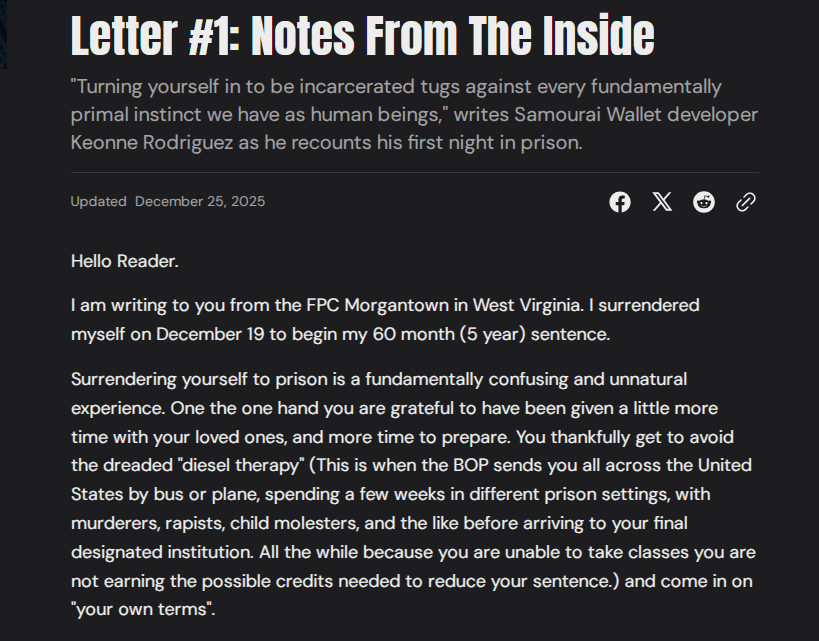
Samourai Wallet co-founder Keonne Rodriguez penned his first public letter since surrendering to authorities earlier this month. The message, shared with supporters, describes the entire legal process as "confusing and unnatural"—a stark human perspective from the heart of the U.S. government's escalating war on financial anonymity tools.
The Indictment That Shook Privacy Tech
Federal prosecutors didn't mince words. They labeled Samourai Wallet a "criminal tool," alleging it facilitated over $2 billion in unlawful transactions and laundered more than $100 million in criminal proceeds. The platform's mixing service, Whirlpool, became a central focus, accused of obscuring the trail of funds from dark web markets and hacking schemes.
The arrest of Rodriguez and co-founder William Lonergan Hill sent shockwaves through the crypto-privacy community. It marked a decisive shift from targeting rogue exchanges to prosecuting the developers of non-custodial, open-source software itself—a precedent that has developers worldwide reviewing their code with newfound anxiety.
A Tool or a Weapon? The Core Debate
This case cuts to the core of a fundamental crypto tension: the right to financial privacy versus the state's mandate to police illicit flows. Supporters frame Samourai as essential privacy tech, no different than a VPN for your bitcoin. The Department of Justice sees a sophisticated money transmitter operating without a license, willfully blind to the criminal empires using its service.
The founders face a combined maximum of 25 years if convicted on charges of conspiracy to commit money laundering and operating an unlicensed money transmitting business. The severity of the potential sentence underscores the government's intent to set a harsh example.
The Chilling Effect on Innovation
Beyond the courtroom, the real battle is for the future of open-source development. Can a developer be held liable for how others use their neutral tool? The crypto industry is watching, knowing the answer could reshape innovation. Some projects have already begun geo-blocking U.S. users or preemptively shutting down features.
It's a classic regulatory squeeze—innovate in a gray area, attract massive volume, and then wait for the hammer to drop. A cynical finance veteran might note it's a profitable business model until it isn't, with the legal bill serving as the final, brutal margin call.
Rodriguez's letter from prison isn't just a personal account. It's the first draft of a defense that will play out in legal briefs and on crypto Twitter for months. His confusion mirrors the industry's own: when does building privacy become a crime? The answer will define the next era of digital money—and determine who gets to build it from a prison cell.
Inside The Prison Letter
Rodriguez wrote that he had gone through searches and medical checks during intake, and that he was settling in after what he called an emotional goodbye to family days before the holiday.
The note was dated Christmas Eve and marked his seventh day at the facility. Reports said his wife was scheduled as his first visitor on Christmas Day. Those details make the timing — and the human side of the story — hard to miss.
Rodriguez was sentenced on Nov. 19 on charges tied to his role in a crypto mixing protocol. His case has become a touchpoint for a wider dispute about whether building or maintaining privacy software can carry criminal liability when others misuse those tools.
The debate has drawn comparisons to the prosecution of Roman Storm, a co-founder of Tornado Cash, and raised questions about how the law treats open-source code and the people who write it.
Samourai: Legal Debate Over Code And Crime
Supporters say Rodriguez’s prosecution threatens free speech and software development. A petition asking for clemency gathered more than 12,000 signatures, and many privacy advocates argue that no direct victims were harmed by his work.
In public posts, Rodriguez framed his case as “lawfare” and criticized regulators and judges for targeting innovation. Those claims have been repeated widely in crypto circles.
Prosecutors argue differently. They point to the structure and promotion of certain tools and say some actors used them to hide illicit transfers.
Courts have faced the hard question of where to draw the line between code as neutral technology and code used to facilitate crime. That tension is central to why Rodriguez’s sentence has drawn such attention from developers, legal scholars, and privacy groups.

US President Donald TRUMP said on Dec. 16 that he would “take a look” at Rodriguez’s case after it gained public attention. That brief remark kept the possibility of executive clemency in public view, though such reviews do not always lead to action. Rodriguez publicly appealed to the president for a pardon as he began serving his sentence.
Public reaction has been mixed. Some see the petition and media coverage as a push to protect open-source developers. Others stress that courts will weigh evidence about intent and conduct, not just the code itself.
What remains clear is that this case has pulled the issue into the open and made it harder for lawmakers and courts to ignore.
Featured image from Cyber Security News, chart from TradingView
