Galaxy Digital Moves $39M In Bitcoin To Exchanges – Is This The Start Of A Major Sell-Off?

A whale-sized Bitcoin transaction just hit the radar, and it's got the market buzzing. Galaxy Digital, the crypto-focused financial services firm, shifted a cool $39 million worth of BTC to major exchanges. That's not pocket change—it's a move that typically signals one thing: preparation to sell.
The Setup
Institutional players don't move nine figures on a whim. Transferring assets from cold storage to an exchange is the final step before an order hits the books. It's the crypto equivalent of a fighter rolling their shoulders in the corner—the action hasn't started, but everyone knows what's coming next.
Reading the Tea Leaves
The timing is everything. Was this a routine portfolio rebalance? A strategic deployment of capital for another play? Or is it a classic case of 'buy the rumor, sell the news' playing out at an institutional level? The market's knee-jerk reaction is often to brace for impact, assuming the big players know something the retail crowd doesn't. Sometimes they do. Sometimes they're just as reactive as everyone else, just with more zeros on the screen.
The Ripple Effect
Watch the order books. A single large sell order can create temporary slippage, but sustained selling pressure from a major holder can test key support levels. It forces the question: are other institutions waiting in the wings with similar plans, or is Galaxy going solo here?
The Bottom Line
One firm's treasury management is another's panic signal. In the hyper-volatile world of crypto, a $39 million move is a headline. Whether it becomes a trend depends on what happens next—does the BTC get sold, or does it just take a vacation on an exchange wallet? It's a stark reminder that in this market, 'long-term holding' is often just a story told until the profit-taking becomes too tempting to ignore. After all, even the most bullish narratives eventually meet their maker: a spreadsheet.

Adding to the significance, Darkfost notes that an additional 200 BTC were moved just a few hours later, reinforcing the idea that this was not an isolated operational transfer. In total, the movements represent a sizable amount of Bitcoin entering exchange venues during a period of low conviction and compressed price action. Such timing naturally raises concerns about renewed sell-side pressure, especially as Bitcoin continues to struggle below key resistance levels.
What stands out further is the historical context. It has been nearly one month since Galaxy Digital last transferred such a large quantity of BTC to exchanges. This pause suggests that the firm had largely remained inactive on the sell side throughout December, making the latest activity a notable change in behavior.
While institutional transfers do not always translate into immediate market selling, they often precede shifts in short-term liquidity. As Bitcoin remains range-bound, Galaxy Digital’s renewed exchange activity could influence near-term price dynamics, particularly if broader sentiment fails to improve.
Bitcoin Testing Structural Demand Level
Bitcoin’s price action on the higher timeframe reflects a market stuck between structural support and persistent overhead pressure. After peaking above the $120,000 region earlier in the cycle, BTC has entered a clear corrective and consolidation phase, with price now trading NEAR $87,300. The chart shows that Bitcoin has decisively lost the 50-day moving average (blue), which has rolled over and is acting as dynamic resistance during rebound attempts.
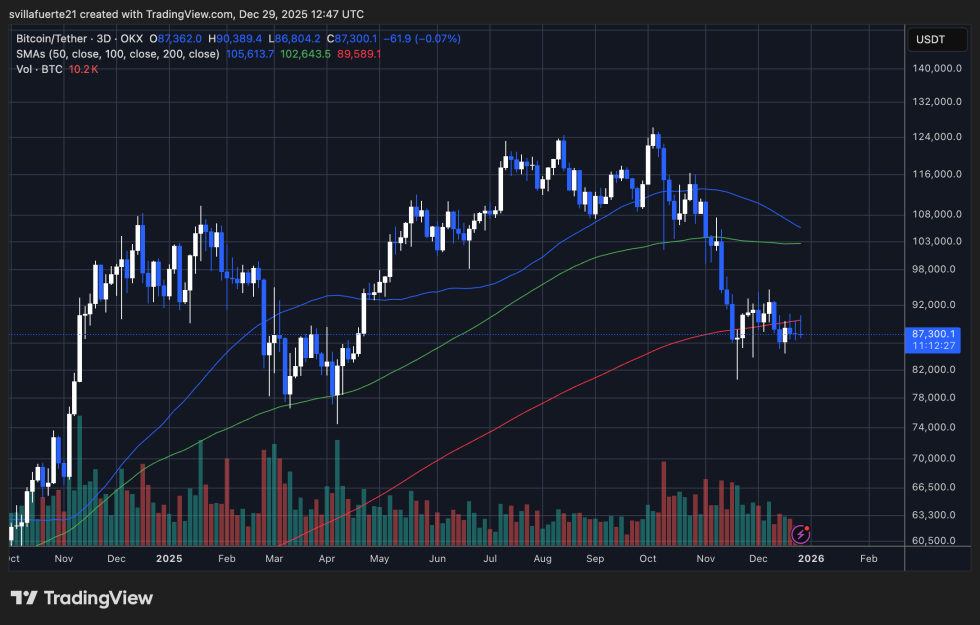
More importantly, price is now compressing between the 100-day moving average (green) and the 200-day moving average (red). The 200-day MA, currently just below the $90,000 zone, has become a critical pivot. Multiple recent candles show rejection near this level, confirming it as a major supply area. As long as BTC remains below the 200-day MA, upside momentum is structurally limited.
On the downside, the market has so far managed to defend the $85,000–$86,000 region, which aligns with prior consolidation and acts as short-term support. Volume has declined compared to the impulsive phases earlier in the trend, reinforcing the idea that the market is in a waiting mode rather than trending aggressively.
From a broader perspective, the sequence of lower highs since October signals weakening bullish control, but the absence of a sharp breakdown below long-term averages suggests distribution rather than panic. Bitcoin remains range-bound, and a decisive MOVE above the 200-day MA or a breakdown below $85,000 will likely determine the next directional phase.
Featured image from ChatGPT, chart from TradingView.com
