Ethereum’s 2026 Turning Point: Supply-Demand Structure Signals Major Shift Ahead

Ethereum's economic engine is quietly rewriting its own rulebook. Forget the daily price chatter—the real story is unfolding in the underlying mechanics that could redefine its value proposition by 2026.
The Coming Squeeze
On-chain data points to a fundamental supply-demand rebalancing. The network's post-merge issuance model, combined with accelerating burn mechanisms from layer-2 scaling, is setting the stage for a structural shift. It's not about hype; it's about arithmetic. The deflationary pressure isn't a maybe—it's a when.
Demand's New Frontiers
Meanwhile, demand vectors are multiplying. Real-world asset tokenization isn't a buzzword anymore; it's a pipeline. Institutional staking, once cautious, is now building positions. And the decentralized app ecosystem? It's quietly eating traditional finance's lunch, one automated smart contract at a time. The network is becoming its own biggest customer.
The 2026 Inflection
Analysts tracking the convergence timeline see 2026 as the pivot year. That's when the cumulative effects of reduced new supply meet scaled transactional demand. It's the point where the economics potentially flip from 'crypto asset' to 'digital commodity'—a shift Wall Street might finally understand, albeit two years late with a hefty management fee attached.
This isn't prediction; it's projection based on visible, on-chain trajectories. The code doesn't lie. By 2026, Ethereum's market narrative may be forced to graduate from speculative trading to fundamental scarcity. The turning point isn't coming—it's being built, block by verifiable block.
Ethereum’s On-Chain Structure Improves As Price Weakness Persists
While Ethereum continues to struggle below key resistance levels, on-chain indicators suggest that the underlying market structure may be gradually improving. Data shows ETH leaving exchanges at the fastest pace of this cycle, a move increasingly associated with self-custody, staking, and long-term holding rather than short-term trading activity.
This shift is reinforced by validator queue dynamics: for the first time in six months, the entry queue has surpassed the exit queue, with roughly 745,000 ETH waiting to be staked versus around 360,000 ETH queued for withdrawal. The imbalance points to renewed staking participation and a tightening medium- to long-term supply profile.
Additional context comes from the 90-day Spot Taker CVD, which indicates a transition away from strongly sell-dominant conditions toward neutral to mildly positive pressure. Although this does not imply an immediate price rebound, it suggests that aggressive selling is beginning to lose intensity.

That said, Ethereum ETF flows remain negative on both daily and weekly timeframes, signaling that institutional demand via financial products continues to weigh on price action.
Beyond market flows, Ethereum’s network activity remains resilient. Deployed smart contracts reached a record 8.7 million in Q4 2025, while on-chain real-world asset value expanded to approximately $19 billion, led by Ethereum. These trends indicate that usage-driven demand remains intact despite weak sentiment.
The data support a scenario of ongoing price pressure alongside gradual structural improvement. This assessment WOULD weaken if exchange balances rise again or sell-side flows regain dominance.
Price Remains Below Key Moving Averages
Ethereum continues to trade in a tight consolidation NEAR the $2,900–$3,000 zone, reflecting persistent indecision after the sharp correction from the $4,800 cycle peak. The chart shows ETH struggling to reclaim the 50-day and 100-day moving averages, which are now acting as dynamic resistance around the $3,200–$3,600 region. Each attempt to push higher has been met with selling pressure, reinforcing the broader bearish structure that has been in place since November.
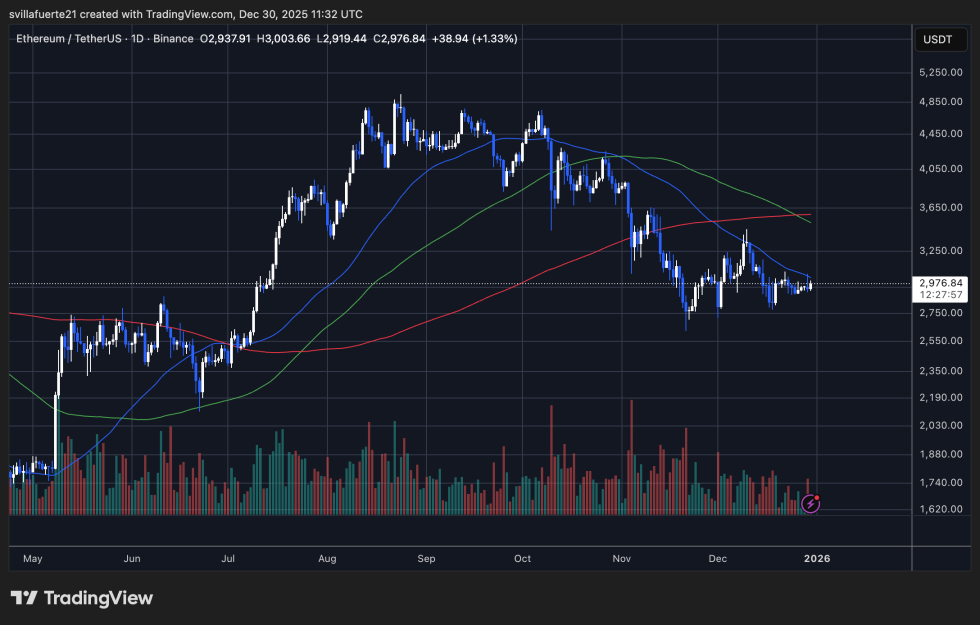
From a trend perspective, price remains below the declining short-term moving average, while the 200-day moving average near the $3,500 area continues to slope downward. This configuration signals that Ethereum is still trading in a corrective phase rather than a confirmed recovery.
However, downside momentum appears to be weakening. The recent series of higher lows around $2,750–$2,800 suggests that buyers are defending this range as a short-term demand zone.
Volume has also compressed during the latest consolidation, a sign that aggressive selling may be losing intensity. This aligns with the broader narrative of exhaustion rather than renewed capitulation. Still, without a decisive reclaim of $3,200 and a MOVE back above the 50-day average, any upside attempts remain vulnerable.
Featured image from ChatGPT, chart from TradingView.com
