Bitcoin’s Big Shift: Key Data Reveals Long-Term Holders Are Finally Stopping Distribution

The sell-off might be over. New on-chain data points to a dramatic behavioral shift among Bitcoin's most committed investors—the long-term holders (LTHs). Their wallets are locking up, not cashing out. This isn't just a pause; it's a potential inflection point signaling a major supply squeeze.
The Data Behind the Dry-Up
For months, the market narrative centered on distribution. Long-term holders, those who've held coins for over 155 days, were consistently moving assets to exchanges, adding relentless sell-side pressure. That flow has now flatlined. The metrics are clear: the LTH spent output volume, a key gauge of selling, has plunged to levels not seen since the last cycle's accumulation phase. The whales are going dormant.
Why This Time Is Different
Past cycles show this pattern isn't random. When LTHs stop distributing en masse, it typically precedes a period of price discovery where new demand meets a shrinking available supply. It's the calm before the storm—a storm of bids chasing a limited number of coins. The hodl mentality is reasserting itself with a vengeance, suggesting the weak hands have already been shaken out. The remaining holders aren't selling for a quick profit; they're waiting for a number with more zeros.
The Road Ahead: Scarcity in Action
If this trend holds, the implications are stark. With institutional ETFs vacuuming up daily issuance and long-term investors going into hibernation, the liquid supply of Bitcoin is set to tighten dramatically. This creates a textbook setup for volatility—but this time, to the upside. The market's next move hinges on whether fresh capital steps in to meet this structural scarcity. One thing's for sure: the old playbook of waiting for veteran holders to bail out the market at every peak—a favorite pastime of underfunded hedge funds—just got ripped up.

After adjusting the data to exclude this anomaly, a clear change in supply dynamics emerges. Rather than accelerating distribution, the adjusted chart shows signs that long-term holder supply is stabilizing, and in some cases beginning to recover. This challenges the dominant bearish narrative and suggests that selling pressure from seasoned holders may be fading.
As bitcoin consolidates below key resistance, the divergence between price weakness and shifting on-chain behavior sets the stage for a critical inflection point ahead.
Long-Term Holders Reduce Selling PressureDarkfost adds important context to the evolving Bitcoin narrative by focusing on long-term holder (LTH) supply dynamics. According to his analysis, the monthly LTH supply change—measured as a 30-day rolling sum—had remained firmly locked in a distribution phase since July 16.
For several months, this metric consistently showed negative readings, confirming that long-term holders were gradually reducing their exposure and releasing supply into the market.
That trend has now shifted. The latest data shows the metric moving back into positive territory, with approximately 10,700 BTC transitioning into long-term held coins. While this figure is still relatively small in absolute terms, it marks a clear inflection from sustained distribution to early re-accumulation.
In practical terms, it suggests that LTHs have slowed their selling activity to the point where their aggregate supply is beginning to grow again.
This shift is particularly notable because it is occurring while short-term holders (STHs) continue to hold their positions rather than aggressively selling. The combination points to a cooling of sell-side pressure from both cohorts, even as price remains under pressure.
Historically, similar transitions in LTH supply behavior have often preceded periods of sideways consolidation or, in more constructive cases, the early stages of bullish recoveries.
While this signal alone does not guarantee an upside move, it does suggest that the market may be moving away from forced distribution and toward a more balanced phase, depending on how broader macro and price trends develop.
Bitcoin Consolidates Above Long-Term SupportBitcoin’s price action continues to reflect a market caught between structural support and lingering downside pressure. After failing to hold above the $100K–$105K region earlier in the quarter, BTC entered a sharp corrective phase that accelerated into November. That move pushed price decisively below the 50-day and 100-day moving averages, confirming a short-term trend shift from expansion to contraction.
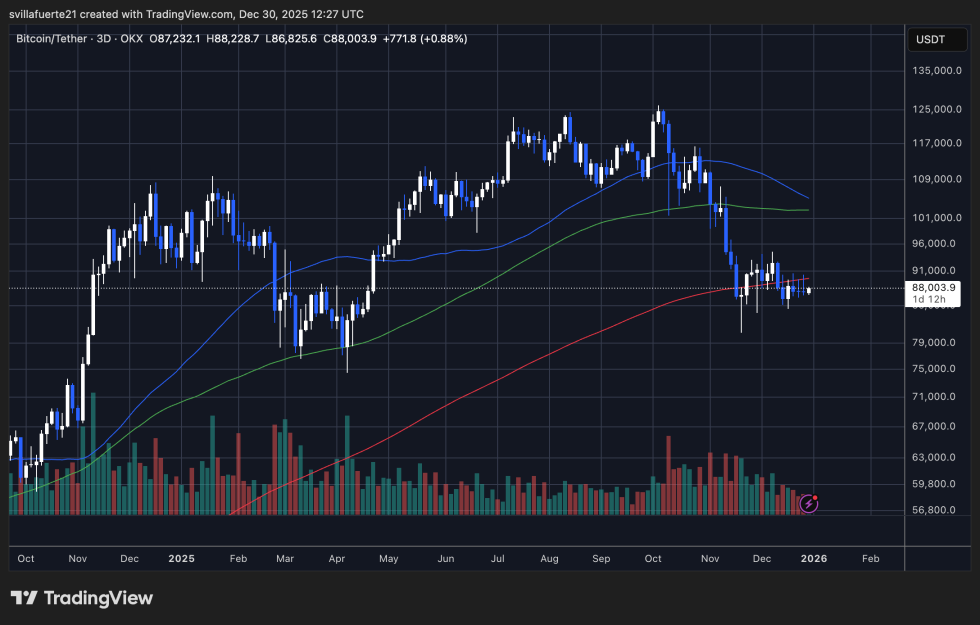
At present, Bitcoin is consolidating around the $88K zone, hovering just above the rising 200-day moving average, which sits slightly lower and continues to act as a critical long-term support.
This area has become a key battleground: repeated downside wicks suggest buyers are defending the level, but upside follow-through remains limited. The declining slope of the shorter moving averages reinforces the idea that bullish momentum has not yet returned.
Volume dynamics also support a consolidation narrative rather than active accumulation. Selling pressure has eased compared to the November breakdown, but demand has not expanded meaningfully enough to reclaim prior resistance. Structurally, the market appears to be transitioning from a high-volatility selloff into a compression phase.
As long as BTC holds above the 200-day moving average, the broader bullish structure from earlier in the cycle remains technically intact. However, a failure to defend this level WOULD expose the $80K–$75K region as the next major support.
Featured image from ChatGPT, chart from TradingView.com
