Cardano Greenlights Critical Integrations Budget in Landmark Governance Vote

The Cardano network just flexed its governance muscles. A key vote has passed, unlocking a critical budget for integrations that could reshape its ecosystem.
Governance in Action
Forget backroom deals. This was a transparent, on-chain decision by ADA holders. The community treasury is now primed to fund the technical bridges and partnerships that turn a standalone blockchain into a connected hub. It's a direct investment in utility.
Why This Vote Matters
Budgets are boring until they're not. This one funds the plumbing—the APIs, SDKs, and protocol work that let developers build without friction. It's a signal to builders: Cardano is open for business and ready to connect. No more working in a silo.
The Bigger Picture
In a space crowded with hype, this is substance. While some chains chase speculative narratives, Cardano's methodical, vote-driven funding targets long-term infrastructure. It’s a bet on interoperability as the next major value driver—a stark contrast to the 'vibe-based' investing plaguing the sector.
One cynical take? In traditional finance, this would involve months of committee reviews and consultant fees. Here, the stakeholders voted, the code executed, and the funds moved. A rare case of blockchain governance actually governing something tangible—not just another token vote for a mascot.
Why This Is Crucial For Cardano
The distinction matters in Cardano’s post-Voltaire governance flow. The Budget Info Action signals alignment around scope and direction, while the Treasury Withdrawal Action is the point at which the ecosystem’s intent is translated into an on-chain withdrawal, meaning governance scrutiny typically intensifies as the discussion moves from principle to disbursement.
EMURGO also used the moment to emphasize that the process is already yielding concrete outputs under what it called the “Critical Integrations framework,” describing coordination across the “Pentad” that includes Input Output (IOG), the Cardano Foundation, EMURGO, Intersect, and the Midnight Foundation.
Two integrations were highlighted as already confirmed. The first is PYTH Network, which EMURGO described as “real time, institutional-grade market data coming to Cardano,” aimed at supporting DeFi primitives that depend on robust price feeds. EMURGO pointed to use cases including “lending, derivatives, stablecoins, and onchain risk management,” underscoring that oracle availability remains a gating factor for more complex on-chain markets.
The second is Dune, which EMURGO said will bring “Cardano data integrated into a shared analytics platform used across the industry,” making on-chain activity “easier to analyze, compare, and build on.” For builders and funds that already rely on common analytics tooling across ecosystems, the pitch is straightforward: lower friction for monitoring cardano activity alongside other chains, and less bespoke infrastructure work to get dashboards, queries, and reporting into production.
EMURGO cast the vote outcome as an indicator of governance maturity and ecosystem alignment, explicitly thanking Constitutional Committee members and DReps for participation “even during the holiday period.” It also framed the timing as a setup for 2026 execution, writing that “this momentum reflects an ecosystem working together with a shared goal” and that Cardano is “positioned to enter 2026 stronger, more capable, and ready to support the next phase of ecosystem growth with these critical integrations in place.”
The near-term question now shifts to whether the Treasury Withdrawal Action maintains similar levels of support as the conversation moves from approvals to actual treasury spend, an inflection point that will test not just consensus, but the community’s appetite for follow-through on what “critical integrations” should look like in practice.
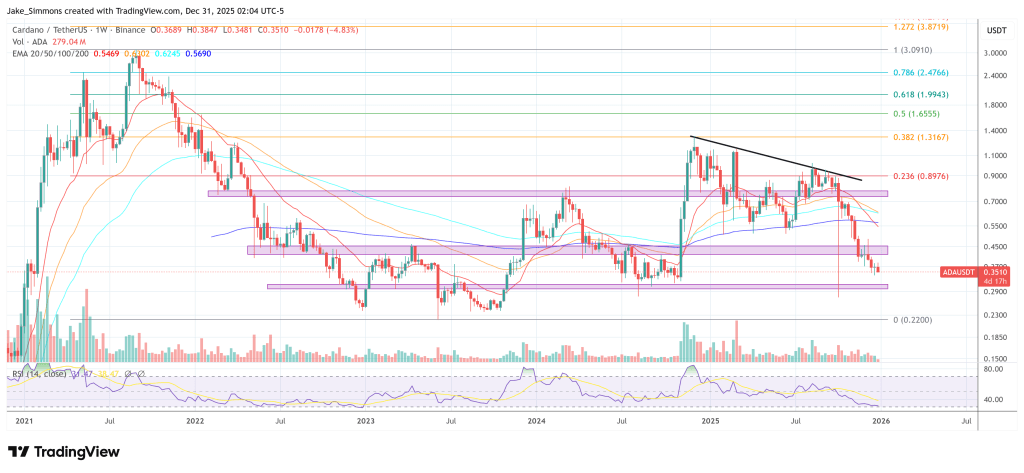
At press time, ADA traded at $0.351.