Ethereum TVL: The Silent Engine Driving ETH’s Price Stability and Ecosystem Expansion – Critical Insights

Forget the daily price swings. The real story for Ethereum's future is being written in its Total Value Locked.
TVL isn't just a metric; it's the bedrock. It represents the capital actively working within Ethereum's decentralized finance (DeFi) and application layer. More value locked means more utility, more fees burned, and a stronger economic moat against volatility. While traders chase headlines, the steady accumulation of TVL acts as a massive, institutional-grade shock absorber for ETH's price.
The Growth Flywheel in Action
Here's how it works: rising TVL signals robust ecosystem health, attracting developers to build the next killer dApp. Those new applications, in turn, pull in more users and more capital, further boosting TVL. This self-reinforcing cycle doesn't just support the price—it fundamentally revalues the network. It transforms ETH from a speculative asset into a productive, interest-bearing cornerstone of the new financial system. Every new protocol launch is a bet on this dynamic.
Beyond the Hype Cycle
This mechanism provides a crucial counter-narrative to crypto's boom-bust reputation. While other chains might spike on hype, Ethereum's TVL-driven stability offers a glimpse of maturity. It's the difference between a meme stock and a blue-chip with real cash flow—even if that cash flow is in digital potatoes and algorithmic stablecoins, much to the chagrin of traditional finance purists clutching their spreadsheets.
The bottom line? Watch the TVL, not just the ticker. The quiet accumulation of value on-chain is building a foundation that short-term market noise can't easily shake. That's the key to long-term stability and the next leg of growth.
Rising TVL Reinforces ETH’s Price Foundation
In the dynamic cryptocurrency landscape, Ethereum’s Total Value Locked (TVL) is still emerging as a subtle but powerful anchor for the altcoin’s long-term price stability and the growth of its evolving ecosystem. Over the past few years, this narrative has held strong, bolstering ETH’s price.
While short-term price action still varies with overall market sentiment, ETH’s core value is being reinforced by the consistent concentration of capital throughout the network. Milk Road, a crypto and macro researcher, stated that the price of the altcoin has increasingly tracked the amount of capital that is present on the network.
The development suggests that ETH’s valuation is becoming more structurally supported and less speculative. As a result, the network is maturing to a phase where price floors are primarily determined by utilization rather than hype.
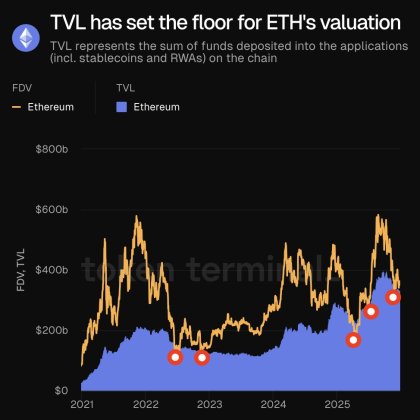
According to the expert, if the TVL expands meaningfully, the network’s economy simultaneously sees noticeable growth. This implies deeper liquidity, stronger collateral base, and more durable demand for block space and the network’s security.
Milk Road highlighted that non-speculative capital, such as stablecoins, treasuries, Real-World Assets (RWAs), and on-chain asset management, are likely the major drivers of the rising TVL. Meanwhile, as the capital flowing from these areas continues to scale, ETH’s floor also rises outside of bull markets.
However, it appears to be more difficult to break into bear markets. It is worth noting that the broader ecosystem’s resilience is strengthened when this occurs, and also improves the long-term valuation anchor.
Why You Shouldn’t Be An ETH Bear
After examining the value of ETH vs. the size of the ethereum ecosystem chart, Emperor Osmo, a data analyst and researcher, declares that being an ETH bear now is not an ideal choice despite the current bearish state of the market.
Osmo’s bold statement hinges on the major shift in Ethereum network fees. As blockspace becomes commoditized, the expert highlighted that ETH has moved from generating 90% of fees generated by Layer 1s to 2%. Despite this massive shift, the network continues to dominate in TVL and ecosystem growth.
The chart shows that ETH trades are at $353.2 billion while the ecosystem built on top of the network trades at $330 billion, representing a 1.1x premium. According to Osmo, this trend makes the assumption that there is no growth, no value capture, and no liquidity inflows.
At the time of writing, the ethereum price was trading near the $3,000 mark, after recording a nearly 1% increase over the last 24 hours. Its trading volume is moving in the opposite direction to ETH’s price, dropping by more than 13% in the past day.
