Vitalik Buterin Revives ’Milady’ Concept to Supercharge Ethereum’s World Computer Vision

Vitalik Buterin just dusted off an old idea—and it could reshape the entire internet.
The 'Milady' Revival
Forget stale roadmaps. Buterin's latest push resurrects the 'Milady' framework, a long-dormant blueprint for scaling Ethereum into a true global computational layer. This isn't about incremental upgrades; it's a foundational shift in how the network processes data and executes smart contracts.
Building the Unstoppable Machine
The core thrust bypasses traditional bottlenecks. By re-architecting state management and consensus around Milady's principles, Ethereum aims to finally deliver on its original promise: a decentralized world computer that rivals centralized cloud services in speed, but beats them on neutrality and resilience. Developers get a more robust playground; users get applications that don't rely on a single corporate server farm.
The Finance Angle (With a Jab)
Of course, the trading desks are already spinning this as the next narrative to pump bags. But look past the speculative noise. The real value isn't in a short-term price pop—it's in building infrastructure that makes today's fintech platforms look like dial-up internet. If Buterin's vision holds, Ethereum doesn't just host tokens; it becomes the backbone.
The race for the soul of the internet's next layer is on. And Ethereum just got a major software update.
Ethereum Must Deliver The World Computer
But the post’s center of gravity wasn’t a victory lap. It was a warning that the network is still falling short of its own stated goals and that chasing whatever narrative is currently printing attention is not the point.
Buterin drew a bright line between Ethereum’s long-term mission and trend-driven incentives that often dominate crypto cycles. “Ethereum needs to do more to meet its own stated goals,” he wrote. “Not the quest of ‘winning the next meta’ regardless of whether it’s tokenized dollars or political memecoins, not arbitrarily convincing people to help us fill up blockspace to make ETH ultrasound again, but the mission: To build the world computer that serves as a central infrastructure piece of a more free and open internet.”
From there, he offered a description of what “world computer” should mean in practice: decentralized applications that can’t be quietly altered or shut off, and that remain usable even when the companies and infrastructure most users take for granted fail.
“We’re building decentralized applications. Applications that run without fraud, censorship or third-party interference,” he wrote. “Applications that pass the walkaway test: they keep running even if the original developers disappear. Applications where if you’re a user, you don’t even notice if Cloudflare goes down — or even if all of Cloudflare gets hacked by North Korea.”
Buterin extended that same set of expectations beyond finance, explicitly name-checking identity, governance, and “whatever other civilizational infrastructure people want to build,” and he emphasized privacy as a Core property rather than a nice-to-have.
A notable thread in the post is that Buterin refuses to treat usability-at-scale and decentralization as a trade-off Ethereum can punt on. “To achieve this, it needs to be (i) usable, and usable at scale, and (ii) actually decentralized,” he wrote, arguing those requirements apply both to the base layer—“including the software we use to run and talk to the blockchain” and to the application layer.
That framing implicitly puts pressure on multiple constituencies at once: CORE protocol work, client diversity and quality, infrastructure that doesn’t centralize around a few providers, and dapp architectures that can survive developer abandonment while still meeting user expectations.
Buterin closed on a note of resolve rather than specifics, saying Ethereum has “powerful tools” but needs to apply them more aggressively. “All of these pieces must be improved — they are already being improved, but they must be improved more,” he wrote. “Fortunately, we have powerful tools on our side — but we need to apply them, and we will.”
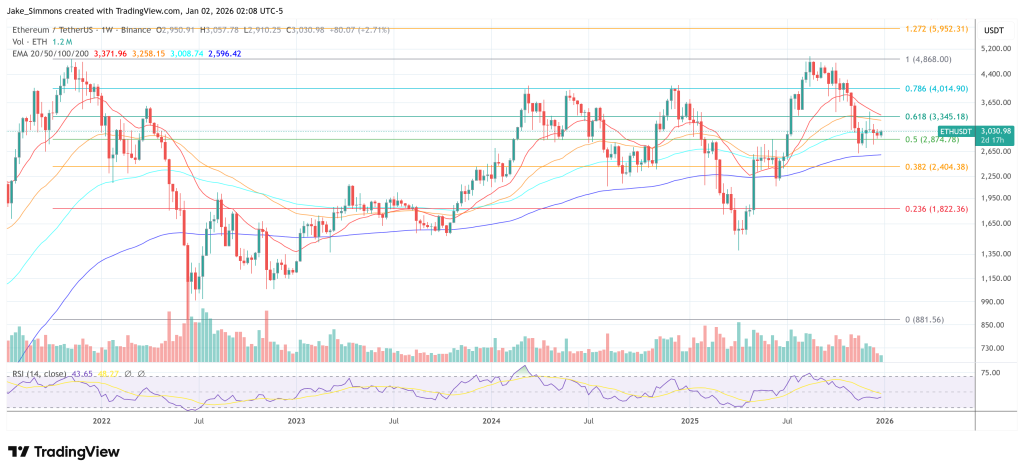
At press time, ETH traded at $3,030.