Peter Schiff Declares Bitcoin’s ’Good News’ Era Over in 2026 - What Comes Next?

Bitcoin's cheerleaders might want to sit down. Gold bug and perennial crypto skeptic Peter Schiff just fired a warning shot across the digital bow, declaring the era of easy wins and celebratory headlines officially over.
The Party's Over
For years, the narrative around Bitcoin was one of relentless ascent—halvings, institutional adoption, and regulatory nods fueled a seemingly unstoppable bull run. Schiff's latest pronouncement suggests the script has flipped. The market's moved past the phase where any positive development sends prices rocketing. Now, it's about fundamentals, or the perceived lack thereof.
New Rules, New Game
The implication is stark: the training wheels are off. No more riding the wave of hype cycles or speculative fervor. Assets get judged on utility, stability, and real-world function—metrics where a volatile, energy-intensive digital token can face brutal scrutiny. It's a shift from counting potential users to demanding proven ones.
Survival of the Fittest
This isn't necessarily a death knell, but a maturation alarm. Projects built on substance and clear use cases could thrive, while those propped up by memes and momentum face extinction. The market's entering a phase where it cuts the weak and bypasses the superficial, separating digital gold from digital fool's gold.
One cynic's prediction or a sobering reality check? Either way, the easy money era might be closing its doors, leaving only the true believers—and the ruthlessly pragmatic—to navigate what comes next. After all, on Wall Street, they don't throw parties for assets that start acting like, well, actual investments.
Schiff’s Bitcoin Prediction For 2026
In a Jan. 1 “Year-End Special” episode outlining his 2026 market forecasts, the renowned Bitcoin-critic argued that the cryptocurrency spent 2025 doing the one thing it wasn’t supposed to do in a year packed with pro-crypto narratives: fall. He framed that underperformance as the tell for what comes next.
Schiff contrasted BTC’s year against both risk assets and his preferred macro hedges. Stocks finished 2025 higher, he cited the Dow up 13%, the S&P 500 up 16.4%, and the Nasdaq up 20.4%, while Gold rose 64% and silver more than doubled. Bitcoin, he said, was the outlier on the wrong side.
“Everybody on CNBC was pounding the table on when the year began was Bitcoin,” Schiff said, describing a narrative mix that included “a bitcoin president,” “a Bitcoin strategic reserve,” heavy corporate buying, and the growth of ETFs. “Bitcoin was one of the only things that was down on the year.”
He pointed to ETF performance to ground that claim, saying he checked where Bitcoin ETFs “closed […] because they’re done for the year,” and that they were “down just over 7.5% on the year,” even as the Nasdaq and gold posted large gains.
Then he delivered the Core of his setup: “If something doesn’t go up when everybody thinks it’s going to go up, that’s a pretty good indication that it’s going to go down,” he said. “If a market can’t go up on good news, that means all that good news is already priced into the market […] and that means all that it can do is go down.”
Strategy As The “Poster Boy” Stress Test
Schiff also used Strategy, the market’s most visible Leveraged Bitcoin proxy, as his preferred diagnostic for sentiment and structural demand.
He said Strategy finished 2025 at a new 52-week low and was “down 47.5% on the year” and “67% below its peak 52-week high,” calling it “the poster boy” for maximum BTC leverage. Schiff’s argument was not that Strategy failed to buy BTC but that the equity market was already pricing the downsides of the model.
Schiff went further, claiming Strategy’s five-year average BTC cost basis sits around $75,000, implying only a modest gain with Bitcoin NEAR $87,000. “That’s about a 16% gain, 3% a year over 5 years,” he said, arguing it undercut the pitch that the trade is a one-way compounding machine. He also claimed Strategy could not realistically exit at its average price without slippage, framing the “profit” as fragile in a liquidation scenario.
From there, Schiff extended the thesis into 2026 market structure: if Strategy slows or stops buying, and if ETF flows flip decisively negative, marginal demand may not be there when it’s needed. “The ETFs are selling now,” he said. “They’ve gone from big Bitcoin buyers to consistent Bitcoin sellers.”
While Schiff refrained from naming a BTC price target for 2026 in the video, the gold bug set a downside “minimum target” of about $50,000 mid-December 2025. He argued that Strategy could not fall as much as he expected without Bitcoin also taking a major leg lower.
Year-End Special: My 2026 Economic and Market Forecastshttps://t.co/pqy8bWJBjP
— Peter Schiff (@PeterSchiff) January 1, 2026
The Macro BackdropSchiff’s broader 2026 macro call was a mix of weaker growth, stickier inflation, and intensifying political pressure on monetary policy, conditions he expects to support precious metals and pressure Bitcoin.
He argued the Fed is already effectively back in easing mode: “it just went back to quantitative easing, even though it hasn’t officially acknowledged that that’s what it’s doing” and expects further rate cuts alongside a weakening dollar. He also tied tariffs to higher consumer prices and margin pressure, forecasting a 2026 environment where “the economy is going to be weak” while “inflation is going to be strong,” a combination he called “toxic.”
Schiff’s practical conclusion for crypto listeners was direct: he urged viewers to “get rid of your Bitcoin above $87,000,” while reiterating that he expects capital to rotate toward gold and silver as “the bloom comes off that crypto […] tulip.”
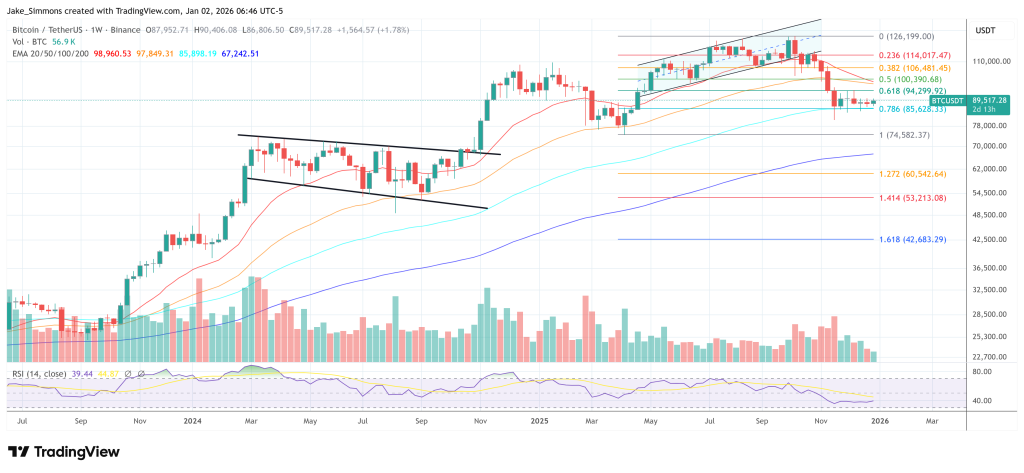
At press time, BTC traded at $89,517.