Ethereum’s 2026 Paradox: Technical Breakthroughs & Surging Adoption Defy Market Headwinds

Ethereum sends the market mixed signals as foundational upgrades clash with macroeconomic pressure.
The Bull Case: Building Through the Noise
Look past the daily price charts. The real story unfolds on-chain. Network activity isn't just holding—it's evolving. Major protocols are hitting throughput milestones once thought years away, while institutional onboarding pipelines are fuller than a pre-halving Bitcoin maximalist's Twitter feed. Developers aren't fleeing; they're building the next wave of applications on a more robust, scalable foundation. This isn't speculation—it's infrastructure.
The Bear Trap: Macro vs. Micro
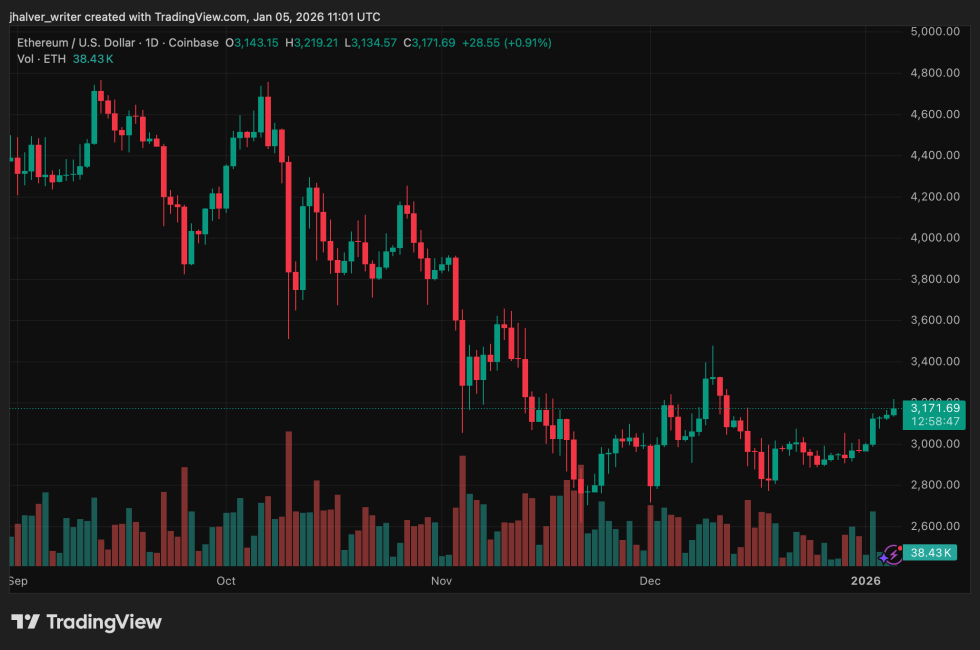
Meanwhile, traditional finance applies its old playbook. Interest rate whispers and equity market tremors send shockwaves through digital asset valuations, treating Ethereum like just another risky tech stock. It's a classic case of the market pricing the asset, not the network. The disconnect is stark: as technical metrics scream growth, broader risk-off sentiment applies a blunt-force discount. Some hedge funds are making bank on the volatility—proving once again that Wall Street profits whether the tech succeeds or fails.
The Verdict: A Stress Test for Conviction
This divergence creates the ultimate stress test. Is Ethereum a speculative asset or a global settlement layer? The current tension provides the answer. Short-term traders see uncertainty; long-term builders see a fire sale on blockchain real estate. The network's value proposition is being pressure-tested in real-time—and the core technology isn't blinking. Adoption curves rarely move in straight lines, but they're still pointing up. The signal will eventually drown out the noise.
Technical Progress and Network Upgrades
Recent comments from Ethereum co-founder Vitalik Buterin have drawn renewed attention to the progress on the blockchain trilemma, which is the challenge of balancing decentralization, security, and scalability.
According to Buterin, upgrades such as Peer Data Availability Sampling (PeerDAS) and zero-knowledge Ethereum VIRTUAL Machines (zkEVMs) have moved this goal from theory into live conditions on the mainnet.
PeerDAS, introduced with the Fusaka upgrade in December, reduces the burden on validators by allowing them to verify data availability through sampling rather than processing full datasets. This improves scalability while maintaining accessibility to participation.
At the same time, zkEVMs have reached an early operational stage, with proof generation times falling sharply and verification costs dropping significantly. While still in alpha, these systems are expected to assume a larger validation role between 2027 and 2030, following further security enhancements.
Alongside performance gains, Ethereum’s roadmap is shifting toward protocol safety. The Ethereum Foundation has set a target of achieving 128-bit provable security by late 2026, indicating that recent speed and cost improvements are now being matched with increasingly stringent security goals.
Ethereum (ETH) Adoption Shifts Toward Utility
Beyond Core protocol work, Ethereum’s usage metrics point to expanding adoption. Stablecoin transfer volume on the network exceeded $8 trillion in the fourth quarter of 2025, nearly doubling from earlier in the year.
Active addresses and daily transactions also reached record levels, reinforcing Ethereum’s role as a primary settlement LAYER for payments and tokenized assets.
Industry figures increasingly point to crypto-native neobanks as a key growth driver for 2026. These platforms combine self-custody, stablecoins, and yield products with familiar banking interfaces, lowering barriers for mainstream users.
Institutional participation in 2025, particularly through digital asset treasuries and staking-related structures, has helped lay the groundwork for this shift toward everyday financial use rather than short-term trading.
Market Pressure and Developer Momentum
Despite these developments, market flow data indicate that Ethereum remains under dominant selling pressure, reflecting a broader de-risking trend across cryptocurrency assets. This has limited upside and led to choppy price action, despite the emergence of positive narratives.
Similarly, developer activity tells a different story. An estimated 8.7 million smart contracts were deployed in the fourth quarter of 2025, the highest quarterly figure on record.
Taken together, Ethereum’s current signals point to consolidation rather than contraction. While market conditions continue to weigh on price, technical progress and rising adoption indicate the network is positioning itself for the next phase of growth once broader pressure eases.
Cover image from ChatGPT, ETHUSD chart from Tradingview
