PwC’s Crypto Caution Collapses: How US Digital Asset Rule Changes Sparked a Corporate Pivot

Big Four accounting giant PwC just ripped up its crypto risk playbook. New US regulations are flipping the script, turning digital assets from a compliance headache into a strategic asset.
The Regulatory Green Light
For years, corporate treasuries treated crypto like a radioactive ledger entry. The rules were murky, the tax implications a nightmare, and the auditors? They were the gatekeepers of 'no.' But a seismic shift in US digital asset policy just bulldozed those barriers. Clear custody rules, defined accounting standards, and a path for institutional adoption have arrived. PwC isn't just dipping a toe—it's building the pool.
From FUD to Fundamentals
The pivot is stark. Advisory teams are now structuring crypto holdings for balance sheets. Audit protocols are being rewritten to verify blockchain transactions, not just question their existence. It's a full-scale operational overhaul, driven by one simple fact: the rules of the game changed. When the biggest names in professional services move, the market notices. It signals that digital assets have graduated from speculative gamble to a legitimate—if volatile—financial instrument.
Corporate America's New Balance Sheet
This isn't about buying Bitcoin for the corporate yacht fund. This is about treasury diversification, hedging against currency devaluation, and tapping into a 24/7 global liquidity pool. Companies can now hold, transact, and report digital assets with a framework that satisfies even the most conservative boardroom. The floodgates for institutional capital are officially creaking open.
The bottom line? When the accountants give the all-clear, you know the asset class has moved from the fringe to the portfolio. Just don't expect them to stop charging by the hour for the privilege. Some traditions in finance, it seems, are truly blockchain-proof.
PwC Has Softened Its Stance On Crypto
According to a report from the Financial Times, PwC has changed its strategy around digital assets following the new laws passed by Donald Trump’s administration. PricewaterhouseCoopers, PwC in short, is a multinational professional services network headquartered in London. It provides services such as audits, tax planning, and business consulting to companies worldwide.
PwC is the second-largest firm of its kind and part of the Big Four accounting firms. Previously, the British company steered clear of crypto-related work in the US like other Big Four firms, but it seems that stance has now changed. The shift has come as the US has made advancements in its crypto regulatory framework. Among the new laws is the Genius Act, which regulates stablecoins, digital assets pegged to a fiat currency like the US Dollar (USD).
“The Genius Act and the regulatory rulemaking around stablecoin, I expect, will create more conviction around leaning into that product and that asset class,” said Paul Griggs, senior partner at PwC US, in an interview with FT.
Griggs added that PwC has been pitching companies on how they can use digital asset technology, with stablecoins as a means of improving payment systems’ efficiency, cited as one example.
PwC and other Big Four firms budging on crypto showcases the legislative momentum that the industry has had recently, with traditional finance increasingly unable to ignore the sector. Stablecoins, in particular, have been witnessing growing adoption. Beyond the American Genius Act, this class of digital assets also attracted regulatory attention in other parts of the world.
Hong Kong introduced a stablecoin issuer licensing framework last year, while Japan observed the launch of its first yen-based token. In Europe, major banks have come together to work on a euro-pegged coin, aiming to challenge the sector’s USD dominance. The positive regulation in 2025 meant that the space witnessed some sharp growth, with the market cap exploring new records, as data from DefiLlama shows.
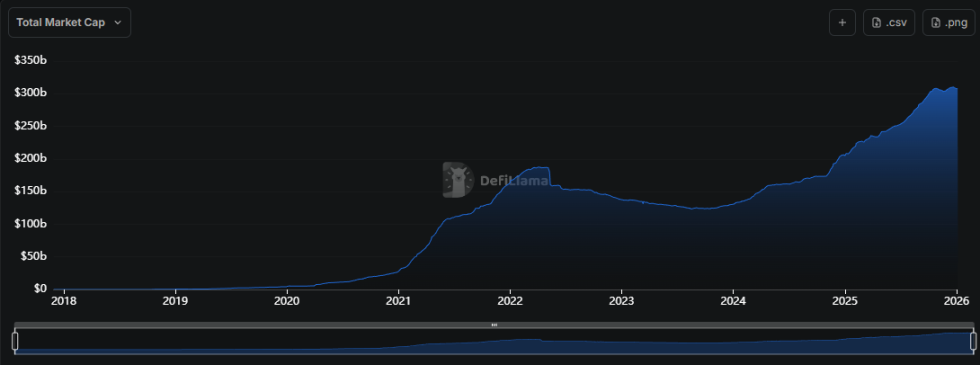
The sector hasn’t been unaffected by the wider slowdown in crypto since October, however. From the above chart, it’s visible that the stablecoin market cap has seen consolidation in the last few months.
Nonetheless, while other parts of the market have shrunken, these fiat-tied tokens still have their combined market cap sitting at $307 billion today, which is very close to the all-time high (ATH).
Bitcoin Price
At the time of writing, Bitcoin is trading around $92,900, up nearly 6% over the last week.
