3,200 Bitcoin In Motion: Galaxy Digital’s Moves Signal Potential Sell-Side Pressure Ahead

When a major institutional player shifts thousands of coins, the market holds its breath.
The Whale Watchers' Alert
Galaxy Digital's recent activity—moving a significant tranche of the original cryptocurrency—has traders scanning the horizon for incoming waves. That much digital gold changing wallets isn't a quiet event; it's a tremor felt across exchanges and OTC desks.
Liquidity vs. Leverage
Institutions don't move assets for fun. These transfers are chess moves, not checkers. The question isn't *if* but *when* and *where* that liquidity hits the market—and what kind of leverage is stacked against it. One fund's treasury management is another's signal to hedge.
The Ripple Effect
Potential sell-side pressure from a single entity can distort the order book, tempting algorithmic traders to front-run and shaking out weak hands. It’s a classic tension: long-term conviction versus short-term treasury needs. Sometimes, even the most bullish players need to cover a margin call on some other, less fortunate bet—welcome to modern finance, where diversification means being wrong in multiple asset classes at once.
The move is a stark reminder: in crypto's volatile seas, even digital fortresses can decide to lighten the load. Watch the bids.
Institutional Exchange Inflows Raise Short-Term Supply Risk
According to Darkfost’s analysis, a portion of the bitcoin recently moved by Galaxy Digital has already reached major centralized exchanges, including Binance, Bybit, and Coinbase. Notably, roughly 560 BTC—worth close to $50 million—were transferred to exchanges in a single day. In on-chain terms, this type of movement is significant because transfers to exchanges typically increase the probability that coins are being prepared for sale, hedging, or liquidity provision.

In the current market context, these flows carry added weight. Bitcoin is attempting to stabilize above key psychological levels, but overall sentiment remains cautious, and liquidity conditions are still tight. When large holders send coins to exchanges during such phases, it often introduces short-term supply risk, as even partial selling can weigh on price if spot demand is not strong enough to absorb it.
However, it is important to avoid overinterpreting a single data point. Institutional entities like Galaxy Digital manage large, diversified strategies that can include OTC sales, derivatives hedging, or internal reallocations. Not all exchange inflows result in immediate spot selling. That said, the timing is notable: these transfers are occurring while Bitcoin is still struggling to reclaim major resistance levels.
From a market perspective, this behavior reinforces a cautious stance. It suggests that some large players may be taking advantage of the recent rebound to reduce exposure or manage risk, rather than aggressively accumulating. As a result, continued monitoring of exchange inflows and follow-through selling pressure will be critical in assessing whether this rebound can sustain or faces renewed downside pressure.
Bitcoin Consolidates As Bulls Test Structural Resistance
Bitcoin’s weekly chart shows a market attempting to stabilize after a sharp corrective phase, with price now consolidating around the $93,000–$94,000 zone. The recent rebound has allowed BTC to reclaim territory above the weekly 50-period moving average, which currently acts as short-term dynamic support. This recovery signals that buyers are still active, particularly after the late-2025 sell-off pushed price toward the $85,000–$88,000 region.
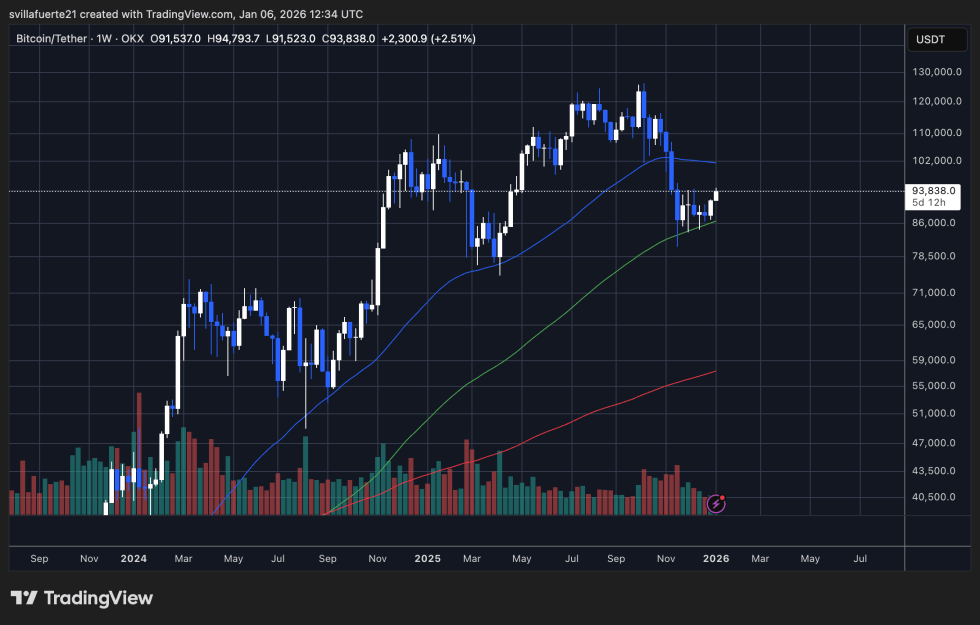
However, the structure remains mixed. Bitcoin is still trading below the declining weekly 100-period moving average, a level that has historically acted as a trend-defining resistance during transitional phases. The failure to reclaim this moving average on a weekly close suggests that bullish momentum, while improving, is not yet strong enough to confirm a full trend continuation.
The 200-period moving average remains far below the current price, reinforcing that the broader macro uptrend is intact, but near-term conditions remain fragile.
Volume has increased modestly during the rebound, indicating participation, though not at levels typically associated with strong breakout phases. This supports the view that the move higher may still be corrective rather than impulsive.
Bitcoin appears to be in a consolidation-to-recovery phase. Sustained acceptance above the $95,000–$100,000 zone would be required to shift the structure decisively bullish. Until then, price action suggests cautious Optimism rather than confirmation of a renewed uptrend.
Featured image from ChatGPT, chart from TradingView.com
