Ripple President Reveals $500 Million Strategy: No IPO, No Exchange, Bigger Ambitions Ahead

Ripple's leadership just dropped a bombshell—and it's not the one Wall Street was waiting for. The fintech giant secured a massive half-billion-dollar war chest, but President Monica Long made it clear: this isn't funding a traditional exit. Forget the IPO runway. Ignore the exchange listing rumors. Ripple is playing a completely different game.
The $500 Million Pivot
That capital raise? It's fuel for something more ambitious. While legacy finance scrambles to fit crypto into old frameworks—IPO filings, exchange tickers—Ripple is building its own track. The funds are earmarked for aggressive expansion: scaling their liquidity hub, deepening institutional on-ramps, and doubling down on real-world asset tokenization where the regulatory fog is (slightly) thinner.
Bypassing the Broken Gatekeepers
The move is a masterclass in strategic sidestepping. Why queue for the SEC's approval lottery when you can deploy capital directly into the infrastructure that makes traditional gatekeepers irrelevant? It's a bet that the future of value transfer won't be owned by the NYSE or Nasdaq, but by the protocols and enterprises that move assets instantly, globally, and with finality. One cynical observer might note it's easier to raise $500 million than to get a clear regulatory nod—but when has waiting ever built a market?
Building Beyond the Buzz
So, what's the bigger plan? It's about utility at scale. While meme coins hijack headlines and ETF flows dominate trader chats, Ripple is targeting the plumbing: cross-border settlements, central bank digital currency platforms, and enterprise-grade blockchain solutions. The $500 million signals a shift from playing the public markets' game to defining the next era of institutional crypto—one partnership, one pipeline, one solved pain point at a time. The message is stark: the real innovation isn't in the listing, but in the ledger.
What Ripple Is Really Doing With Its $500M War Chest
The raise, done in the fourth quarter at a reported $40 billion valuation, brought in major names including Citadel and Fortress, alongside a number of crypto native funds. The deal reportedly allows investors to sell shares back to Ripple at a guaranteed price and return, plus preferential treatment in major events such as a sale or bankruptcy.
Long did not dwell on the specific mechanics, but framed the structure as favorable for Ripple and positioned the investor mix as strategic for where the company wants to go next.
“So the overall structure for the fundraiser is very, very positive, very favorable for Ripple,” Long said. “We were really pleased to welcome Fortress and Citadel onto our cap table in addition to a number of other crypto native premier funds. And what they really saw was that our business is working, you know, our strategy of creating digital asset infrastructure for businesses and financial institutions alongside the inflection point that stable coin payments hit last year was something that they wanted to be a part of.”
Long added that as Ripple looks “more toward applying these technologies to the world of capital markets,” investors like Citadel and Fortress can be “great strategic partners on that front.”
Pressed on whether the investor protections were necessary to secure the valuation and close the deal, Long offered limited additional detail, saying only that “to my knowledge, they were excited to be a part of to be investors in Ripple,” and that Ripple was “very pleased with how the terms of the deal panned out.”
Long said the money is supporting a company that is still in build-and-integrate mode after an acquisitive year. “You know, 2025 was a big year for Ripple for both our organic growth and then also inorganic,” she said, adding Ripple “had acquired four companies last year with the fundraise as well,” and is now focused on “integrating those businesses [Hidden Road, Rail, GTreasury and Palisade] and continuing to grow.”
Long also described Ripple’s broader effort to diversify value creation beyond the company’s XRP holdings by building what she called the “connective tissue” needed to make tokenized assets usable for institutions, custody, compliant on- and off-ramps, and regulatory permissions. She said Ripple has taken a “compliance first” approach and has acquired “70 plus licenses around the world” to support customer flows.
Long also outlined how recent acquisitions fit Ripple’s product roadmap. She pointed to “adding components like MPC custody through Palisade,” strengthening the stablecoin offering “with rail,” and buying complementary businesses that can consume Ripple’s infrastructure, citing GTreasury, which she said serves “a thousand corporates,” and Ripple Prime, which she said serves “hundreds of hedge funds,” as Ripple pushes into use cases like collateral mobility.
Ripple President Monica Long on moving beyond #XRP, acquisitions & the future of blockchain in tradfi
The Massive Nov fundraise (w/ Citadel & Fortress), plans, acquisitions ahead, & embracing regulation to legitimize the space pic.twitter.com/1o3AnvISmY
— 𝗕𝗮𝗻𝗸XRP (@BankXRP) January 6, 2026
What Ripple Is Not Doing With The Raise
Despite adding new large investors, Long reiterated Ripple’s stance on staying private. She said the company still has “no plan, no timeline for an IPO,” arguing Ripple can fund growth and acquisitions with its existing balance sheet strength and private-market interest rather than pursuing public-market liquidity.
Asked whether Ripple might buy a centralized exchange, Long called exchanges “definitely key partners” but said Ripple does not plan an acquisition in that category, while noting the rise of decentralized exchanges and a broader trend of “verticalization” among major crypto firms.
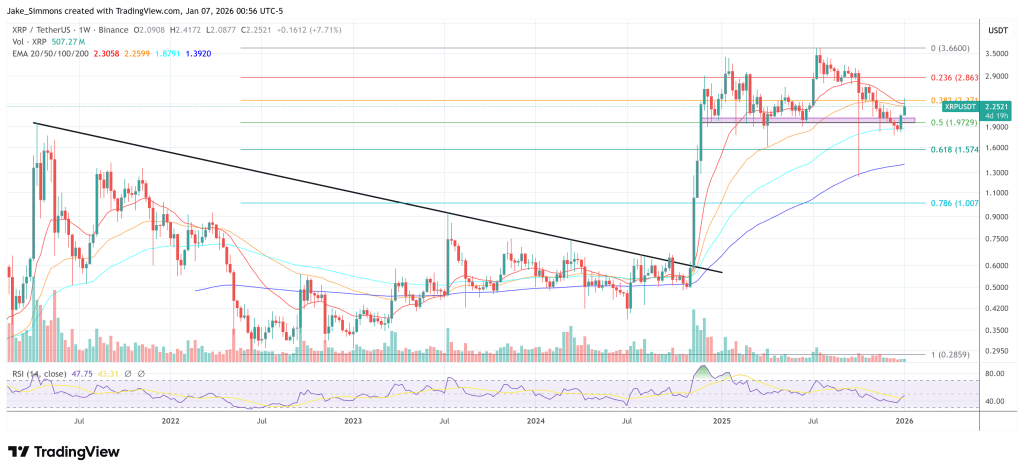
At press time, XRP traded at $2.25.