Morgan Stanley Doubles Down: Ethereum ETF Filing Signals Major Institutional Crypto Shift

Wall Street just placed another massive bet on crypto's future.
Morgan Stanley—yes, the same blue-chip institution your grandparents trust with their retirement funds—has officially filed with regulators to launch a spot Ethereum ETF. This isn't a toe-dip; it's a cannonball into the deep end of digital assets.
Why This Move Screams Confidence
Forget niche crypto funds. This filing represents mainstream finance's growing comfort—and hunger—for blockchain-based investment vehicles. They're not just buying Bitcoin for the treasury; they're building the infrastructure to offer Ethereum exposure to every wealth management client on their books.
The Institutional On-Ramp Gets Wider
An approved ETF creates a clean, regulated pathway. Financial advisors can allocate with a click, bypassing the complexities of private keys and crypto exchanges. It legitimizes Ethereum as a core asset class, right beside stocks and bonds.
A Quiet Revolution in Portfolio Management
This filing whispers a loud truth: smart contracts and decentralized finance are too big to ignore. Institutions now see beyond the speculative hype to the underlying utility—the global settlement layer being built in real-time.
One cynical take? Traditional finance always moves slowly, until it smells profit. Then it moves mountains—and files all the necessary paperwork. Morgan Stanley's move proves crypto is no longer the rebellion; it's becoming the new portfolio.
Morgan Stanley Files For Ethereum Trust
On Tuesday, banking giant Morgan Stanley submitted an S-1 form with the US SEC for its Morgan Stanley Ethereum Trust, which seeks to generate returns for investors by tracking the price of ETH and to “reflect rewards from staking a portion of the Trust’s ether.”
The SEC Filing shows that the bank “plans to engage one or more Staking Services Providers to conduct such Staking Activities,” using a staking model that “aims to maximize the portion of the Trust’s ether available for staking while controlling for liquidity and redemption risks.
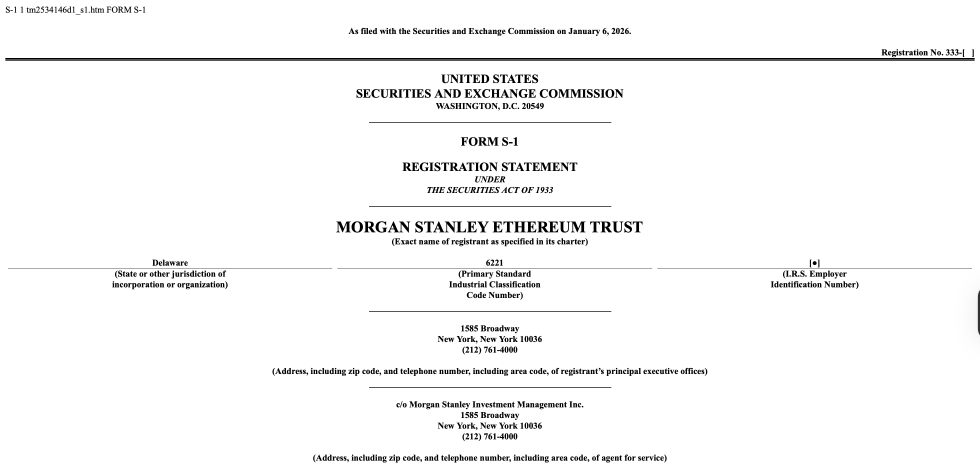
Nonetheless, the document doesn’t address key details, such as the exchange on which the fund will be listed, the Trust’s custodian, or the ticker. Morgan Stanley’s Ethereum ETF filing follows recent efforts to launch other investment products based on some of the largest cryptocurrencies by market capitalization.
As reported by Bitcoinst, the Wall Street giant announced that it had submitted preliminary filings for spot Bitcoin (BTC) and Solana (SOL) Trusts on Tuesday, seeking to hold and generate returns by tracking these two cryptocurrencies.
In a January 6 statement, the bank detailed that “Morgan Stanley bitcoin Trust and Morgan Stanley Solana Trust are pending regulatory approval and would be passive investment vehicles that seek to track the performance of the price of the relevant cryptocurrency.”
Similar to its submitted Ethereum ETF, the solana fund will include an allocation for staking, and plans to engage one or more third-party staking service providers to conduct these activities.
A Broader Crypto Push
Notably, Morgan Stanley’s crypto ETF move is part of a broader shift toward a more welcoming approach that expands the presence of traditional institutions in the digital assets industry.
This pivot follows US regulatory efforts led by the TRUMP administration to turn the country into the “crypto capital of the world.” Amid this major push, the SEC has published new generic listing standards for crypto-based ETFs, which have seen a successful run since their initial launch nearly two years ago.
In 2024, Morgan Stanley, which had built one of the most significant Bitcoin ETF holdings in the US, allowed its managers to offer the products as an investment option for its wealthy customers. This enabled access to individuals with a minimum of $1.5 million in assets and an aggressive risk tolerance.
In October 2025, it expanded its access to crypto fund investments for all clients, including those with retirement accounts, moving away from its previous customer restrictions. The shift allowed its financial advisors to present crypto funds to any client.
It also announced last year that it WOULD enable trading of the largest cryptocurrencies, Bitcoin, Ethereum, and Solana, through its E-Trade subsidiary.