South Korea’s Bitcoin Spot ETF Ambition Ignites: 2026 Target Set for Crypto Market Transformation

Seoul throws its hat into the ETF ring, aiming to launch a domestic Bitcoin spot ETF by 2026—joining a global race that's reshaping institutional crypto access.
The Regulatory Countdown Begins
South Korean financial authorities are drafting the rulebook. The move signals a major policy pivot—from cautious oversight to structured market integration. It's a calculated play to capture institutional capital currently sidelined by regulatory ambiguity.
Why a Spot ETF Changes Everything
Unlike futures-based products, a spot ETF holds actual Bitcoin. It cuts through complexity, giving traditional investors direct exposure without the headaches of custody or private keys. Think of it as a bridge—one that bypasses the technical friction keeping billions on the sidelines.
The Global Domino Effect
With the US, Canada, and Europe already in the game, South Korea's entry isn't just follow-the-leader—it's a strategic power grab. The nation's tech-savvy population and robust trading infrastructure could turn it into an Asian liquidity hub overnight. Watch for neighboring markets to accelerate their own plans.
What's Really at Stake
Approval isn't just about another financial product. It's a legitimacy stamp for Bitcoin within a traditionally conservative system. Success here could unlock pension funds, endowments, and a wave of capital that still treats crypto as a speculative sideshow—for now.
Sure, Wall Street will find a way to charge a 2% management fee for 'digital gold storage.' But behind the cynical finance jab lies a real shift: the old guard is finally building doors into the new economy. South Korea just picked up the blueprint.
South Korea Using US & Hong Kong Crypto Spot ETFs As A Reference
South Korea revealed in its 2026 Economic Growth Strategy plans to allow spot digital asset ETFs this year, according to Wu Blockchain, citing local media outlet News1.
Spot ETFs are investment vehicles that allow traders to gain exposure to an underlying asset without having to directly own it. Such vehicles trade in the traditional markets, so investors of a spot ETF tied to a cryptocurrency never have to interact with blockchain components like wallets and exchanges.
Instead, the funds buy and custody the assets on behalf of investors. In recent years, spot ETFs tied to cryptocurrencies like Bitcoin have gained adoption in different regions of the world as DeFi and TradFi intersect.
The US Securities and Exchange Commission (SEC) approved spot ETFs for Bitcoin in January 2024 and ethereum in July 2024, while the Hong Kong Securities and Futures Commission (SFC) allowed both in April 2024. Approvals related to altcoins like Solana followed in 2025.
Now, it WOULD appear that South Korea is also looking to join the fray. Per the report, the country’s government has explicitly cited the digital asset spot ETF markets active in the US and Hong Kong as key reference points. Plans related to spot ETFs aren’t all that South Korea has announced. The Financial Services Commission (FSC) of the country is also accelerating the next phase of its digital asset legislation, which will establish a framework for stablecoins.
In the East Asian bloc, other governments have already made progress on stablecoins. Hong Kong enacted its stablecoin legislation in August, while Japan saw the launch of its first yen-backed token in October. While South Korea has set a timeframe of 2026, it’s unknown when exactly spot ETFs could be introduced. As such, it only remains to be seen what plans the government will reveal next and which assets besides Bitcoin will be covered.
Speaking of spot Bitcoin ETFs, these funds have been facing outflows in the US recently, as data from SoSoValue shows.
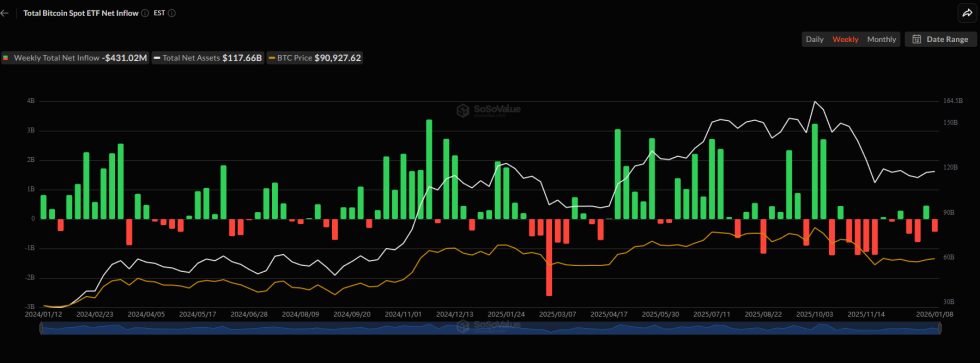
From the chart, it’s visible that the Bitcoin spot ETF weekly netflow has mostly been negative since the cryptocurrency’s decline started in October. There were a few weeks that saw a positive value, but the scale of net inflows remained limited.
The netflow for the latest week has stood at a negative $431 million, meaning that the US funds are continuing to bleed.
BTC Price
Bitcoin has erased some of its recent gains as its price has retraced back to $90,500.
