Bitcoin Enters Loss-Dominant Phase as Short-Term Holder SOPR Weakens — What’s Next?

Bitcoin's market psychology just flipped. Short-term holders are now selling at a loss—a signal that's flashing caution across crypto trading desks.
The SOPR Signal
The Spent Output Profit Ratio for short-term holders dipped below one. That simple metric tells a complex story: coins moved recently are being sold for less than their purchase price. It's the definition of loss realization, and it's now the dominant force.
This isn't just a blip. It marks a shift in sentiment. The 'weak hands'—traders with a months-long horizon—are capitulating. Their pain is the market's new reality.
What Triggers the Tipping Point?
Panic doesn't need a headline. Sometimes, it's just a slow bleed of confidence—a creeping doubt that the next all-time high isn't around the corner. Price stagnates, leverage gets unwound, and the exit door looks more appealing than the promise of future gains. It's the old Wall Street adage in digital form: fear feeds on itself.
The Bull Case in the Red
Here's the counterintuitive twist veteran crypto watchers are eyeing. Mass loss-taking by short-termers often precedes a local bottom. It's a flushing out—a transfer of assets from impatient speculators to steadfast believers. The market shakes out the leverage and resets on a firmer, if less exuberant, foundation. Consider it a necessary cleanse, however uncomfortable.
The road ahead hinges on whether this weakness stays contained or infects the long-term holder cohort. For now, the data shows conviction among the diamond-handed crowd. They've seen this movie before.
Bitcoin's latest phase is a stark reminder: in crypto, euphoria and despair aren't just emotions—they're tradable on-chain metrics. And sometimes, the best time to plant a tree was twenty years ago; the second-best time is when everyone else is selling theirs at a loss to cover a margin call.
Short-Term Holders Capitulate as Loss-Dominant Regime Persists
The latest on-chain update from Adler focuses on the behavior of short-term holders through the STH SOPR metric, which measures the ratio between the selling price and the acquisition price of coins that last moved within the past 155 days. When this indicator trades below 1.0, it means that short-term participants are, on average, realizing losses rather than profits.

As of January 11, the STH SOPR (7-day simple moving average) stands at 0.994, while the daily reading dropped to 0.9817, marking its lowest level since the start of the year. This is not an isolated data point. On January 8, the 7-day SOPR average crossed below the 30-day average, falling from 0.9996 to 0.9928. This crossover provides technical confirmation of a regime shift toward a loss-dominant environment.
Further reinforcing this signal, the SOPR Z-Score currently sits at -0.58. This indicates that SOPR values are trading roughly half a standard deviation below their annual mean, a zone that has historically coincided with local price bottoms rather than trend exhaustion.
Sustained SOPR readings below 1.0 increase psychological and financial pressure on short-term investors, often forcing capitulation. A meaningful regime change WOULD require the 7-day SOPR to reclaim levels above 1.0, supported by a Z-Score turning positive and signaling renewed profitability for short-term holders.
Bitcoin Consolidates as the Market Searches for Direction
Bitcoin’s weekly chart shows a market locked in consolidation after a sharp correction from the October highs, with price currently hovering just above the $90,000 level. This zone has become a key pivot, acting as short-term support after BTC failed to hold above the $95,000–$100,000 region. The recent candles reflect indecision rather than strong directional conviction, consistent with a broader pause in momentum.
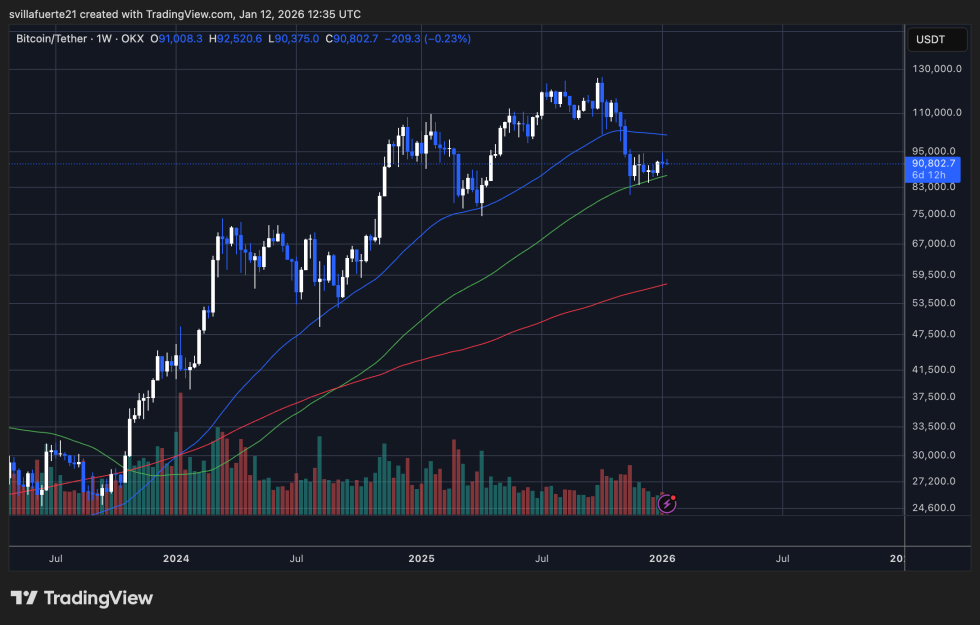
From a trend perspective, Bitcoin remains above its long-term moving averages, with the 200-week MA still rising well below the current price. This confirms that, structurally, the broader uptrend has not been invalidated. However, the shorter-term moving averages have flattened, and price is trading below the faster weekly MA, highlighting a loss of upside momentum since late 2025.
The consolidation structure resembles a range-bound base, where volatility has compressed following the aggressive sell-off. Volume has declined compared to the distribution phase NEAR the highs, suggesting that forced selling pressure has eased, but new demand has yet to step in decisively. This aligns with on-chain data showing weak participation from marginal buyers.
As long as BTC holds above the $88,000–$90,000 support band, the market appears to be digesting gains rather than entering a full trend reversal. A sustained reclaim of the $95,000 area would signal renewed strength, while a breakdown below current support could open the door to a deeper corrective leg.
Featured image from ChatGPT, chart from TradingView.com
