Bitcoin Demand Slump: The Quiet Before The Storm For Long-Term Accumulation

Bitcoin's buy-side pressure has flatlined—and that's not the bearish signal you think it is.
The Accumulation Window Cracks Open
Weak demand paints a picture of retail capitulation. The noise fades. The charts whisper a different story to those with a multi-year horizon. This isn't a breakdown; it's a clearance sale for patient capital.
Institutional Patience vs. Trader Panic
While day-traders chase the next shiny altcoin, strategic wallets are methodically stacking sats. The lack of frenzy creates the perfect conditions for stealth accumulation, bypassing the slippage and premium of a roaring bull market. Think of it as wholesale pricing before the retail stampede.
The Long Game's Calculated Bet
History doesn't repeat, but it often rhymes. Periods of apathy have consistently set the foundation for the next parabolic move. This phase separates the tourists from the residents in the digital asset ecosystem.
The current demand vacuum isn't a failure of the thesis—it's a feature of the cycle. It’s the market offering a rare, quiet moment to build a position before the traditional finance crowd shows up late, as always, with their overpriced ETFs and a press release. The weak hands exit; the strong accumulate. The stage is being set.
Demand Weakness Signals Caution, Not Capitulation
Currently, Bitcoin’s apparent demand remains firmly negative, with roughly −106,000 BTC on a 30-day cumulative basis. This reading confirms that more supply is entering the market than is being absorbed by new buyers, a dynamic typically associated with cautious positioning rather than aggressive accumulation. Investors appear risk-averse, gradually reducing exposure as Bitcoin continues to be treated as a high-beta asset sensitive to macro uncertainty and policy signals.

This negative demand environment reflects a market that is defensive but not panicked. There is no evidence of forced liquidation or broad capitulation; instead, the data points to controlled distribution and a lack of urgency from buyers. In practical terms, participants are waiting for clearer confirmation—either from macro conditions, price structure, or on-chain metrics—before committing fresh capital.
Importantly, history shows that periods of weak or negative demand often coincide with zones where long-term opportunities begin to form. When interest is low and sentiment is muted, prices tend to stabilize rather than trend aggressively, allowing patient investors to build positions with reduced competition. However, these conditions favor long-term, risk-managed strategies, not short-term speculation.
Betting aggressively against the prevailing demand trend remains risky. As long as apparent demand stays negative, upside moves are more likely to be corrective rather than impulsive. For now, Bitcoin sits in a phase where discipline matters more than conviction, and time—not momentum—becomes the primary ally.
Bitcoin Consolidates as Long-Term Support Holds
Bitcoin continues to consolidate after the sharp correction from the October highs, with price now stabilizing around the $90,500–$91,000 area. On this 3-day chart, BTC remains below its declining short- and medium-term moving averages, signaling that bearish momentum has not fully dissipated. The blue and green moving averages above price continue to act as dynamic resistance, capping upside attempts near the $94,000–$96,000 zone.
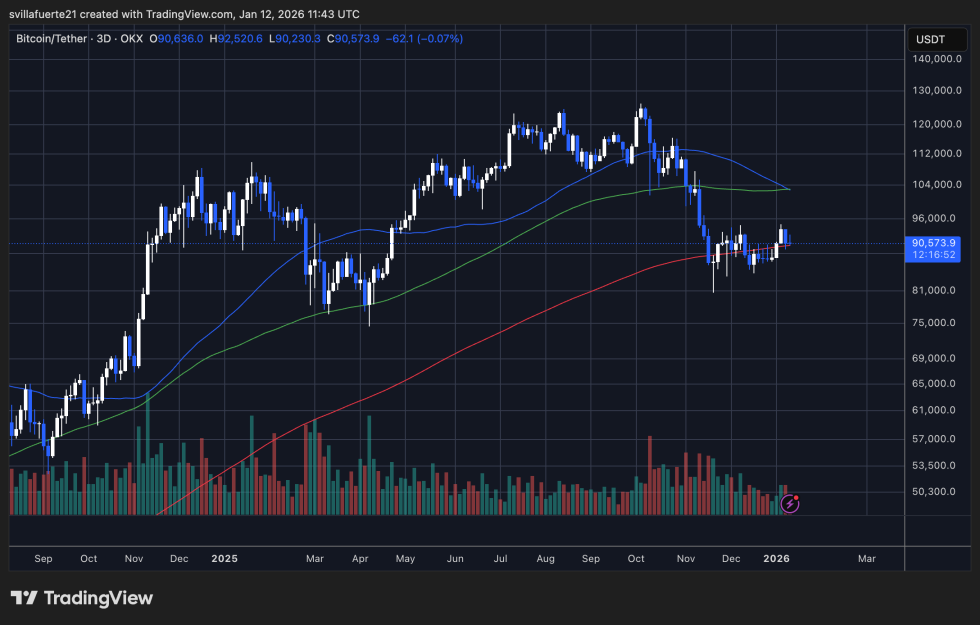
At the same time, the long-term trend structure has not broken. Bitcoin is still holding above the red long-term moving average, which is rising steadily and currently sits in the $88,000–$89,000 region. This level has acted as structural support during the recent consolidation, suggesting that sellers are losing strength as price compresses into a tighter range.
Price action over the past weeks shows lower volatility and overlapping candles, typical of a market transitioning from impulse to balance. Volume has also declined, reinforcing the idea that aggressive selling pressure has faded, but that buyers remain cautious and selective.
As long as BTC holds above the long-term moving average, this phase looks more like consolidation than trend reversal. However, a sustained reclaim of the $94,000–$96,000 resistance is required to confirm renewed upside momentum. Until then, Bitcoin remains range-bound, building energy for the next decisive move.
Featured image from ChatGPT, chart from TradingView.com
