Ripple’s Latest SEC Letter: The XRP Game-Changer Wall Street Isn’t Talking About

Ripple just fired another shot across the SEC's bow—and this one could finally tip the scales for XRP.
The regulatory chess match enters a critical phase as Ripple submits fresh arguments to the Securities and Exchange Commission. This isn't just legal posturing; it's a strategic move that could redefine the entire digital asset landscape.
Why This Letter Changes Everything
Forget the legal jargon. At its core, this submission challenges the SEC's fundamental authority over crypto transactions. Ripple's argument hinges on a simple premise: digital assets traded on secondary markets aren't securities—full stop. If the court agrees, it blows a hole in the SEC's entire enforcement playbook.
The Institutional Domino Effect
Banks and payment processors have been watching this case like hawks. A clear win for Ripple doesn't just boost XRP's price—it gives traditional finance the green light to build on blockchain infrastructure without regulatory ambiguity. Suddenly, those 'cautious pilot programs' become full-scale deployments.
The Cynical Take
Meanwhile, Wall Street firms continue charging 2% management fees for funds that basically just buy Bitcoin and wait. Some innovation.
The bottom line? This legal maneuver isn't about one company or one token. It's about forcing clarity in a market that's been paralyzed by regulatory theater. When the fog lifts, XRP stands positioned not just as a cryptocurrency, but as the bridge asset institutional finance actually needs.
Ripple Presses SEC To Cement XRP’s Post-Lawsuit Status
Ripple’s core thesis is that regulators should MOVE away from “decentralization” as a legal metric because it is “not a binary state” and creates “intolerable uncertainty,” including both “false negative” and “false positive” outcomes.
One of Ripple’s key concerns is that an asset could be treated as stuck in a securities regime simply because an entity still holds inventory or continues contributing to development, a point with obvious parallels to Ripple. The company still holds a large chunk of all XRP in their escrow while developer arm RippleX contributes heavily to the development of the XRP Ledger.
Instead, Ripple pushes the SEC to ground jurisdiction in “legal rights and obligations,” emphasizing enforceable promises rather than market narratives about ongoing efforts. The letter argues that regulatory theories focusing on “efforts of others” risk collapsing the multi-part Howey analysis into a single factor and, in Ripple’s view, sweeping too broadly.
The most consequential section is Ripple’s argument that the SEC’s jurisdiction should be time-bound to the “lifespan of the obligation,” rather than treating the asset as permanently labeled. In a passage that goes directly to secondary-market implications, Ripple writes:
That framing matters for XRP and draws parallels to the SEC lawsuit: whether secondary-market trading of a token can remain subject to securities-law oversight long after any initial distribution, marketing, or development-era statements. Ripple explicitly rejects the idea that active secondary trading is itself a jurisdictional hook, comparing high-velocity crypto markets to spot commodities like gold and silver and even secondary markets for consumer devices.
Ripple also spends meaningful time on the “capital raising” boundary, arguing for privity as a bright line that distinguishes primary distributions from exchange trading where counterparties are unknown and the issuer is “merely as another market actor.”
In that context, the letter warns that treating every issuer sale as a perpetual capital raise creates “perverse outcomes,” including what it calls a “Zombie Promise” and “Operational Paralysis”: language that, while generalized, clearly speaks to concerns around issuer-held token inventories and the compliance burdens that could attach to treasury management and sales practices.
Separately, Ripple endorses “fit-for purpose” disclosures in cases where securities regulation is actually warranted, rather than forcing “full corporate registration designed for traditional equity.” For XRP holders and market participants, that is a directional signal: Ripple is arguing for a regime where disclosure triggers attach to specific promises or specific forms of ongoing control, not to the token as an object indefinitely.
The timing is also notable. Ripple dated the letter January 9, 2026, less than a week before a January 15 markup on comprehensive digital-asset market structure legislation in the US Senate Banking Committee, an approaching deadline that could shape how classification language, jurisdictional lines, and disclosure concepts harden into legislative text.
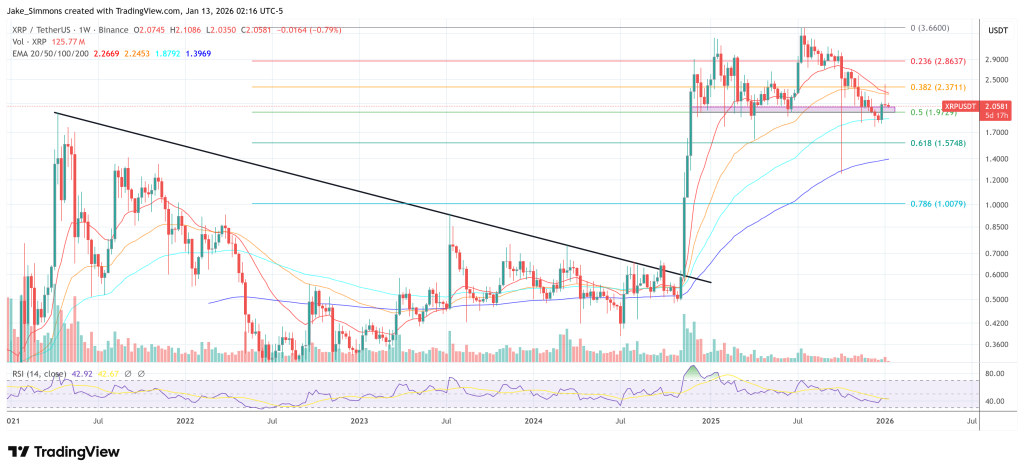
At press time, XRP traded at $2.05.