Bitcoin’s Inner Circle Expands: Meet TheCharlatan, the New Core Keyholder Shaking Up Crypto’s Most Exclusive Club

Bitcoin's most guarded vault just got a new gatekeeper. TheCharlatan joins the elite circle of Bitcoin Core keyholders—a move that reshapes the power dynamics at the very heart of the world's original cryptocurrency.
Who Holds the Keys?
Forget Wall Street boardrooms. Real crypto power lies with those who control Bitcoin's source code. Keyholders like TheCharlatan possess the cryptographic authority to sign off on critical Bitcoin Core releases. No single entity calls the shots—it's a decentralized dance of multi-signature approvals, where consensus isn't just a concept; it's a security protocol.
Why This Addition Matters Now
The timing isn't random. As institutional adoption accelerates and regulatory scrutiny intensifies, the integrity of Bitcoin's development process becomes its strongest armor. Adding a new, trusted keyholder diversifies control and reinforces the network's antifragility. It's a silent upgrade to Bitcoin's political firewall.
The Unseen Battle for Bitcoin's Soul
Every new keyholder represents a subtle shift in the balance of power. TheCharlatan's induction signals continued trust in the existing developer ethos—a commitment to censorship resistance and sound money principles, even as traditional finance tries to slap a ticker symbol on it and call it an 'asset class.'
This isn't about a promotion; it's about perpetuating a system designed to outlast governments and outsmart rent-seekers. While bankers debate quarterly earnings, Bitcoin's guardians are playing a longer game—one where the rules are written in code, not compliance manuals.
Who Is The New Bitcoin Core Key Holder?
Protos identified TheCharlatan as a University of Zurich computer science graduate from South Africa, with a focus on reproducibility and Bitcoin Core’s validation logic.
In practice, that points to two areas that Core contributors tend to treat as release-critical. First, reproducible builds aim to make the path from source to binaries independently verifiable, an important property for a security-sensitive client where users want assurance they’re running what maintainers reviewed.
Second, Protos said TheCharlatan has worked on validation logic in ways that build on Carl Dong’s kernel library effort, separating validating from non-validating logic used to determine whether a block extends the best-work chain.
While Bitcoin’s development process is intentionally consensus-driven and diffuse, commit keys remain a concrete locus of responsibility. Protos situated the current model historically, noting that early Bitcoin development concentrated commit access in Satoshi Nakamoto’s hands before moving to a succession of maintainers. “Only Satoshi Nakamoto possessed Commit-level access… . Nakamoto first passed his key privilege to Gavin Andresen…”
Protos also referenced the later push to decentralize commit-key control into a group under Wladimir van der Laan, in the shadow of legal threats tied to Craig Wright’s claims, part of a broader effort to avoid any single maintainer becoming a practical or legal single point of failure.
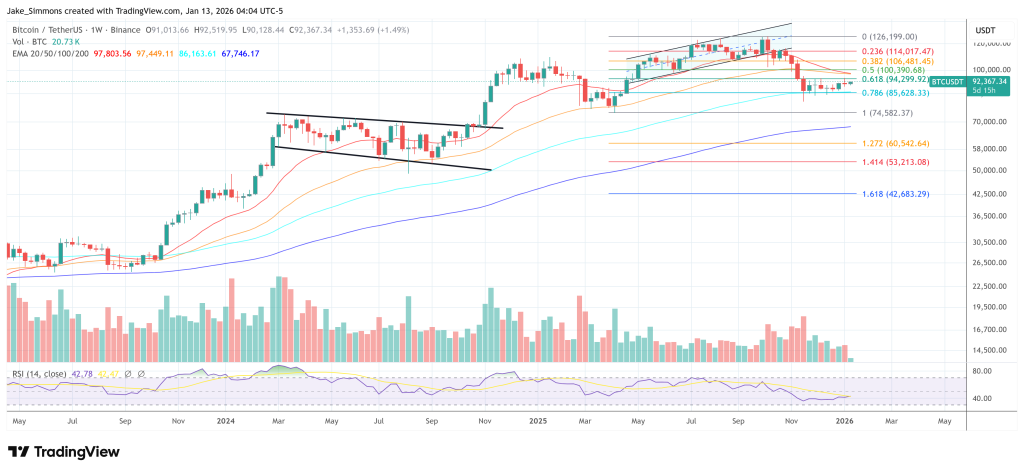
At press time, BTC traded at $92,367.