Ethereum’s Active Addresses Just Shattered All Records – Here’s What the Historic Numbers Reveal

Ethereum's network just hit a milestone that's turning heads across crypto and traditional finance alike.
Forget the usual noise about price swings—this metric cuts straight to the heart of real, on-chain adoption. The number of unique wallets interacting with the Ethereum blockchain has surged past its previous all-time high, signaling a wave of user activity that bypasses speculative chatter and points to genuine utility.
What the surge really means
When active addresses climb, it's not just a number on a chart. It represents developers deploying contracts, users swapping tokens, and collectors minting assets—the fundamental economic engine of Web3 firing on all cylinders. This isn't passive holding; it's the network being put to work.
The institutional eyebrow-raise
While some legacy finance desks are still puzzling over 'what's a gas fee?', this data point is the kind that gets quant funds and venture portfolios recalibrating their models. It's a tangible signal of network health that even the most cynical trader—the type who thinks 'decentralization' is just a marketing term—has to acknowledge.
Sure, one could jab that Wall Street would kill for this kind of transparent, on-demand audit trail instead of their quarterly, massaged filings. But in Ethereum's world, the proof is in the protocol, published in real-time for anyone to verify.
This record isn't just a flash in the pan. It builds a foundation. More users beget more developers, which begets more applications, fueling a flywheel that's notoriously hard to stop once it gets spinning. The network effect isn't a theory here; it's logging another data point.
So watch the price charts if you must, but the real story is being written in active addresses. And right now, that story has more characters than ever before.
Another Historic Moment For Ethereum Network
Since the beginning of 2026, the ethereum network has been hitting major milestones that reflect the blockchain’s efficiency and expanding ecosystem. Even in a volatile crypto landscape, ETH’s network usage and adoption have increased sharply, as evidenced by its rapidly growing active wallet addresses.
On-chain data reveals that the network has recently crossed a key threshold in terms of active wallet addresses following a sudden spike. From the report from Joseph Young, a market expert and narrator, the number of active addresses on ETH has surged to the highest level ever in its history.
This spike in user activity and interest signals more than just routine market noise and speculation. It shows growing adoption, increasing on-chain activity, and rekindled conviction in the leading ecosystem in the midst of general market instability.
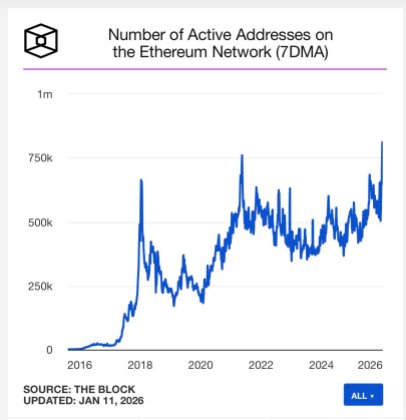
After delving into the metric, the expert disclosed that the number of active 7DMA wallet addresses on Ethereum is sitting at over 811,500. As active address counts reached historic levels, the network’s fundamentals appear to have started surpassing its price performance. Should this performance hold, it is likely to play a huge role in shaping ETH’s next major move.
The blockchain’s performance extends beyond just massive active wallet addresses. Young added that Ethereum is the most proven network with more than 10 years of track record, underscoring its reliability and robust scalability.
During the period, ETH remained one of the most active and liquid crypto ecosystems by far. With several key updates over the years, such as the Fusaka Upgrade, the ETH network is now scaling faster than it ever did since its launch.
ETH Carry Out More Transactions Than Ever
Given that a significantly high level of transactions is carried out on the network, Ethereum is still showing robust strength and a growing ecosystem. On-chain Foundation head of research, Leon Waidmann, shared a report that reveals that ETH is experiencing a wave of transactions, reaching unprecedented levels.
With over 2.2 million transactions being executed per day, the network has just hit yet another all-time high. The chart shows that the previous peak was positioned at 1.89 million per day, as recorded on January 10, reflecting its rising real-world usage in a period where network fundamentals are gaining robust significance.
While transactions continue to increase, the network’s transaction costs have remained extremely low. Swapping on the blockchain now costs just $0.04, Non-Fungible Token (NFT) sales cost about $0.06, borrowing fees are $0.03, and bridging costs, which are the lowest, are around $0.01.
