Vitalik Buterin Issues Ethereum Ultimatum: ’Pass The Walkaway Test Or Face Obsolescence’

Ethereum's co-founder just threw down the gauntlet. The network's future hinges on a single, brutal metric: user freedom.
The Walkaway Threshold
Buterin's warning cuts to crypto's core dilemma. Can users exit? Truly exit—without begging validators or praying to centralized exchanges. If a blockchain fails this test, it's just digital feudalism with extra steps. The kind of system where your assets aren't really yours, held hostage by the very infrastructure meant to liberate them. It's the ultimate irony for a movement built on self-custody.
Architecture vs. Advertisement
The real fight isn't about transaction speed or token prices. It's architectural. Layer-2 solutions, rollups, sharding—they're all racing toward one finish line: making departure seamless. A network that locks you in is a product, not a protocol. And in tech, products get disrupted. Remember when people thought their AOL email was permanent?
The User's Ultimate Leverage
True decentralization isn't a marketing slogan. It's the silent power of the exit door. When leaving costs nothing, developers and validators must compete on merit. No more captive audiences, no more tolerated high fees or sluggish updates. The threat of a mass exodus becomes the community's sharpest governance tool. It forces innovation at the protocol level, not just the application layer.
A Cynical Finance Jab
Of course, Wall Street veterans are probably chuckling into their martinis. They've built entire empires on the exact opposite principle—making exit so costly and complex that clients are functionally trapped. In traditional finance, your 'walkaway test' usually involves a small army of lawyers and a multi-year settlement. Ethereum's trying to fix a problem the old guard perfected as a business model.
Buterin's challenge reframes the entire crypto narrative. It's not about who has the flashiest NFT marketplace or the highest DeFi yields this quarter. It's about which network builds a foundation so solid—and so open—that leaving is always an option, but never a necessity. Fail this, and you're just building a prettier cage.
Ethereum Can’t Rely on Endless Upgrades
The post lands amid a broader, recurring tension in Ethereum’s culture: the desire to keep evolving versus the benefits of stability. Buterin’s formulation doesn’t call for freezing the protocol immediately. Instead, he argues Ethereum should reach a position where it could “ossify” without sacrificing its value proposition.
“This means that Ethereum must get to a place where we can ossify if we want to,” Buterin said. “We do not have to stop making changes to the protocol, but we must get to a place where Ethereum’s value proposition does not strictly depend on any features that are not in the protocol already.” In other words, Ethereum can continue to improve—but it should not need to, in order to remain a credible base for durable, user-owned systems.
From there, Buterin lays out the technical and economic conditions he views as prerequisites for passing the test. The most time-sensitive in his framing is cryptography. “Full quantum-resistance” should not be treated as an upgrade to postpone until the last possible moment, he argues, warning against “the trap” of delaying in exchange for short-term efficiency.
The protocol, in his view, should be able to make a straightforward claim about long-lived safety: being able to say Ethereum “as it stands today, is cryptographically SAFE for a hundred years.”
Scalability is presented as an architectural destination rather than a perpetual series of feature-driven forks. Buterin points to “ZK-EVM validation and data sampling through PeerDAS” as key components, and suggests an ideal end-state where improvements increasingly come via “parameter only” changes—potentially implemented through validator voting mechanisms akin to how the gas limit can be adjusted.
He also emphasizes state growth as a durability risk that must be addressed at the protocol level. The goal, as he describes it, is a “state architecture that can last decades,” including “partial statelessness and state expiry” so that sustaining thousands of transactions per second over long periods doesn’t make syncing or hardware requirements untenable. Alongside that, he flags future-proofing storage structures to match that environment.
Other items in the framework target known fault lines for decentralized execution: moving toward a more general-purpose account model via “full account abstraction,” ensuring the gas schedule is resilient against denial-of-service risks in both execution and ZK-proving, and hardening proof-of-stake economics so the system “can last and remain decentralized for decades,” including ETH’s role as “trustless collateral.”
Finally, Buterin highlights block building as a centralization pressure point, arguing Ethereum needs a model that can “resist centralization pressure and guarantee censorship resistance even in unknown future environments.” Buterin’s closing message is less about a single roadmap item than a governance and engineering posture: do the heavy lifting now so later progress can be dominated by client optimization and parameter tuning, not perpetual redesign.
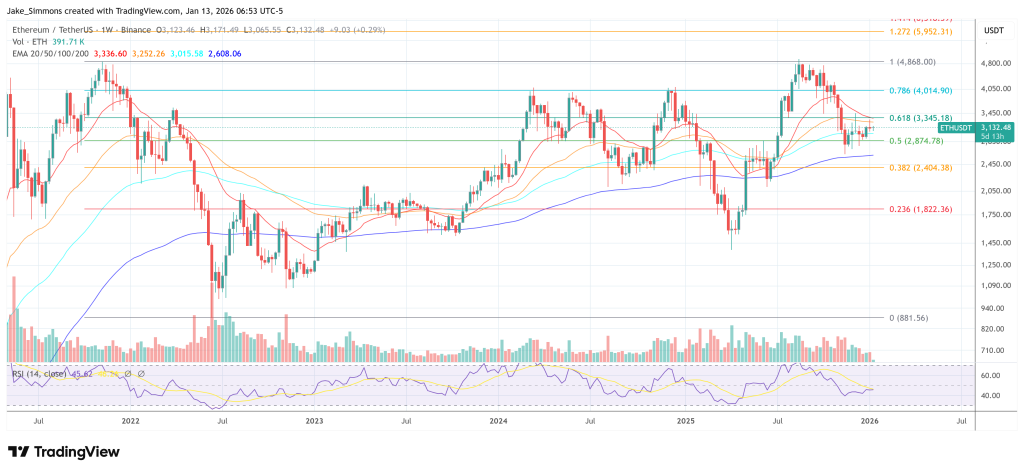
At press time, ETH traded at $3,132.