Flow Foundation Battles Korean Delisting After Binance Clears Crypto Security Concerns

Binance just handed the Flow Foundation a major regulatory shield—and they're wasting no time wielding it.
The Backstory: A Delisting Drama
South Korean exchanges were ready to show Flow the door, lumping it in with other assets deemed too risky. The standard playbook for a project facing this would involve quiet negotiations and compliance tweaks. Flow chose confrontation.
The Binance Gambit Pays Off
The foundation's counterpunch hinged on a recent, critical verdict from the world's largest crypto exchange. Binance's internal review concluded Flow did not meet its criteria for a security—a designation that can sink projects under the weight of legacy finance rules. That wasn't just an internal memo; it was a weapon.
Flow's team immediately packaged that Binance assessment into a formal appeal to Korean authorities. The argument was blunt: if the global market leader sees no security issue, why does Seoul? It's a move that bypasses lengthy legal debates and goes straight to market credibility—a classic crypto power play.
Why This Fight Matters
This isn't just about one token staying listed. It's a test case for how crypto projects can leverage the clout of major exchanges in regulatory fights. A win for Flow sets a precedent; others could use similar approvals to push back against national regulators. A loss reinforces the growing fragmentation of global crypto rules—where each country becomes its own walled garden of compliance, much to the delight of lawyers and consultants who bill by the hour.
The cynical take? Another day, another crypto project spending its treasury not on building tech, but on lobbying and legal fees to appease regulators who still think of digital assets in terms of paper certificates. Flow is fighting to stay on the board in a key market. The outcome will signal whether a nod from a giant like Binance is becoming the new gold standard—or just another piece of paper in a filing cabinet.
FLOW Fights Back
In an announcement made on March 8, Flow Foundation and Dapper Labs (a venture‑backed Web3 company best known for creating CryptoKitties, NBA Top Shot and other major NFT products) have revealed that they filed a motion with the Seoul Central District Court to suspend the planned termination of FLOW trading on Upbit, Bithumb and Coinone.
Crypto Security FearsOn Dec. 27, Flow suffered a protocol‑level exploit that allowed an attacker to mint roughly 3.9 million duplicate tokens, triggering an emergency halt. Initial recovery proposals included a full chain rollback, which drew pushback from partners over double balances and bridge losses; the team pivoted to an “isolated recovery” that targeted and destroyed only the counterfeit tokens.
Despite no user funds on exchanges were ultimately lost, Korean platforms kept FLOW under heightened scrutiny. Upbit, Bithumb and Coinone announced on Feb. 12 that they would end trading support for FLOW on March 16, citing the December protocol-level exploit.
Security Concerns Are Now ResolvedHowever, every major global venue, including Binance, Coinbase, Kraken and HTX, have now independently reviewed the incident and fully restored FLOW trading, with Binance even removing its monitoring tag after a joint resolution on March 6. This confirms, according to Flow Foundation and Binance itself, that “all issues related to the security incident have been resolved”.
“A Commitment To Korea”
In Korea, Korbit (one of South Korea’s oldest regulated cryptocurrency exchanges, focused on KRW spot trading for major coins and retail users) conducted its own review, Korbit removed a trading-caution label on Feb. 27, and continues to support unrestricted FLOW trading. Flow Foundation expressed its special gratitude towards his Korean community continued support:
The Foundation recognizes the uncertainty the Korean community has faced since February, and is grateful for the patience and support of Korean holders through this process
The filing of the motion with the Seoul Central District Court is a step that “reflects the responsibility of the Foundation to advocate for the Korean community using every available pathway”, Flow Foundation claims. The Foundation has also assured that it “remains open to constructive conversation with all parties involved”.
Alongside this, The Foundation is pursuing new listings and expands self-custody options for local users while pushing ahead with its consumer DeFi roadmap, including on-chain automation, EVM‑equivalent infrastructure and an enshrined lending protocol, betting that long‑term adoption will outlast short‑term regulatory frictions in one market.
The Growth Of The Flow Ecosystem
While Korea wrestles over FLOW’s listing status, the underlying network is quietly behaving like a top‑tier consumer chain. Disney, the NBA, the NFL and Ticketmaster all continue to build on Flow, together distributing over 100 million NFTs to more than 13 million fans and generating billions in primary and secondary sales.
As Flow’s ecosystem momentum continues to build, the real question for investors watching the Korean injunction drama is whether a localized delisting can truly derail it.
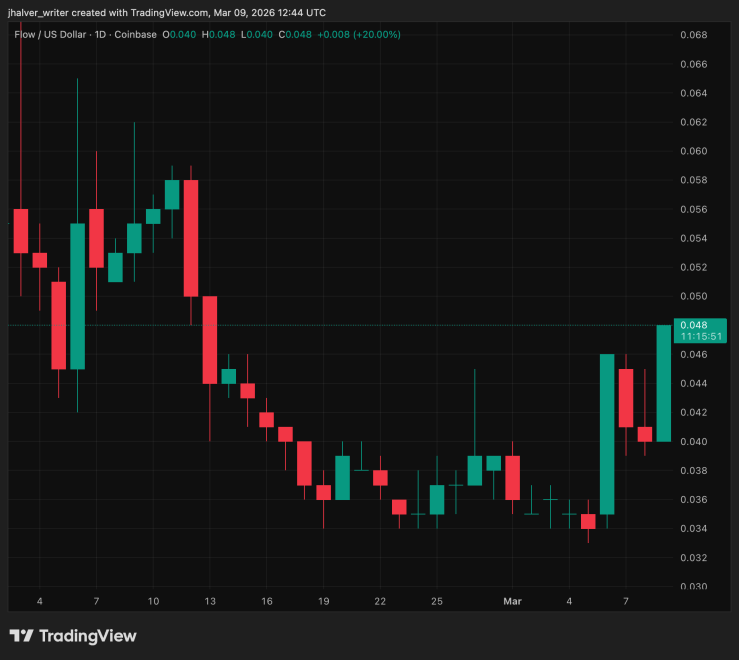
Cover image from ChatGPT, FLOWUSD chart from Tradingview
