White House Advisor Reveals Bipartisan Backing for US Strategic Bitcoin Reserve

A White House digital asset advisor has revealed growing bipartisan support for legislation to formally establish the U.S. Strategic Bitcoin Reserve, signaling a major political shift toward institutionalizing Bitcoin at the federal level. Patrick Witt, executive director of the President's Council of Advisers for Digital Assets, confirmed the legislative momentum during a March 9 address at the Economic Club of New York, indicating that while timing may extend beyond the current Congress, political consensus is building around the reserve created by President Trump's 2025 executive order. The reserve, capitalized with government-held forfeited bitcoin and prohibited from selling its holdings, represents a landmark move toward treating Bitcoin as a strategic national asset, with Treasury and Commerce authorized to develop budget-neutral acquisition strategies.
Bipartisan Support Builds For US Bitcoin Reserve
The order also came with concrete deadlines. Agencies had 30 days, until April 5, 2025, to review whether they could transfer government-held BTC into the reserve and to provide a full accounting of digital assets in their possession. Treasury then had 60 days, until May 5, 2025, to deliver a legal and investment evaluation on how the reserve should be established and managed, including whether further legislation would be needed.
The most substantive official update arrived on July 30, 2025, when the President’s Working Group on Digital Asset Markets said the Treasury had already delivered those considerations to the White House under Section 3(e) of the order and would keep coordinating on “appropriate next steps” to operationalize the reserve. The White House was still publicly describing the reserve as an established policy as recently as January 20, 2026.
One important caveat remains: those deadlines produced internal reporting, not a public accounting of the reserve. In other words, agencies were required to report what they held, and Treasury was required to report back to the White House, but the administration has still not publicly disclosed how many BTC are actually in the Strategic Bitcoin Reserve. For the public, that leaves a crucial piece of the story unresolved: the reserve exists on paper and as executive policy, but its confirmed size remains unknown.
That leaves the current status fairly clear, even if not fully transparent. The reserve exists as executive branch policy. The deadlines in the order have long since passed. The Treasury has formally reported back. But a fuller statutory framework still appears to be the next step if the administration wants the reserve locked in beyond executive action alone.
Witt’s remarks are notable because they point to exactly that next stage. “There is also a push to advance other legislation to codify the strategic Bitcoin reserve,” he said. “Whether or not we’re able to get to those in this Congress, there is some bipartisan support for those. So, into the next Congress, a lot of those bills can be marked up potentially in advance and then be taken up in a future either individual vote on those or potentially in a must pass like an NDAA for example.”
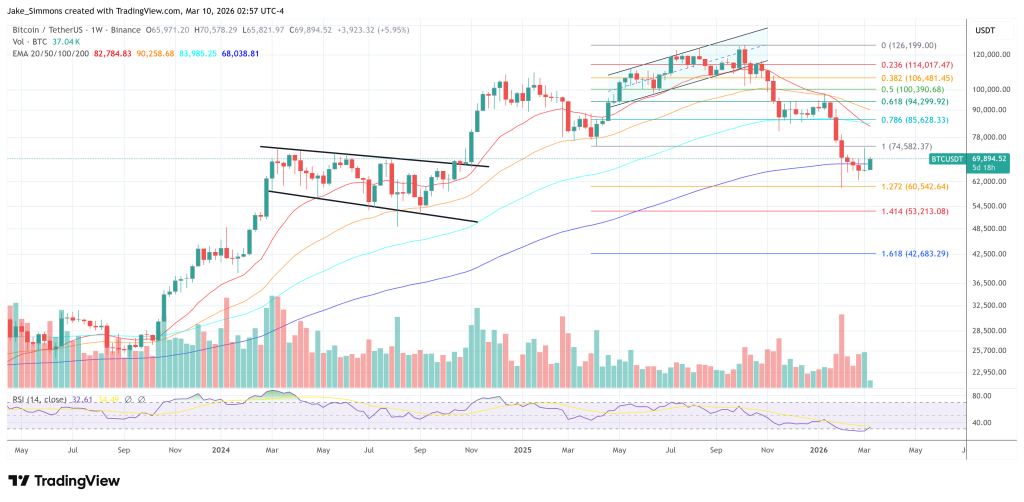
At press time, Bitcoin traded at $69,894.