Harvard Drops Bombshell: $117M BlackRock Bitcoin ETF Bet Exposed in SEC Filing

Ivy League money just went full crypto-bullish.
Harvard University's endowment—the largest academic war chest in the world—just got caught with its hands in the digital cookie jar. A fresh SEC filing reveals a staggering $117 million position in BlackRock's spot Bitcoin ETF.
Wall Street meets blockchain
This isn't some crypto hedge fund's plaything. We're talking about staid institutional money—the same folks who used to dismiss Bitcoin as 'rat poison'—now diving headfirst into the ETF pool. BlackRock's IBIT product has become the golden child of TradFi's crypto embrace.
The irony? Harvard's economics department still teaches that Bitcoin is a speculative bubble. Meanwhile, their investment office quietly stacks sats like a degenerate on Binance.
Institutional FOMO reaches fever pitch
With this move, the Harvard Management Company joins the growing list of blue-chip investors treating Bitcoin like a legitimate asset class. Pension funds, sovereign wealth managers, and now elite university endowments—all chasing the digital gold rush.
One question remains: When will Yale start copying Harvard's homework again?
Harvard Ranks Bitcoin ETF Among Top Portfolio Holdings
According to Harvard University’s recent FORM 13F filing with the US Securities and Exchange Commission (SEC), its $117 million position in BlackRock’s spot Bitcoin ETF ranks as the institution’s fifth-largest investment. This allocation places Bitcoin just ahead of the university’s holdings in major technology giants such as Alphabet, Google’s parent company, and NVIDIA. At the end of the reporting period, Harvard held nearly $114 million worth of Alphabet stock, underscoring the significance of its Bitcoin exposure within its broader portfolio.

The decision to prioritize Bitcoin over some of the most established names in global technology signals a notable shift in institutional thinking. For decades, elite endowments like Harvard’s have been known for their conservative, long-term investment approach, focusing on assets with proven resilience and growth potential. Including Bitcoin at this level shows that the university views the digital asset as not only a speculative opportunity but also as a strategic reserve holding with long-term value.
Harvard’s MOVE reflects a growing consensus among leading institutions that BTC is emerging as a core asset for diversification, inflation protection, and asymmetric upside potential. The fact that Bitcoin now sits alongside — and in some cases above — blue-chip equities in major portfolios highlights its evolution from a niche investment to a mainstream financial instrument.
Price Action Details: Testing Resistance
Bitcoin (BTC) is currently trading at $116,526, consolidating just below the key resistance zone at $122,077. The 3-day chart shows a sustained bullish structure, with price holding well above the 50-day ($101,725) and 100-day ($96,494) moving averages — both trending upward, signaling strong medium-term momentum.
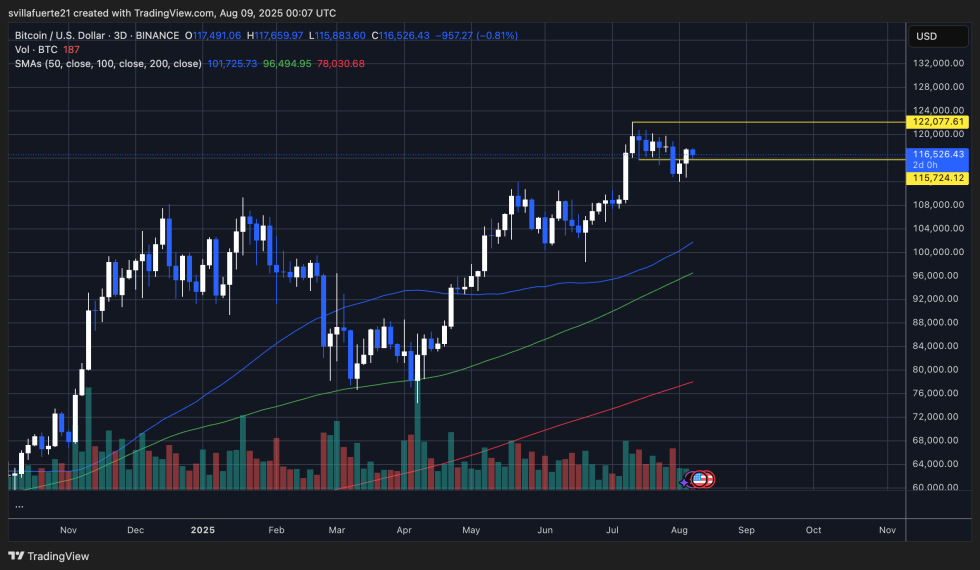
After reclaiming the $115,724 support level, BTC has maintained a steady upward bias, suggesting that bulls are still in control despite recent volatility. The consolidation phase just under resistance indicates market indecision, with buyers accumulating strength for a potential breakout. A decisive close above $122,077 could open the path toward retesting the all-time highs and potentially extending into price discovery.
Volume remains relatively stable, but a noticeable uptick on breakout attempts WOULD strengthen the bullish case. On the downside, failure to hold $115,724 could trigger a pullback toward the $110K–$112K range, where additional support and the 50-day moving average converge.
Featured image from Dall-E, chart from TradingView
