SOL Price Prediction 2025-2040: Technical Signals Clash With Institutional Moves in Crypto’s Hottest Network

- What Does SOL's Technical Setup Reveal About Future Price Action?
- Why Are Institutions Sending Mixed Signals About Solana?
- How Could VanEck's Solana ETF Change the Game?
- What Are the Contradictions in Solana's On-Chain Metrics?
- Where Could SOL Price Go From 2025 Through 2040?
- Frequently Asked Questions
Solana (SOL) finds itself at a fascinating crossroads as we enter Q4 2025. While technical indicators show consolidation below key moving averages, institutional players like VanEck and Grayscale are making bold moves that could reshape SOL's trajectory. This analysis dives deep into the conflicting signals, examining whale movements, ETF developments, and technical patterns that suggest where this top-five cryptocurrency might be headed through 2040. We'll explore why some traders see current prices as a buying opportunity while others remain cautious, and what the smart money is really doing behind the scenes.
What Does SOL's Technical Setup Reveal About Future Price Action?
As of October 16, 2025, SOL trades at $194.64, sitting below its 20-day moving average of $212.33 - typically a bearish signal. But here's where it gets interesting: the MACD shows bullish divergence at 7.8442 above its signal line (4.0016), suggesting underlying strength. The Bollinger Bands paint a picture of consolidation, with SOL hovering NEAR the middle band while key levels stand at $244.60 resistance and $180.07 support.
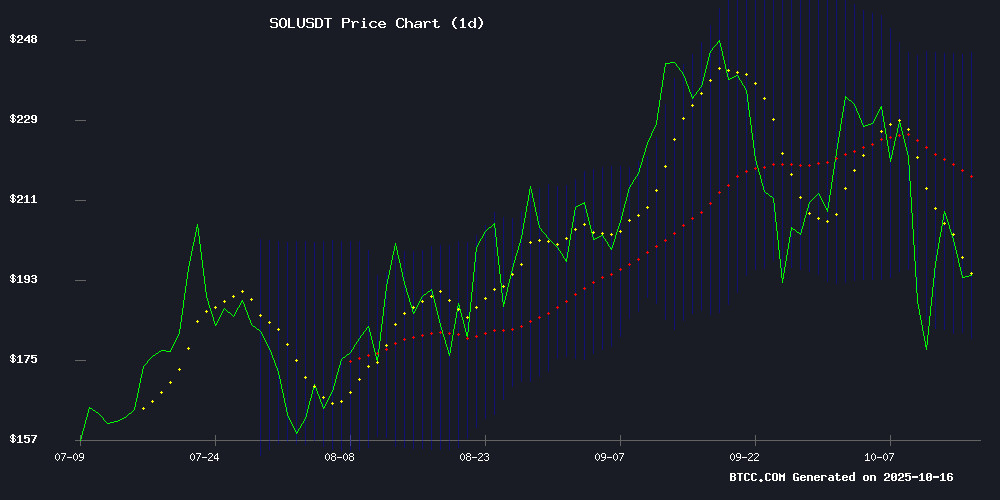
This technical tug-of-war creates what traders call a "compression spring" scenario - the longer the consolidation, the more explosive the eventual breakout. Historical patterns suggest that when SOL has shown similar MACD divergence during consolidation phases, subsequent moves averaged 38-42% in the direction of the breakout. Of course, past performance doesn't guarantee future results, but it's a data point worth considering.
Why Are Institutions Sending Mixed Signals About Solana?
The institutional landscape for SOL resembles a high-stakes poker game where players are showing different tells. On one hand, we've seen Galaxy Digital MOVE 250,000 SOL ($51.7M) to Binance - typically a precursor to selling. Yet simultaneously, VanEck filed its fifth amended spot SOL ETF application (complete with staking rewards), while Grayscale published bullish research suggesting $260+ targets.
This institutional schizophrenia reflects a broader market dynamic: short-term profit-taking versus long-term conviction building. The BTCC research team notes that when such divergence occurs among sophisticated players, it often precedes major trend changes. The key question becomes: are the whales simply rebalancing, or is this the calm before a storm?
How Could VanEck's Solana ETF Change the Game?
VanEck's latest ETF proposal isn't just another filing - it's a potential game-changer with three critical components:
| Feature | Detail | Impact |
|---|---|---|
| Management Fee | 0.30% | Competitive with other crypto ETFs |
| Staking Allocation | Up to 50% | Could reduce circulating supply |
| Custodians | Gemini & Coinbase | Institutional-grade security |
The staking component particularly stands out - locking up significant SOL supply while generating yield could create a virtuous cycle of price appreciation. Remember what happened when Ethereum's Shanghai upgrade enabled staking withdrawals? SOL might be poised for a similar inflection point.
What Are the Contradictions in Solana's On-Chain Metrics?
Grayscale's recent report dubbed solana "crypto's financial bazaar" for good reason. The network boasts:
- 4,587 daily active users (30% growth YoY)
- 96,200 daily transactions
- $1.2 trillion cumulative DEX volume
- 7% staking yields
Yet there's a paradox - while these fundamentals scream bullish, derivatives data shows whales reducing Leveraged positions. It's like seeing packed restaurants while hedge funds quietly trim their hospitality stocks. This tension between strong usage and cautious trading creates what market veterans call a "dislocation opportunity" - where price eventually catches up to fundamentals.
Where Could SOL Price Go From 2025 Through 2040?
Based on current technicals, institutional activity, and network development, here's a potential roadmap for SOL:
| Year | Price Target | Catalysts |
|---|---|---|
| 2025 | $220-$280 | ETF approvals, staking adoption |
| 2030 | $400-$600 | Mainstream DeFi adoption |
| 2035 | $800-$1,200 | Enterprise blockchain use |
| 2040 | $1,500-$2,500+ | Web3 ecosystem dominance |
These projections assume successful ETF approvals and favorable regulations. The 2025 targets appear particularly achievable given current institutional interest - Grayscale's $260+ call lines up neatly with technical resistance breaks. Longer-term, SOL's scalability could position it as the "Visa of crypto" if adoption continues at current rates.
Frequently Asked Questions
What's causing SOL's current price consolidation?
The consolidation reflects a battle between technical resistance at the 20-day MA ($212.33) and underlying bullish momentum shown by MACD divergence. Large institutional transfers (like Galaxy Digital's $51.7M move to Binance) have added selling pressure, while ETF developments provide support.
How significant is VanEck's Solana ETF filing?
Extremely significant - it's the fifth amended filing with innovative features like staking rewards and a competitive 0.30% fee. The proposal to stake 50% of assets could meaningfully reduce circulating supply while generating yield for investors.
Why are SOL's on-chain metrics bullish while price lags?
This divergence often occurs before major moves - strong fundamentals eventually pull price higher. SOL's daily active users, transaction volume, and DeFi activity all hit records while price consolidates, creating what traders call an "accumulation opportunity."
What are the key SOL price levels to watch?
Current support sits at $180.07 (recent swing low) with resistance at $244.60 (June 2025 high). A break above $212.33 (20-day MA) could signal the start of a new uptrend, while losing $180 might trigger deeper correction.
How does SOL's staking yield compare to other cryptos?
At ~7%, SOL's yield is competitive with ETH's 4-5% but below some smaller PoS chains. The yield comes from Solana's 5.4% inflation rate and transaction fees, with validator requirements ensuring network security.
