ETHZilla Doubles Down on Sticky Restaking with Ether.fi and Puffer Partnerships

Ethereum's restaking revolution just got stickier—and potentially riskier.
ETHZilla's latest maneuver plunges deeper into the restaking arena with strategic alliances involving Ether.fi and Puffer. This isn't just dipping toes—it's full-scale immersion into DeFi's most controversial yield strategy.
The Sticky Restaking Gambit
Restaking transforms staked ETH into collateral for additional protocols—creating layered yield but compounding risk. ETHZilla's play exploits what analysts call 'stickiness'—once assets get locked into these nested protocols, they become harder to extract than Wall Street bonuses during a downturn.
Protocol Mechanics Unleashed
Ether.fi brings decentralized validator infrastructure while Puffer adds native restaking capabilities. Together they create a feedback loop where staked ETH generates rewards while securing multiple networks simultaneously. The strategy promises amplified returns but ties assets into increasingly complex dependencies.
Market Implications
This aggressive restaking push signals institutional confidence in Ethereum's long-term viability—or desperation for yield in a saturated market. Either way, it's creating a web of interconnected risks that could make traditional finance's collateral chains look straightforward by comparison.
As restaking volumes approach $50 billion industry-wide, ETHZilla's bet illustrates how DeFi continues innovating—whether the market's ready or not. Because nothing says 'financial revolution' like recreating 2008's systemic risk with blockchain transparency.
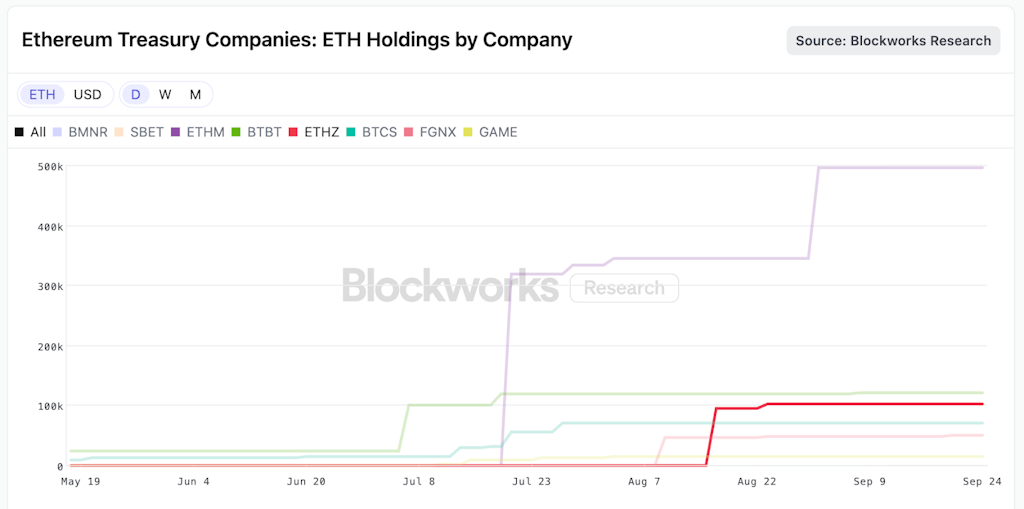
Ethereum treasuries race: ETHZilla (red) has amassed just over 100k ETH, putting it roughly neck-and-neck with Bit Digital (BTBT, green) and well behind Ether Holdings (ETHM, purple), which leads public ETH treasuries with nearly 500k ETH. (BMNR and SBET — not shown — hold even larger positions.) Source: Blockworks Research
The DAT’s goal: sleeves that are large enough to matter but diversified enough to avoid concentration in operators or AVSs and with predictable liquidity during stress. As for the details, ETHZilla leaves risk curation up to the service providers, Silagadze said.
“They’ve certainly asked questions — make sure that we’re being reasonable about it — but no, they haven’t gotten involved,” he said.
Blockworks reached an ETHZilla spokesperson but the company did not respond to questions for this story.
ETHZilla’s capital stack gives it room to run the playbook while it manages public-company optics. In a Sept. 22 update, the firm announced a $350 million add-on convertible debenture investment alongside a broader business update, signaling continued access to financing even as it balances share repurchases and on-chain deployments.
Ether.fi says it’s seeing broad interest across the DAT landscape. “We’ve talked to all of them,” Silagadze said.
For Puffer, an extra yield kick may come from appchain revenue. As Puffer rolls out its UniFi stack, Forouzani says, “All sequencing fees (including MEV) will be captured and distributed fairly between the rollup owner and UniFi AVS.” That means pufETH holders should eventually accrue a slice of sequencing/MEV fees tied to based appchains secured by UniFi.
If ETHZilla can keep sleeves “sticky,” it may prove that institutional restaking isn’t just possible, it’s better than vanilla ETFs — with or without staking yield.
- The Breakdown: Decoding crypto and the markets. Daily.
- 0xResearch: Alpha in your inbox. Think like an analyst.
- Empire: Crypto news and analysis to start your day.
- Forward Guidance: The intersection of crypto, macro and policy.
- The Drop: Apps, games, memes and more.
- Lightspeed: All things Solana.
- Supply Shock: Bitcoin, bitcoin, bitcoin.
