2025: The Year New Tokens Died - And Why That’s Bullish for Crypto

The crypto graveyard just got a whole new wing. Forget bear markets—2025 witnessed something more fundamental: the death of the new token narrative.
The Launchpad Paradox
Launchpads, once the beating heart of retail speculation, fell silent. Projects that would have raised millions in 2021 couldn't muster a crowd. The 'next big thing' became a punchline before the smart contract even deployed. It wasn't a liquidity crisis; it was an attention collapse. The market didn't just run out of money—it ran out of patience for empty promises and copy-paste whitepapers.
Survival of the Fittest (and Most Useful)
While new tokens flatlined, established networks with clear utility saw capital consolidation. Developers stopped chasing quick launches and started building on proven, battle-tested layers. The narrative shifted from 'what's launching' to 'what's working.' In a delicious twist of irony, the death of novelty forced a return to fundamentals—something traditional finance has been pretending to do for decades.
The Great Filter Arrives
This isn't a downturn; it's a filter. The low-interest-rate, hype-driven era of 'tokenizing everything' is over. What remains are protocols that solve real problems and communities that offer more than just price speculation. The market cut out the noise, bypassing vaporware to focus on genuine technological throughput. The year new tokens died might just be remembered as the year crypto finally grew up—proving once again that the most brutal market corrections often deliver the healthiest long-term outcomes.
Indices
Bitcoin was essentially flat over the past week (+0.3%), underperforming traditional benchmarks — NASDAQ (+1.7%), Gold (+1.1%), and S&P 500 (+0.9%). The divergence accelerated mid-week around Dec. 18, when most crypto sectors sold off sharply while equities held steady, suggesting a crypto-specific risk-off MOVE rather than broader macro weakness.
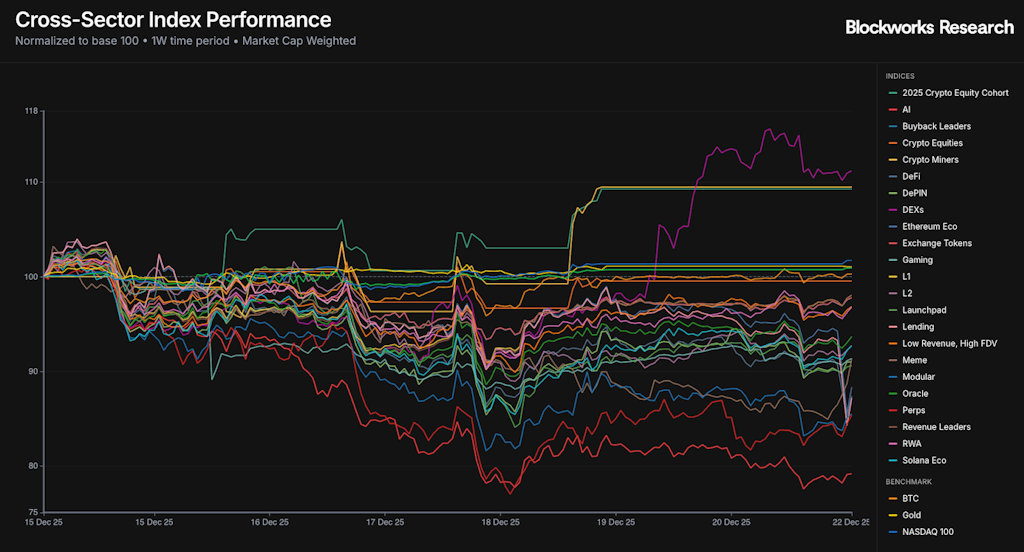
DEXs (+11%) led all indices, followed by Crypto Miners (+9.5%) and the 2025 Crypto Equity Cohort (+9.2%). DEX outperformance was driven by UNI up +15.4%, following the UNIfication vote live onchain, with 69M UNI (40M quorum) voting yes. L1s (-2%) and Exchange Tokens (-2.2%) posted modest losses.
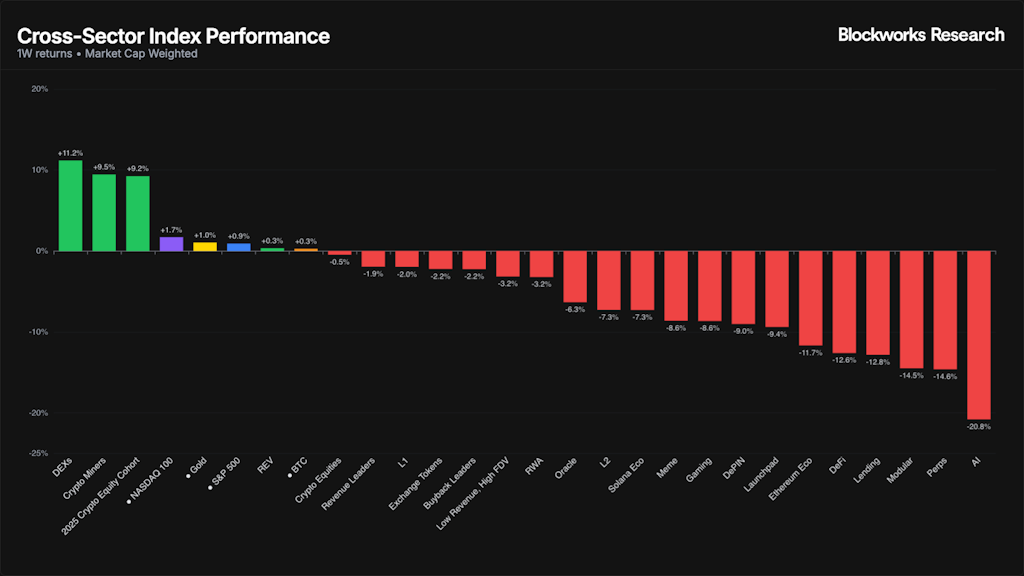
AI was the worst-performing sector (-21%), driven largely by TAO (-21%). TAO weakness likely reflects a sell-the-news unwind around Bittensor’s first halving (around Dec. 14), which cut daily issuance in half but did not immediately translate into incremental demand, alongside broader de-risking across the AI token complex.
Negative returns on new tokens
With year-end approaching, it’s worth zooming out on 2025’s worst tape: new token launches. A recent post by Ahboyash put hard numbers behind what many felt intuitively. Across 117 tokens launched in 2025, returns are overwhelmingly negative. The median token is down ~71% versus its listing fully diluted valuation (FDV). Only 17/117 (15%) trade above launch valuation, while roughly 40% are down more than 80%.
The downside is both broad and severe: 100/117 tokens (85%) are underwater. Losses cluster most heavily in the 50–90% drawdown range, which represents the largest share of launches.
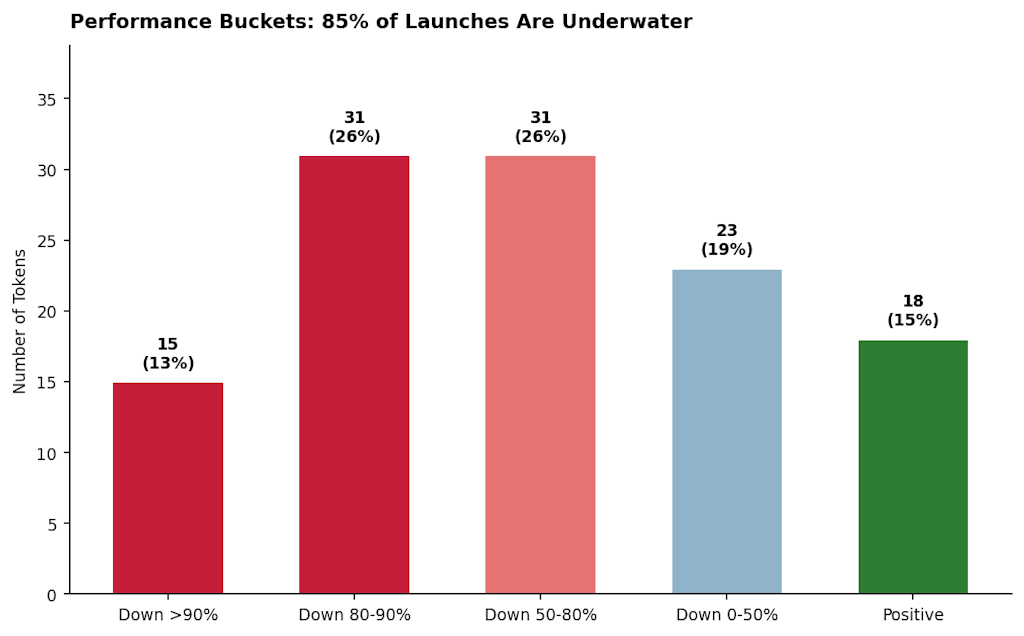
At the extreme tail, 15 tokens have declined more than 90%, including high-profile launches such as Berachain (-93%), Animecoin (-94%), and Bio Protocol (-93%).
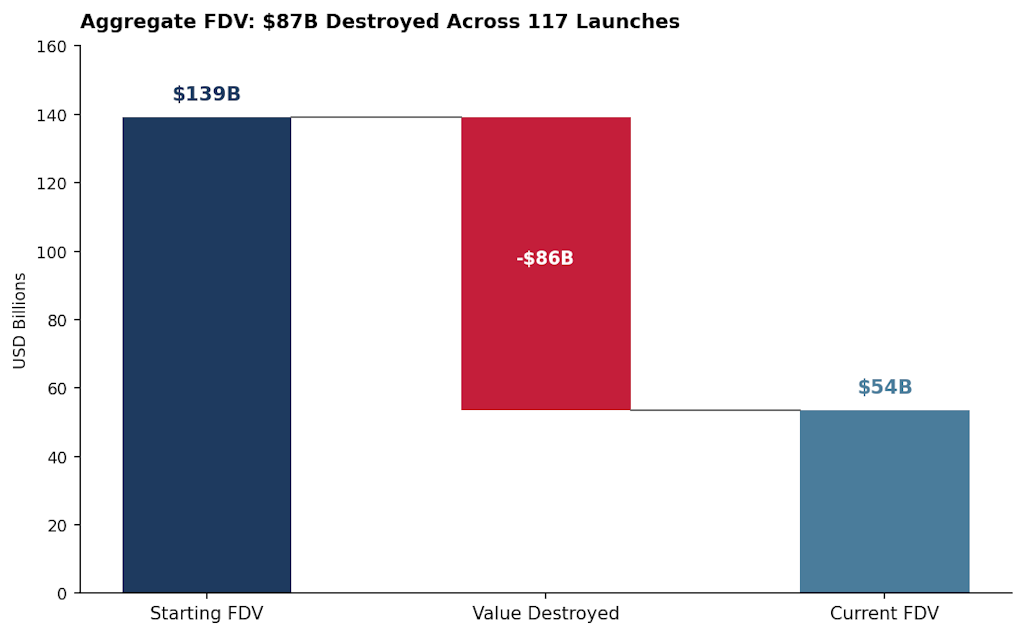
In aggregate, the cohort’s total FDV has compressed from $139 billion at listing to $54 billion today, implying roughly $87 billion (59%) of “paper” FDV destruction, excluding any projects that effectively went to zero.
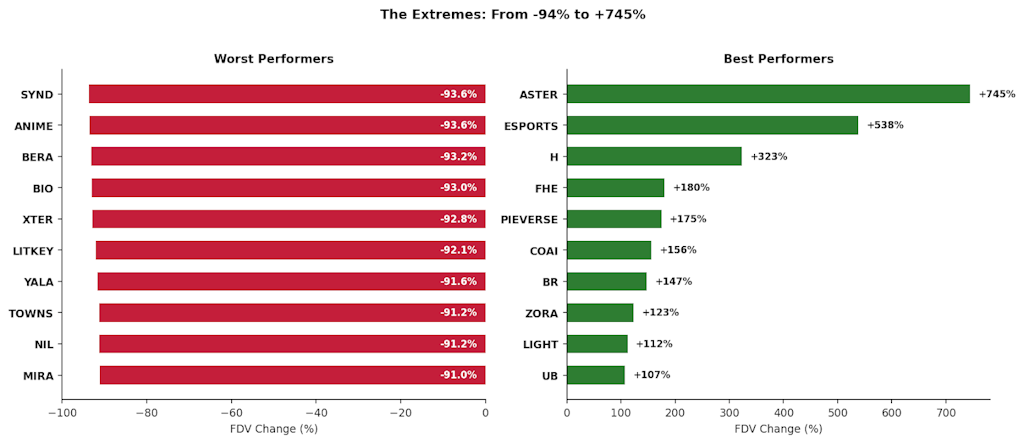
The dispersion on the right tail is real, but concentrated. The worst performers skew toward infrastructure and gaming, with Syndicate (-93.6%) and Animecoin (-93.6%) among the laggards. Meanwhile, the standout winners are largely later-stage, H2 launches with lower starting valuations, including Aster (+745%), Yooldo Games (+538%), and Humanity (+323%).
- The Breakdown: Decoding crypto and the markets. Daily.
- 0xResearch: Alpha in your inbox. Think like an analyst.
