Canton’s $6 Trillion RWA Revolution: How Lighter’s Hyperliquid Multiplier Rewires Finance

Forget tokenized T-bills—the real infrastructure war just went nuclear. Canton Network isn't just building a bridge to real-world assets (RWA); it's laying down $6 trillion worth of institutional-grade rails designed to move the planet's value. Meanwhile, Lighter Finance isn't waiting for permission. Its Hyperliquid architecture creates leverage out of thin air—a multiplier effect that turns dormant capital into a kinetic force.
The New Plumbing
Traditional finance runs on decades-old settlement systems—clunky, slow, and locked in silos. Canton's proposition cuts through the legacy glue. It offers a compliant, interconnected network where assets—from bonds to carbon credits—can move with the finality and speed of crypto, but with the guardrails institutions demand. This isn't a side door; it's a new main highway.
The Velocity Engine
Enter Lighter. If Canton provides the rails, Lighter's Hyperliquid model builds the high-speed trains. It unlocks nested liquidity, allowing assets to be re-hypothecated and leveraged within defined, programmable parameters. More activity, more fee generation, more capital efficiency—all without the traditional middleman's cut. It turns static balance sheets into dynamic engines.
Frictionless, Not Lawless
The magic word is 'compliance-by-design.' Transactions aren't anonymous; they're permissioned and auditable across entities. Regulators get a clear view, participants get certainty, and the system avoids the wild west reputation that haunts public DeFi. It's the institutional playbook, rewritten in code.
The Cynical Take
Let's be real—Wall Street has always loved a good fee layer. The true test will be if this new tech actually dismantles the old rent-seeking models, or just puts a blockchain veneer on them. The promise is radical efficiency; the history of finance suggests someone will find a way to bottle and sell the air.
The bottom line? This isn't just about moving assets onto a ledger. It's about re-architecting the flow of global capital itself. Canton builds the sanctioned corridors. Lighter pumps the pressure. Together, they're not just participating in the RWA narrative—they're aiming to define its physics. The old world settles in days. The new one is just getting started.
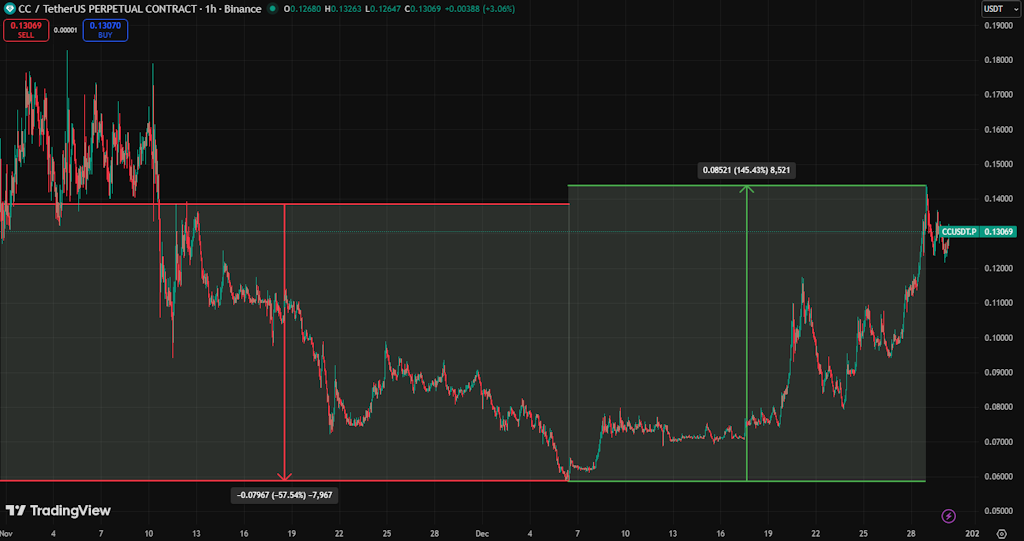
The scale of RWA activity on the network is already notable. As of Q4 2025, Canton has processed $6 trillion in real-world assets and currently handles about $350 billion per day in US treasury activity. Much of this traction comes from institutional partners like Broadridge Financial Solutions, a global fintech leader in trading and settlement infrastructure. Broadridge’s Distributed Ledger Repo platform runs on Canton and processes more than $8 trillion per month in repo transactions, using blockchain rails to improve efficiency in one of the largest markets in global finance.
Momentum has continued to build through deeper integrations. A partnership with Nasdaq connects Canton to Nasdaq Calypso, enabling automated margin and collateral management and allowing institutions to move and reuse capital more efficiently across traditional and digital assets. More recently, DTCC, the central clearing and settlement backbone of US financial markets, selected Canton to support RWA tokenization. The initial rollout will allow a subset of US treasurys held at DTCC’s depository to be issued on Canton following SEC approval. Given that DTCC clears roughly $10 trillion of securities transactions every day, the ability to move settlement from T+2 to NEAR real-time could meaningfully improve efficiency and free up capital within existing market infrastructure.
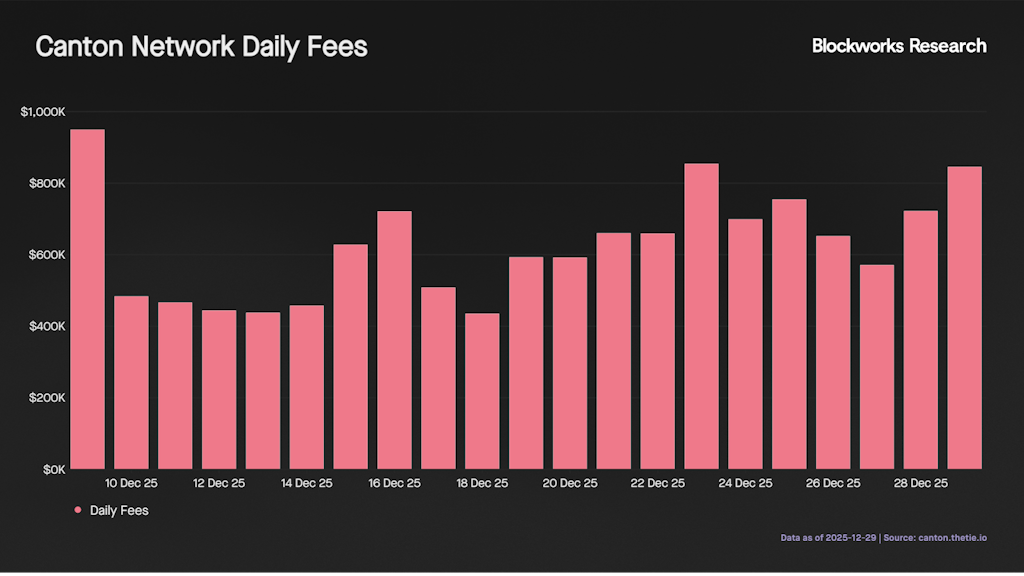
The network usage is closely tied to the token. Canton’s Global Synchronizer coordinates cross-institution transactions, with predictable fees paid in CC that are burned as network activity increases. Over the past 20 days, the network has burned a median of 6.71 million tokens daily, equating to about $627,000 per day, with peaks between $750,000 and $850,000. For context, solana averaged roughly $670,700 in REV daily over the last seven days, yet trades at a FDV about 16x higher than Canton.
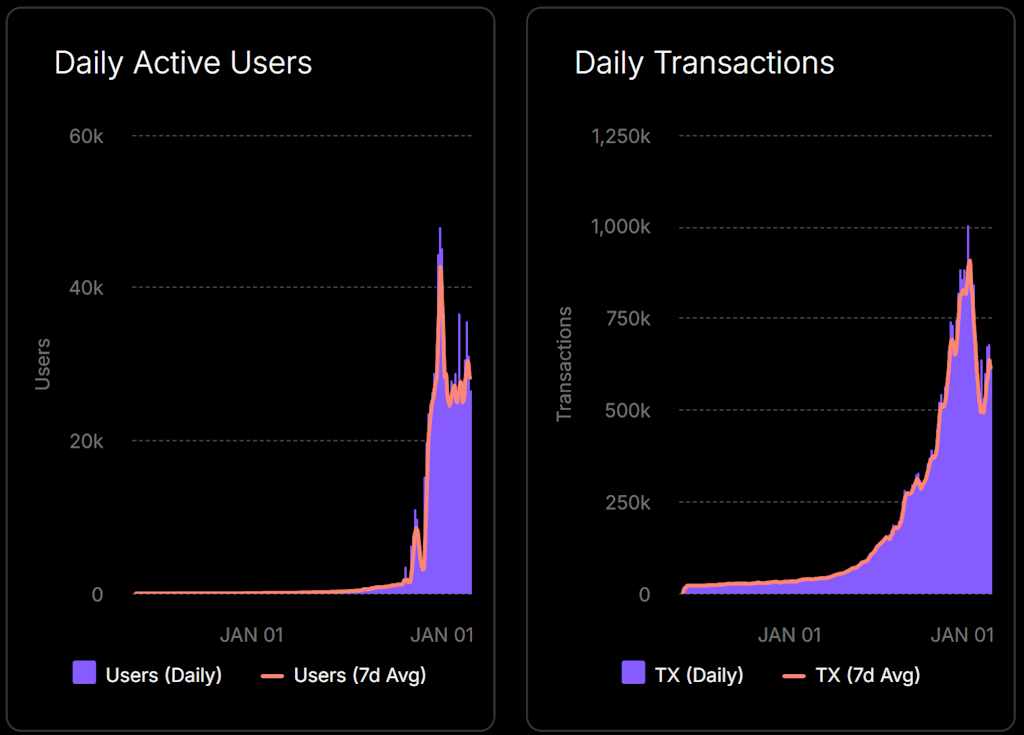
Usage metrics complete the picture. Since November, Canton has averaged around 28,500 daily active users and 678,300 daily transactions, putting it in line with networks like Monad on DAUs and TON on transaction count.
There is still much more to unpack around architecture, validators and long-term token design, but the early signals are hard to ignore. With exposure to narratives such as tokenization, stablecoins and privacy, Canton is shaping up as one of the more interesting protocols to watch as we head into 2026.
Lighter’s TGE
Lighter airdropped and launched LIT on Dec. 30, closing out a timeline that traders had been stress-testing via a Polymarket contract that effectively functioned as a TGE proxy. Odds briefly slipped to ~60% intraday before the launch went through.
LIT’s max supply is 1 billion with 250 million circulating at TGE, a 25% day-one float. The airdrop was funded by Seasons 1 and 2 points, with 12.5 million points converted into LIT, implying roughly ~20 LIT per point on the headline math. Allocation splits are 50% ecosystem (25% now, 25% later), 26% team, and 24% investors. Team and investors sit behind a one-year cliff followed by three-year linear vesting. Against that backdrop, premarket points pricing has repriced sharply post-TGE, with points buyers down around 50% from peak levels that implied roughly $100 per point at the top.
The more interesting debate is not the airdrop, but token holder protection. Lighter is leaning directly into the token equity mismatch critique, arguing that revenues from the core DEX and future products can be tracked onchain in real time and allocated between growth and buybacks depending on conditions. It goes further by claiming the value created by all products and services will fully accrue to LIT holders, with the token issued directly from its US C-Corp, which will operate the protocol “at cost.” Directionally, that is a stronger posture than the common separate labs capture profits model, but it is not a hard guarantee: “At cost” is elastic (e.g. Uniswap Foundation employee salaries).
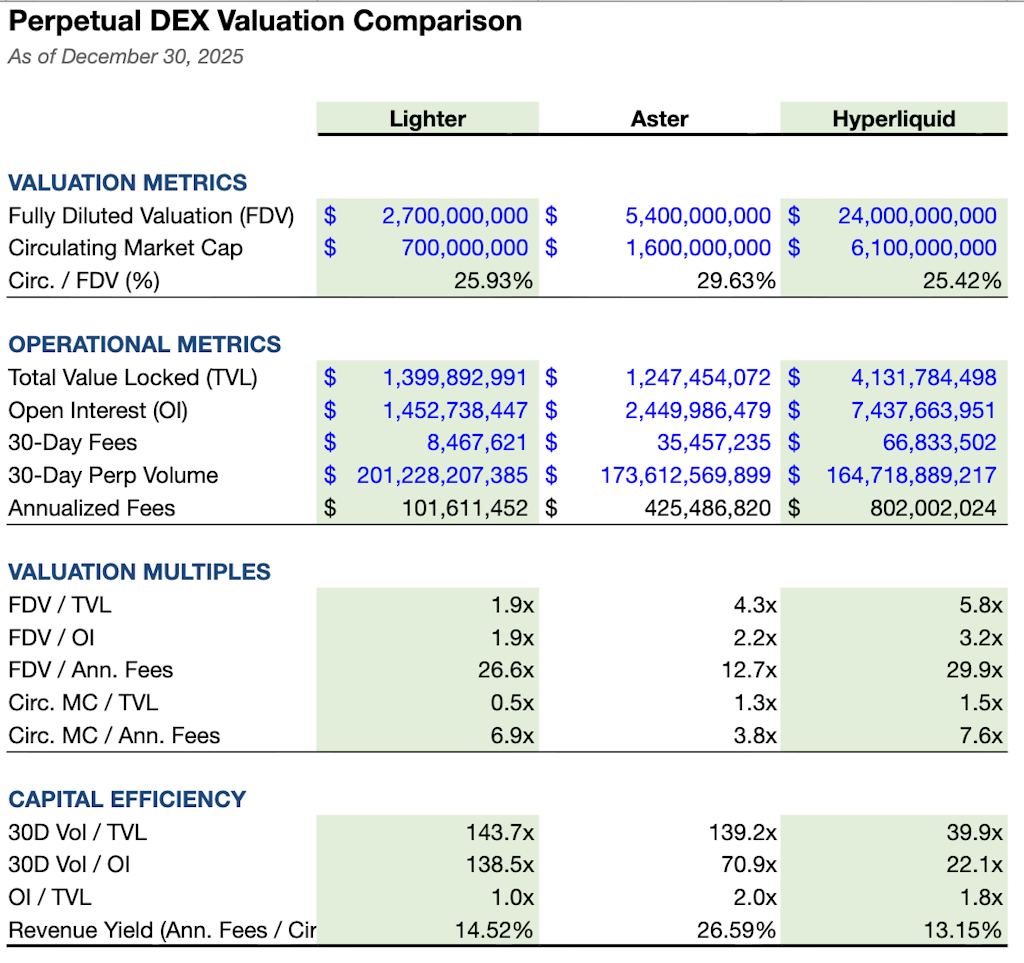
On comps, the market is valuing Lighter similarly to Hyperliquid. At $2.7 billion FDV and $700 million circulating, Lighter’s float is ~25.9%, nearly identical to Hyperliquid’s ~25.4% ($24 billion FDV and $6.1 billion circulating). More importantly, Lighter is trading on a fees multiple that is already in Hyperliquid’s range: 26.6x FDV/annualized fees (and 6.9x circulating/annualized fees) vs. Hyperliquid at 29.9x (and 7.6x). That’s despite a large gap in absolute scale, Lighter printed $8.5 million in 30D fees vs. Hyperliquid’s $66.8 million, and Lighter’s open interest is $1.45 billion vs. $7.44 billion for Hyperliquid.
- The Breakdown: Decoding crypto and the markets. Daily.
- 0xResearch: Alpha in your inbox. Think like an analyst.
