ZKsync Etherscan Support Ends: Why ZKsync’s Own Blockchain Explorer Is a Game-Changer

Etherscan pulls the plug on ZKsync support—and the Layer-2 isn't looking back.
For months, the community relied on the Ethereum block explorer giant to track transactions on the ZKsync Era network. That lifeline just got cut. No more double-checking transfers or verifying smart contracts through the familiar interface. The move wasn't a surprise—it was an inevitability.
The Core Reason: You Can't Fit a Square Peg in a Round Hole
Etherscan is built for Ethereum's architecture. ZKsync runs on zero-knowledge proofs, bundling thousands of transactions into a single, verifiable proof posted to mainnet. Trying to force that innovative data structure into Etherscan's framework was like streaming a 4K movie on dial-up—possible, but painfully inefficient. Key details got lost in translation.
Building the Native Lens
So ZKsync is doing what any self-respecting ecosystem does: building its own window. A native block explorer isn't a luxury; it's infrastructure. It means transaction statuses update in real-time, not after a multi-block confirmation lag. It means visualizing proof generation and verification—the very magic of ZK-rollups—instead of hiding it. It means analytics tailored to Layer-2 economics, not retrofitted from Layer-1.
The Bigger Picture: Sovereignty Over Data
This isn't just about user convenience. It's about narrative control. When you rely on another platform's explorer, you're renting their interpretation of your network. Your transaction finality, your security model, your fee mechanics—all filtered through their UI. Building your own explorer is claiming the right to tell your own story, data-point by data-point. It's a move that cuts out the middleman and, let's be honest, bypasses the rent-seeking tendencies of legacy infrastructure—a classic play in an industry where 'disintermediation' is often just a fancy word for building a new toll booth.
The path forward is clear. Native tooling breeds native understanding, which fuels native growth. The end of Etherscan support isn't an obstacle for ZKsync—it's the catalyst that finally forces the network to stand on its own two feet, with a clear view of the road ahead.
Source: X (formerly Twitter)
Why Is the Indexing Services Ending?
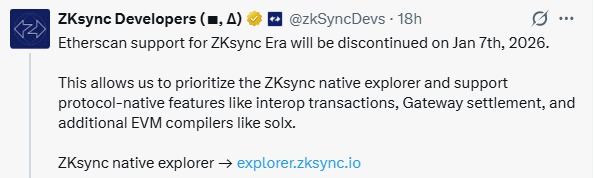
The decision behind the ZKsync Etherscan Support End is not sudden. Over time, the zero-knowledge network has grown from a simple Ethereum-compatible chain to a full-fledged network of interconnected chains composed using ZK Stack.
Cross-chain and interop transactions
Native settlement via ZKsync Gateway
Compiler support like new LLVM-based Solidity (solx)
These features go beyond the standard set of Ethereum Virtual Machine (EVM) rules. Therefore, Etherscan can't understand and display-platform's activity. Moreover, it is better for such advanced functions to be clear and accurate in its native explorer.
What Changes for Users and Developers
To everyday users, this means a simple change. Starting January 7, 2026, they will have to use the native explorer to check transactions, wallet balances, or smart contracts.
Developers will be more affected. In general, many applications have utilized the Etherscan API for ZKsync to fetch real-time blockchain data. As the network indexing service ending, all such tools need to migrate to the native explorer API to keep everything working properly.
Due to this change, developers are encouraged to update their bookmarks, dashboards, and analytics tools prior to the deadline, and update their backend systems.
What This Means for Ethereum's Infrastructure
This shows a shift in network's future: Ethereum Layer-2 is becoming more and more independent, professional, and specialized. Advanced networks no longer rely on such shared tools; they need explorers specifically built for their protocols.
This change shows ETH blockchain is moving from a “one-size-fits-all” model into a modular ecosystem. Each Layer-2 now should innovate faster because of less dependency on generic infrastructures.
This, in turn, creates a stronger, more scalable blockchain that is better positioned to deal with mass adoption in the future.
Conclusion
The end of indexing services is not a setback; it's a sign of growth. The path ahead for ZK network has chosen deeper control, better visibility, and long-term scalability.
For users it means a new explorer.
For developers it means migration work.
For ETH Network it means a more mature advanced Layer-2 infrastructure.
January 7, 2026, will become a point where Ethereum scaling networks start building and managing their infrastructures differently.
This article is for informational purposes only, please do your own research before making any investment decisions.
