Another US Government Shutdown Risk Rises Ahead of 2026 Deadline

Washington's fiscal dysfunction is back—and crypto markets are watching.
The countdown to 2026 just got a lot louder. With another potential government shutdown looming, the familiar script of political gridlock is playing out again. This isn't just a D.C. drama; it's a flashing signal for decentralized finance.
Why TradFi's Headache Is DeFi's Opportunity
Every time Congress fails to fund itself, trust in traditional systems erodes. Government shutdowns freeze payments, delay data, and inject uncertainty into every corner of conventional finance. It's the perfect breeding ground for a 'flight to sovereignty'—where investors seek assets and systems outside political control.
Bitcoin was literally born from the ashes of the 2008 financial crisis. Today's potential shutdown is a smaller, but potent, reminder of the same fragility. While politicians debate continuing resolutions, blockchain networks resolve transactions—24/7, without interruption.
The 2026 Cliff Edge
The 2026 deadline isn't an arbitrary date. It's the new fiscal cliff, a point where debt ceiling debates and funding fights converge into a perfect storm of uncertainty. For crypto, this prolonged uncertainty acts as a sustained marketing campaign for its core value proposition: unstoppable code over fallible politicians.
Watch for capital to quietly move toward crypto treasuries and on-chain bonds as a hedge against federal paralysis. It's the ultimate irony—the government's inability to function smoothly could accelerate the adoption of the systems designed to bypass it.
So as Washington gears up for another round of self-inflicted crisis, remember: in the world of digital assets, the network never shuts down. The only thing getting cut here is confidence in the old way of doing things—and maybe that's the point.

With current government funding set to expire in January, and no new settlements happening, markets are again bracing for another political lockup just months after the longest one in history. This uncertainty also affects financial markets, including the already volatile crypto sector.
What Does the Current Scenario Reflect? Market Reactions
This situation is similar to the recent shutdown that started on October 1, 2025, and ended around November 12–13, lasting about 43 days, the longest in US history. That operational pause ended without fixing the main budget disputes, which raises the risk that the next funding talks could once again drag on until the last minute.
Prediction markets highlight how uncertain the situation remains. Kalshi is pricing in about a 43% chance of a shutdown, while major banks such as Goldman Sachs put the risk between 20% and 50%. Short shutdowns usually have a small economic impact, but longer ones often increase volatility across financial markets.
Economic Impact of a US Government Shutdown
Since the introduction of the shutdown rule in the early 1980s, there have been a total of about 21 disputes that resulted in either a partial or whole govt closure in the US. Most of these lasted only one to three days, but a few dragged on and caused major disruptions.
In general, an eventual service halt reduces the GDP growth rate by 0.05% to 0.2% in weekly terms because of delayed government spending and lost productivity because of furloughed workers. Although most lost output returns with the reopening, lost business due to such aspects as lost tourism will never be regained.
Prolonged government shutdowns also affect the dissemination of economic statistics, making economic policy-making more difficult, among other issues in social services such as food assistance. Economists note that shutdowns impact depend more on duration than political headlines.
Impact on Cryptocurrencies
The US Government Shutdown impact on crypto has been inconsistent. Bitcoin rose during the 2013-shutdown, fell modestly during the 2018–2019 episode, and showed mixed, volatile behavior during the 2025 govt closure. There is no clear historical correlation, as crypto performance largely depends on the broader market cycle and liquidity conditions.
Current Statics: The crypto market fell 1.16% in 24 hours, extending its 30-day decline to 4.75%. Bitcoin slipped 1.55% to $87.402, while Ethereum dropped 1.36% to $2,927.
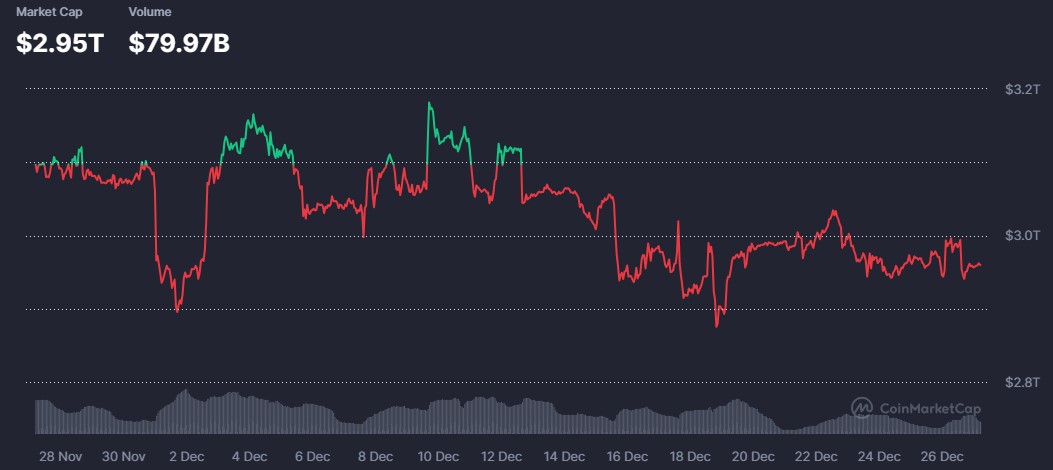
Recent data shows the market is underperforming and highly sensitive to new developments. However, some investors view crypto as a hedge during fiscal dysfunction, especially if shutdowns coincide with expectations of easier monetary policy.
What Comes Next? Fed Rate Decision in 2026
Federal reserve policy adds another LAYER of uncertainty. As of December 2025, the Fed has already cut interest rates three times, lowering the rate to 3.50%–3.75%. 2026 expecting more rate cuts, where official projections point to one additional cut, though markets are pricing in two to three cuts.
But another layer to the Govt stoppage could influence the outcomes. Shutdown-driven slow growth or data disruptions may force the central bank to act more aggressively, and hopes for quicker rate cuts could grow.
This may increase short-term swings in stocks and crypto, while helping assets that benefit from easier liquidity. In short, for investors, another US government shutdown could mean higher volatility across stocks, bonds, and crypto markets.
